
Every bettor has at some point wondered if there’s a reliable way to profit while keeping risks minimal. For me, one of the most interesting answers lies in the concept of surebets.
What Is a Surebet?
A surebet, also known as an arbitrage bet, is a situation where a gambler places wagers on opposing outcomes of the same event and secures a profit regardless of how the match ends.
Why Do Arbitrage Opportunities Exist?
If bookmakers dislike losing money, why do surebets still appear? The truth is, despite their efforts to minimize them, arbitrage continues to exist for a few reasons:
Competition among bookmakers. To attract more customers, bookmakers often raise odds in certain markets, which sometimes creates a mismatch.
Delayed odds adjustments. A bookmaker may fail to update odds quickly in response to rivals, leaving temporary gaps.
Errors in betting lines. Mistakes occasionally occur, though betting on them is risky since such bets can be canceled.
Types of Surebets
By Outcomes
- 2-way arbs – The simplest type, involving just two opposite results (e.g., W1 vs. W2, Over/Under 2.5 goals, or a handicap pair like H1(-1.5) vs. H2(+1.5)).
- 3-way arbs – Covering outcomes like 1-X-2 in football, though harder to find and less common.
- Multi-way arbs – Very rare cases involving up to six possible outcomes.
By Timing
- Prematch arbs – Opportunities before an event starts. They are usually safer for beginners but come with higher competition.
- Live arbs – Opportunities during the game, offering higher returns but also higher risks since odds change rapidly and bets must be placed quickly.
You might be also interested in: Arbitrage Betting vs Value Betting
A Practical Surebet Example
Imagine a WTA tennis match between Timea Bacsinszky and Madison Brengle. Suppose two bookmakers (B1 and B2) offer the following odds:
B1: H1 (-5.5) at 2.10
B2: H2 (+5.5) at 1.961
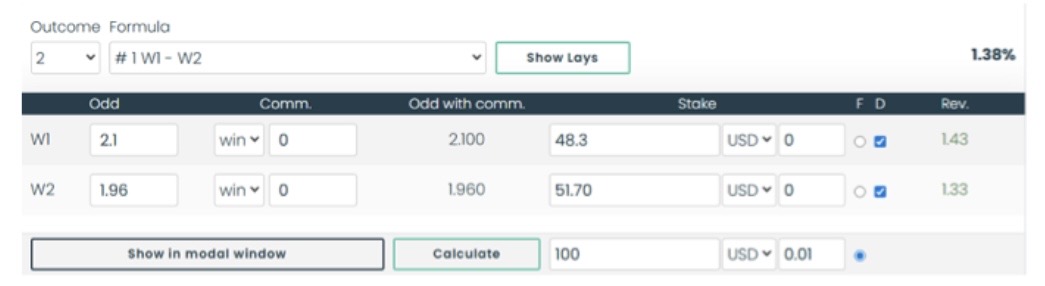
To check if this is an arbitrage, we use the formula:
S=1C1+1C2S = \frac{1}{C1} + \frac{1}{C2}S=C11+C21
If the result is less than 1, it’s a surebet.
For this case:
S=12.10+11.961=0.985S = \frac{1}{2.10} + \frac{1}{1.961} = 0.985S=2.101+1.9611=0.985
Since 0.985 < 1, we’ve found a surebet.
With a $100 bankroll, you would place:
$48.3 on H1 (-5.5)
$51.7 on H2 (+5.5)
No matter the match result, the profit works out to about $1.40.
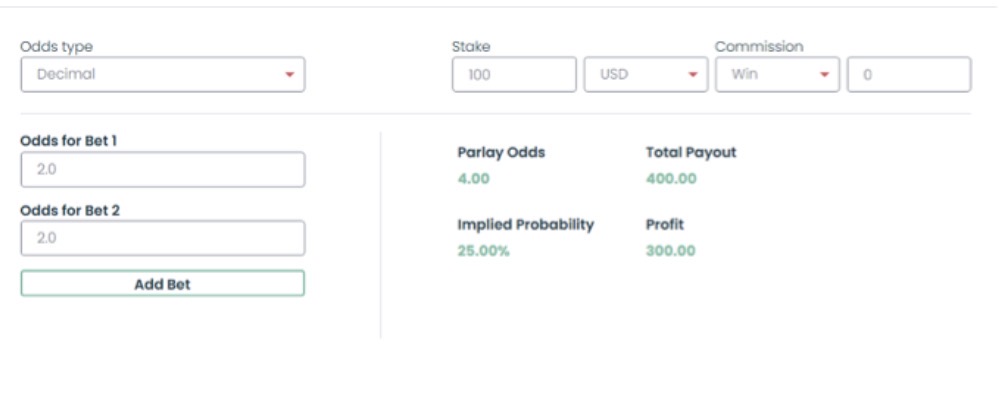
As you see, it’s not the simplest thing to make such calculations for every surebet you’re going to place. However, some arb scanners (we’ll talk about them a bit later) have their own surebet- and even parlay calculator, which greatly simplifies the betting process.
How to Find Surebets
There are two main methods:
Manual calculation – Using formulas like the one above. Effective but time-consuming and prone to mistakes.
Arb scanners – Paid services (such as BetBurger) that automatically detect opportunities, saving time and effort.
Risks of Surebet Betting
Although surebets sound foolproof, there are real challenges:
- Stake limits. Bookmakers can restrict your betting amounts if they detect arbing.
- Canceled bets. If odds errors are spotted, your bet may be voided.
- Fast-moving odds. Particularly in live betting, prices can change before you manage to place your stake.
- Rule discrepancies. Different bookmakers may apply rules differently, leading to unexpected results.
Conclusion
Arbitrage betting can indeed provide steady profits, but it is not risk-free. Success requires discipline, speed, and awareness of the pitfalls. While arb scanners make the process easier, every bettor should also understand how to calculate and identify opportunities manually.
About Author
