
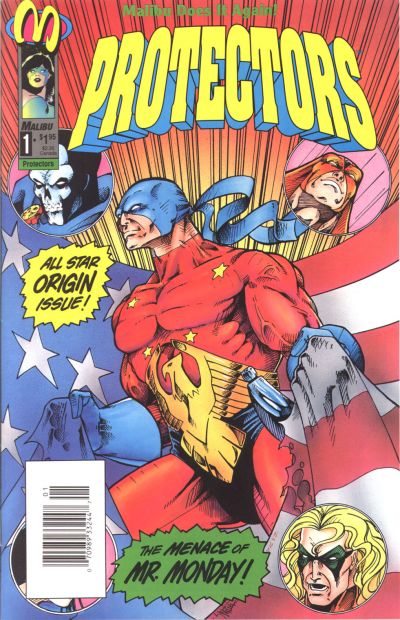
 Before Malibu Comics launched the Ultraverse with characters such as Prime, Hardcase, and Mantra, the publisher had already made an ambitious attempt to build a shared superhero universe. That universe revolved around The Protectors, a team made largely from forgotten Golden Age characters given new identities, updated costumes, and a distinctly 1990s setting.
Published from 1992 to 1994, The Protectors lasted 20 issues and became the centerpiece of what Malibu eventually called its Genesis line.
What made the project particularly interesting was where many of its heroes came from. Rather than inventing an entire superhero universe from scratch, writer R. A. Jones reached back to characters originally published by Centaur Publications during the Golden Age of comics. By the early 1990s, a number of those characters were considered available for Malibu to revive and reinterpret.
Characters including Amazing Man, Airman, Arrow, Mighty Man, Man of War, the Witch, and Eternal Man were brought into the modern era.
Others received more substantial makeovers, including new names. The old Fantom of the Fair became Gravestone, while the Masked Marvel was reinvented as Nightmask. The character originally known as the Shark became Thresher, and Blue Lady became Midnight Blue.
The idea was not simply to reproduce Golden Age stories with modern artwork. Jones wanted the characters to exist in a world that had a history.
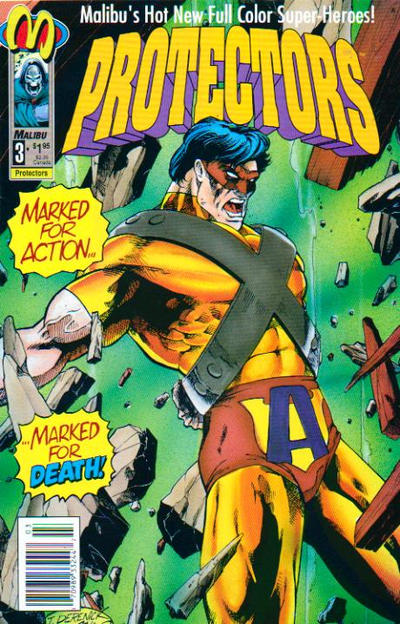 In the Protectors universe, costumed heroes had existed since the late 1930s. Some had retired, others had disappeared, and public opinion toward superhuman adventurers had changed over the decades. A disastrous confrontation involving superheroes years earlier had helped make the public suspicious of them.
That history gave The Protectors something many new superhero universes lacked: the feeling that readers had entered a world already filled with legends.
The modern story begins after Mr. Monday and his Steel Army launch a devastating attack. The President of the United States responds by assembling a team of superhuman operatives capable of dealing with threats conventional forces cannot handle.
The first issue, dated September 1992, was written by R. A. Jones, penciled primarily by Thomas Derenick, and inked by Deodato. The story, “When Heroes Gather,” establishes the new team and the threat posed by Mr. Monday.
The Protectors eventually included an unusually large assortment of heroes:
Man of War, Airman, Amazing Man, Gravestone, the Ferret, Arc, Aura, Mighty Man, Nightmask, the Witch, Arrow, Eternal Man, Thresher, and others moved through the team’s ranks.
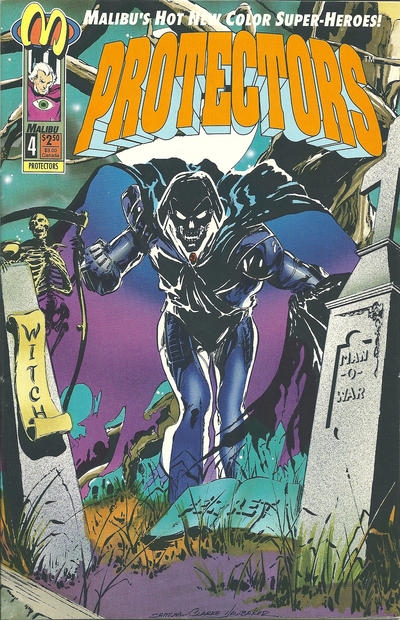 Some were traditional superheroes. Some had mystical backgrounds. Others felt almost like pulp characters transported into a modern superhero comic.
That combination became one of the book’s strengths.
Although The Protectors embraced traditional superhero conventions, the comic wasn’t afraid to demonstrate that being a superhero could be deadly.
One of the series’ most memorable early moments came in The Protectors #5.
The issue featured the climactic battle with Mr. Monday and the Steel Army, and Nightmask was killed.
Malibu went to considerable lengths to make the issue stand out on comic-shop shelves. The direct-market version became known for its unusual production gimmick involving a simulated hole blasted through the comic, tying the physical presentation of the issue directly into the story.
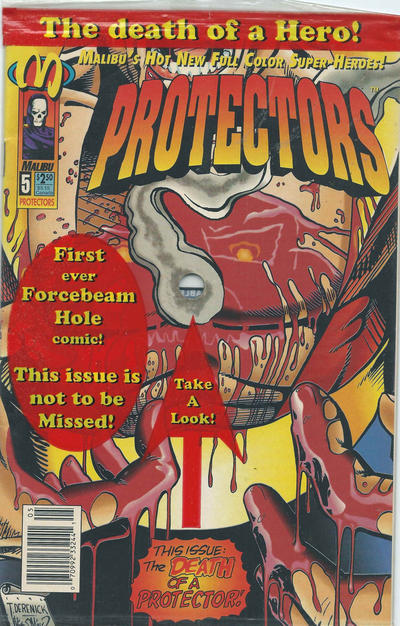 It was very much a product of the early 1990s comic market, when publishers experimented with die-cuts, foil, holograms, polybags, and other special effects.
But underneath the gimmicks, Jones was trying to build a continuing superhero mythology in which characters could change, retire, fail, or die.
The popularity of The Protectors convinced Malibu to expand the concept.
The series had originally been planned as a six-issue project, but reader response led Malibu to continue it as an ongoing title.
Several characters received their own comics.
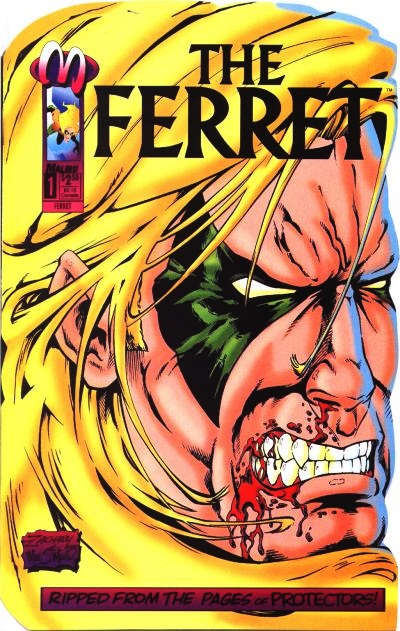 The Ferret starred in his own series.
Gravestone received a solo title.
Man of War received another.
There were also one-shots devoted to characters including Airman and Arrow, as well as a Protectors Handbook that provided additional background on the heroes and their world. Malibu had previously published a Miss Fury miniseries, and she also became connected to the growing universe.
For a short time, Malibu appeared to be constructing something resembling its own version of the Marvel or DC Universe.
Then things became considerably stranger.
In 1993, Malibu launched Genesis, a crossover that combined several of the company’s very different properties.
Suddenly, The Protectors shared an event with Ex-Mutants and Dinosaurs for Hire.
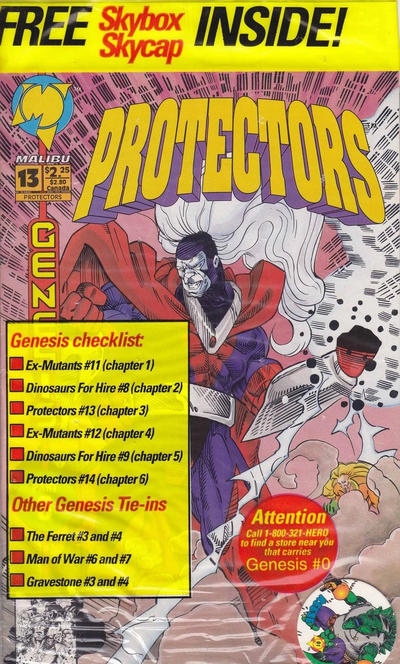
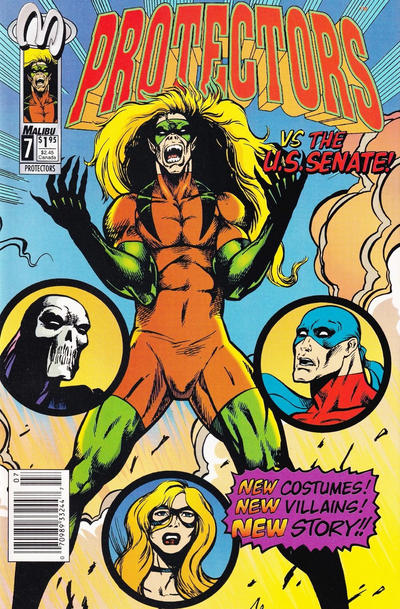 The crossover moved through The Protectors, Ex-Mutants, Dinosaurs for Hire, The Ferret, Gravestone, and Man of War. A Genesis #0 special helped tie everything together.
The central threat was Extreme, and the story involved different realities colliding with catastrophic consequences.
By The Protectors #14, the heroes were fighting Extreme in the conclusion of the Genesis crisis.
It was an unusual crossover even by 1990s standards. Straightforward superheroes, mutated humans, and wisecracking armed dinosaurs were suddenly participating in one enormous storyline.
The result gave Malibu something it had been trying to create from the beginning: a genuine interconnected universe.
Unfortunately, its timing could hardly have been worse.
While Malibu was developing the Protectors universe, the company was preparing another, much larger superhero initiative.
 In 1993, Malibu launched the Ultraverse.
The new line received substantial promotion and introduced an entirely new generation of characters. Titles including Prime, Hardcase, Mantra, Ultraforce, Rune, and The Strangers quickly became the company’s superhero focus.
The Protectors line increasingly became secondary.
Eventually, Malibu chose to discontinue its Genesis titles and concentrate its resources on the Ultraverse. The Protectors ended with issue #20 in 1994.
R. A. Jones did not give his superheroes a gentle farewell.
He destroyed their world.
The final issue depicted the destruction of the Protectors’ Earth, effectively eliminating the possibility of simply continuing the series as though nothing had happened.
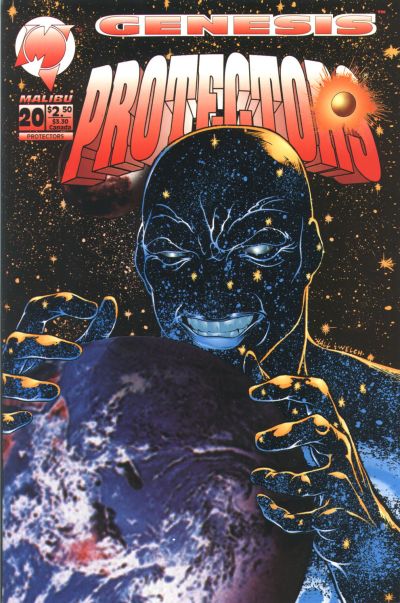 For a superhero comic, it was an extraordinarily definitive ending.
Later in 1994, Marvel Comics acquired Malibu Comics.
That acquisition eventually made Malibu’s characters part of Marvel’s corporate library, although the Protectors have remained largely untouched.
Marvel later designated the Protectors’ reality Earth-1136 in its multiverse terminology.
Unlike the Ultraverse characters, who at least briefly crossed paths with Marvel heroes during the 1990s, the Protectors have essentially remained frozen in their original era.
That makes the series an intriguing comics-history artifact.
Looking back, The Protectors represents an interesting bridge between different eras of superhero publishing.
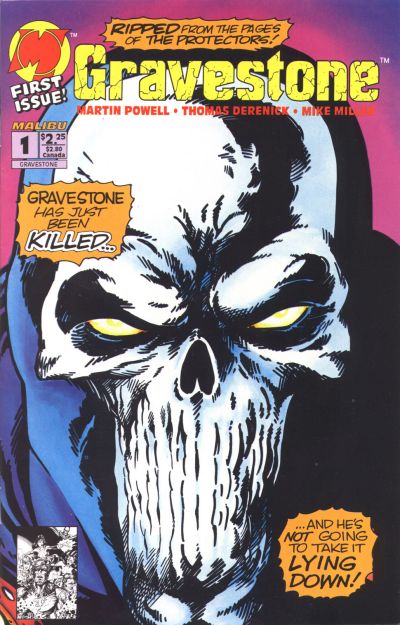 Malibu took obscure characters from the industry’s earliest years and attempted to do what publishers routinely do today: rebuild old intellectual property into a connected modern universe.
But The Protectors did it at a fascinating moment.
The stories retained many traditional superhero elements while embracing the more dramatic storytelling, continuity, crossovers, character deaths, and marketing experiments of the early 1990s.
Most importantly, R. A. Jones and the creators working with him did not treat these forgotten Golden Age characters as museum pieces. They gave them relationships, histories, successors, tragedies, and a world of their own.
For approximately two years, Airman, Gravestone, Man of War, Amazing Man, Mighty Man, the Ferret, Nightmask, the Witch, and their allies had another chance to be superheroes.
Then their universe literally ended.
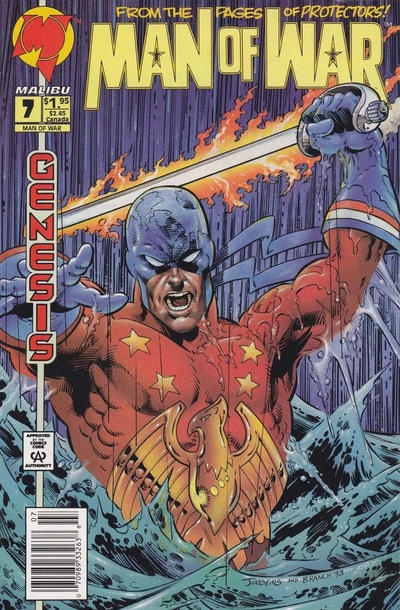 Three decades later, The Protectors remains one of Malibu Comics’ most interesting experiments, overshadowed by the Ultraverse but deserving of another look.
For readers fascinated by forgotten superhero universes and revived Golden Age characters, The Protectors is a particularly entertaining piece of 1990s comics history.
About Author
