 The 1980s independent-comics explosion produced plenty of strange, ambitious, and occasionally outrageous books, but few captured the raw energy of the era quite like GRIPS.
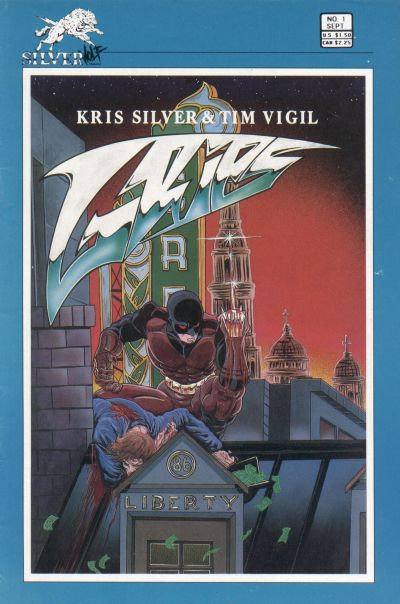
Created and written by Kris Silver, Grips debuted from Silverwolf Comics in September 1986, with early artwork by Tim Vigil, years before Vigil became best known for his work on Faust. The original Silverwolf run lasted only four issues, but the character would survive the collapse of the publisher and return through Greater Mercury Comics, ultimately building a much larger body of stories.
Behind the mask of Grips is Martin Kane, a comic-book artist trying to make a living drawing a character called Fat Ninja. Kane also happens to spend his nights dispensing his own extremely violent form of street justice.
That immediately separated Grips from many superhero comics of the period.
This wasn’t a clean-cut hero who incapacitated criminals and waited for the police. Grips operated in a world of drug dealers, street gangs, killers and assorted psychopaths, and his response was often every bit as brutal as the people he fought.
The first issue, “Nowhere to Escape…”, wastes little time establishing the tone. Grips rescues a young couple from street criminals, disrupts a drug deal, and eventually finds himself confronting the Gladiators, Jackie and Lou. Meanwhile, Martin Kane struggles with his decidedly less glamorous career as a comic-book illustrator.
That combination of everyday frustration and grotesquely exaggerated superhero violence was part of the book’s appeal.
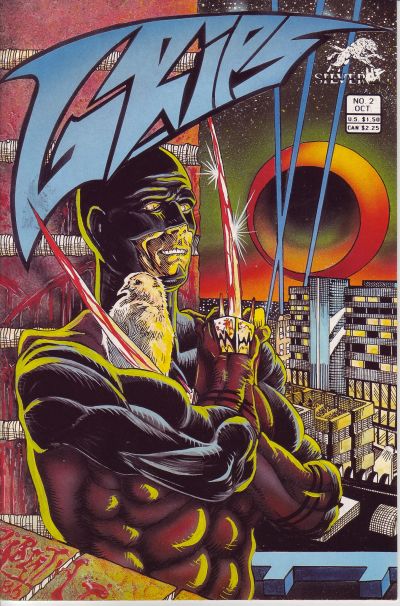 For modern readers, one of the biggest reasons to revisit Grips is the artwork of Tim Vigil.
Vigil’s work already displayed many of the qualities that would later become trademarks of his career: muscular anatomy, heavy shadows, highly detailed figures, and an enthusiasm for violence that seemed almost gleefully excessive.
Silverwolf became one of Vigil’s earliest showcases, and Grips gave him significant exposure before his later success on Faust. Contemporary accounts of Silverwolf’s history consistently single out Grips as the title that first brought Vigil’s artwork to a wider comics audience.
The stories became progressively more violent. Even the Grand Comics Database’s index for Grips #2 describes the material as “extremely violent for its time.”
That is saying something for 1986.
Grips arrived at exactly the right moment.
Following the extraordinary success of Teenage Mutant Ninja Turtles, comic shops were flooded with black-and-white independent comics. Publishers suddenly realized that a small company could produce a comic without Marvel or DC and potentially reach a national audience through the direct market.
Some of those comics were excellent.
Some were terrible.
Some disappeared after one issue.
And some were fascinating combinations of enthusiasm, excess and experimentation.
Grips belonged comfortably in that last category.
The original Silverwolf issues featured color covers with black-and-white interiors and sold for $1.50. Four issues appeared between September and December 1986.
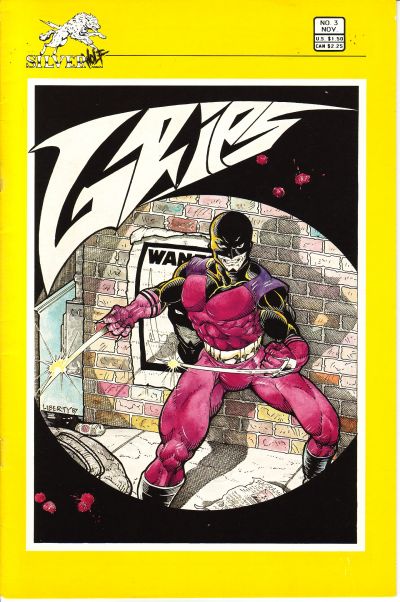 The title had the rough edges that made many black-and-white boom comics interesting. It did not feel focus-grouped or filtered through layers of editorial approval. Kris Silver and Tim Vigil appeared to be making exactly the comic they wanted to make.
Sometimes that meant pushing things far beyond what mainstream superhero publishers would have attempted.
One of the cleverest elements of the series was Martin Kane’s occupation.
Kane drew a comic called Fat Ninja.
Then Silverwolf actually published Fat Ninja.
The fictional comic inside Grips became a real comic available to readers, effectively turning Martin Kane’s imaginary creation into another part of the Silverwolf publishing line. Fat Ninja would continue under Greater Mercury Comics as well.
It was the kind of playful interconnected world-building independent publishers could get away with because nobody was telling them they couldn’t.
Silverwolf Comics itself did not last long.
Founded by Kris Silver in 1986, the company published a surprisingly large collection of characters and titles but ceased publication during the following year. Silver later returned with Greater Mercury Comics, which revived many of those characters.
And Grips came back with it.
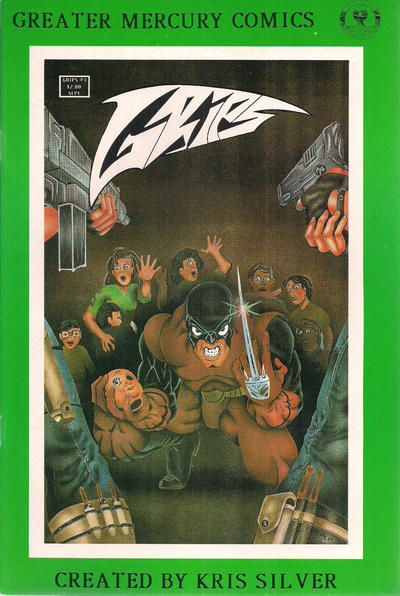 A new Grips series began in August 1989, with artwork on the first issue by Juan Pérez del Muro. The story, “Cry of a Child,” demonstrated that Silver had no intention of softening the character. The plot involved Grips discovering a child-abuse operation and delivering his own particularly unforgiving form of punishment.
The revived series proved substantially more durable than the original.
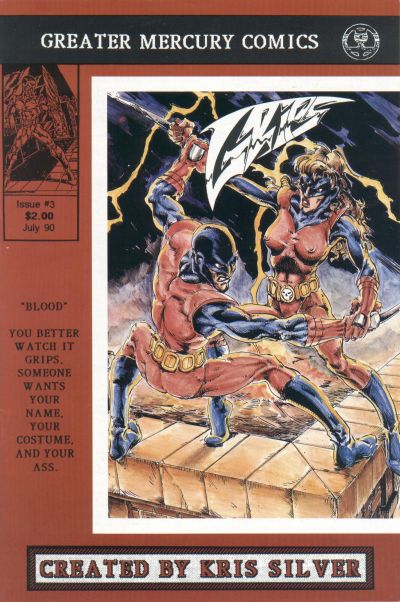
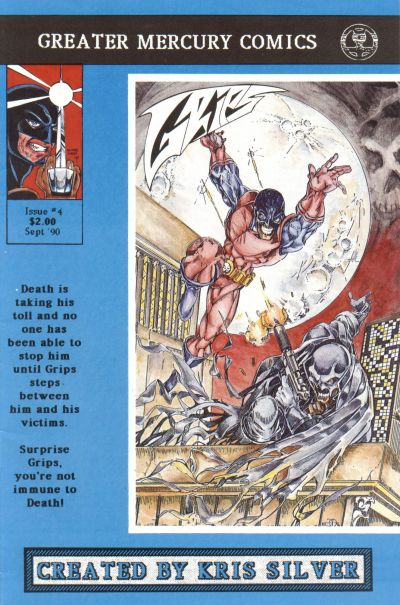
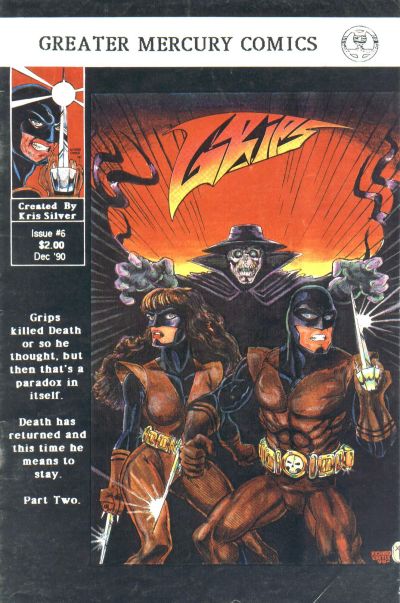
Greater Mercury published 12 issues of Grips between 1989 and 1992.
There was also Grips Adventures, additional anthology appearances, a Grips Special and a collected edition reprinting the original Silverwolf material. The four 1986 stories were collected in Silver Wolf Grips #1-4 in 1990.
For a character originating with a tiny publisher during the black-and-white boom, that represents impressive longevity.
It is tempting to describe Grips simply as another violent vigilante, particularly considering how many Punisher-like characters populated comics during the late 1980s and early 1990s.
But Grips had its own peculiar personality.
Martin Kane wasn’t presented as an immaculate professional soldier or mysterious urban legend. He was an artist. His mundane career existed alongside the increasingly bizarre characters inhabiting Silver’s superhero universe.
That contrast could make the series simultaneously grim and strangely absurd.
The world surrounding Grips included characters with names like Deathborg, the Gladiators, and, naturally, Fat Ninja.
There is a homemade quality to the entire Silverwolf universe that has become increasingly charming with age. Characters were created because somebody thought they sounded cool. Stories could suddenly veer from superhero action into horror or exploitation territory. Nothing seemed particularly concerned with fitting neatly into an established genre.
 The greatest historical importance of Grips may ultimately be Tim Vigil.
Vigil would go on to co-create Faust with David Quinn, establishing himself as one of the most recognizable artists in mature independent comics.
Looking at his Grips pages today is therefore similar to discovering early work by an artist before the style was completely formed.
The anatomy is sometimes exaggerated. The storytelling is aggressive. Characters practically explode off the page.
But the foundations of the Vigil style are already there.
That makes the original four issues particularly interesting artifacts for fans of independent comic-book art.
Many comics launched during the 1986 black-and-white explosion disappeared so thoroughly that even dedicated collectors have difficulty remembering them.
Grips survived.
It survived Silverwolf.
It returned through Greater Mercury.
Its supporting concepts became comics of their own.
And decades later, people still discuss it largely because it represents something increasingly difficult to manufacture intentionally: pure independent-comics energy.
 There was no corporate universe to protect.
No movie franchise waiting in the wings.
No merchandise department worrying whether Grips was sufficiently marketable.
There was simply Kris Silver creating comics and artists such as Tim Vigil drawing them.
The results could be crude, violent, excessive and occasionally ridiculous.
They could also be tremendously entertaining.
The story may not be finished.
In 2026, Grips resurfaced publicly when Everette Hartsoe, creator of Razor, announced that the property was being brought into the Razorverse. Hartsoe specifically cited the same independent, boundary-pushing spirit that originally defined the series.
It is an oddly appropriate destination.
Both Razor and Grips emerged from independent comics scenes willing to go places mainstream publishers generally would not. Although they came from different periods, both were built around extreme antiheroes and creators who saw few reasons to observe traditional superhero boundaries.
Forty years after Martin Kane first put on the mask, Grips still has something to hold onto.
 Grips isn’t remembered because it revolutionized superhero comics.
It is remembered because it perfectly represents a particular moment when almost anyone with enough determination could create a comic, get it into comic shops, and discover whether readers would come along for the ride.
Kris Silver provided the ideas.
Tim Vigil provided astonishingly energetic early artwork.
And Martin Kane provided enough broken bodies to ensure nobody confused Grips with anything coming from the Comics Code Authority.
For readers exploring the forgotten corners of 1980s independent comics, GRIPS deserves another look.
About Author
