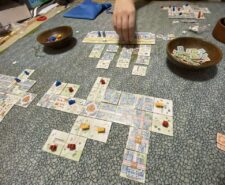
 If you like tile-laying games — a favorite for most in The Meeple Guild — then you’ll want to take a close look at Railroad Tiles.
This one is a relatively new release from designers Hjalmar Hach and Lorenzo Silva, published by Horrible Guild.
Railroad Tiles is a sequel to the roll-and-write series Railroad Ink, which the Guild hasn’t played, but online reports have generally been favorable.
The new version is a quick-play tile placement game, running only eight rounds, in which you pick tiles and place routes to build an interconnected community.
“We wanted to take the small, monochromatic, two-dimensional world of Railroad Ink—made of roads and railways drawn with markers, which we fell in love with—and bring it into three dimensions,” explained Davide Amici, Marketing Manager at Horrible Guild, via email. “We aimed to make it vibrant and colorful, populate it with life, and bring it one step closer to reality.
“What convinced us to pursue the project was its simplicity. When people sit down to play, they naturally start combining tiles and populating them with meeples in a way that closely mirrors the official rules—even without knowing them. There’s something intuitive about this spatial puzzle that immediately ‘clicks,’ and that made us believe it was worth developing into a full game.”
Players start each round by drafting tiles from a common pool, then place routes in front of them, trying to create as many connections as possible.
There’s nothing revolutionary in the mechanics here, but Railroad Tiles still works well. The experience, while not groundbreaking, is satisfying — largely due to the game’s familiar and accessible playstyle.
Asked what stands out, Amici noted, “Probably its unique combination of elements: simple rules, a relaxing and almost romantic visual style, a touch of engine-building (the more cars on the same road, the more points each new one earns), strong variability, and plenty of room for expansions.
“It also builds on the recipe we know works so well with Railroad Ink.
“A less common mechanical twist is that you don’t place just one tile per turn — you place several. This opens up a wide range of options and allows you to build a large, satisfying ‘map’ over the course of just a few turns.”
Each round, players can also place cars, trains, or travelers to populate the landscapes they’re creating. The available actions change from round to round, requiring players to plan.
The more pieces of the same type each new placement connects to, the more points you earn — adding a layer of strategic depth beyond simply laying tiles.
“We think the most distinctive element of Railroad Tiles is the scoring system for cars, trains, and travelers,” said Amici. “The more cars already on a road, the more points each additional one will earn when placed. This mechanism was designed to echo the ‘longest road’ scoring in Railroad Ink: players are incentivized not to close off their roads so they can keep generating points — very much like how players in Railroad Ink try to keep extending their longest road or railway for maximum score.”
Players also score bonus points at the game’s end for specific designs within their tile layouts.
Railroad Tiles won’t tax your brain, and while it doesn’t introduce much you haven’t seen elsewhere, it still stands out as a solid night of gaming fun. Ultimately, it’s likely to hover just outside our top-five games of 2025 — which isn’t bad, considering how many strong titles continue to hit the table.
Check it out at horribleguild.com.
About Author
Calvin Daniels is a Saskatchewan-born, self-taught journalist. He is currently Editor of Yorkton This Week, with 35-years in the newspaper business.

Lay the tiles, create a railroad
This one is a relatively new release from designers Hjalmar Hach and Lorenzo Silva, published by Horrible Guild.
Railroad Tiles is a sequel to the roll-and-write series Railroad Ink, which the Guild hasn’t played, but online reports have generally been favorable.
The new version is a quick-play tile placement game, running only eight rounds, in which you pick tiles and place routes to build an interconnected community.
Players start each round by drafting tiles from a common pool, then place routes in front of them, trying to create as many connections as possible.
There’s nothing revolutionary in the mechanics here, but Railroad Tiles still works well. The experience, while not groundbreaking, is satisfying — largely due to the game’s familiar and accessible playstyle.
Asked what stands out, Amici noted, “Probably its unique combination of elements: simple rules, a relaxing and almost romantic visual style, a touch of engine-building (the more cars on the same road, the more points each new one earns), strong variability, and plenty of room for expansions.
“It also builds on the recipe we know works so well with Railroad Ink.
“A less common mechanical twist is that you don’t place just one tile per turn — you place several. This opens up a wide range of options and allows you to build a large, satisfying ‘map’ over the course of just a few turns.”
Each round, players can also place cars, trains, or travelers to populate the landscapes they’re creating. The available actions change from round to round, requiring players to plan.
The more pieces of the same type each new placement connects to, the more points you earn — adding a layer of strategic depth beyond simply laying tiles.
Players also score bonus points at the game’s end for specific designs within their tile layouts.
Railroad Tiles won’t tax your brain, and while it doesn’t introduce much you haven’t seen elsewhere, it still stands out as a solid night of gaming fun. Ultimately, it’s likely to hover just outside our top-five games of 2025 — which isn’t bad, considering how many strong titles continue to hit the table.
Check it out at horribleguild.com.
About Author
Calvin Daniels
Calvin Daniels is a Saskatchewan-born, self-taught journalist. He is currently Editor of Yorkton This Week, with 35-years in the newspaper business.
See author's posts