
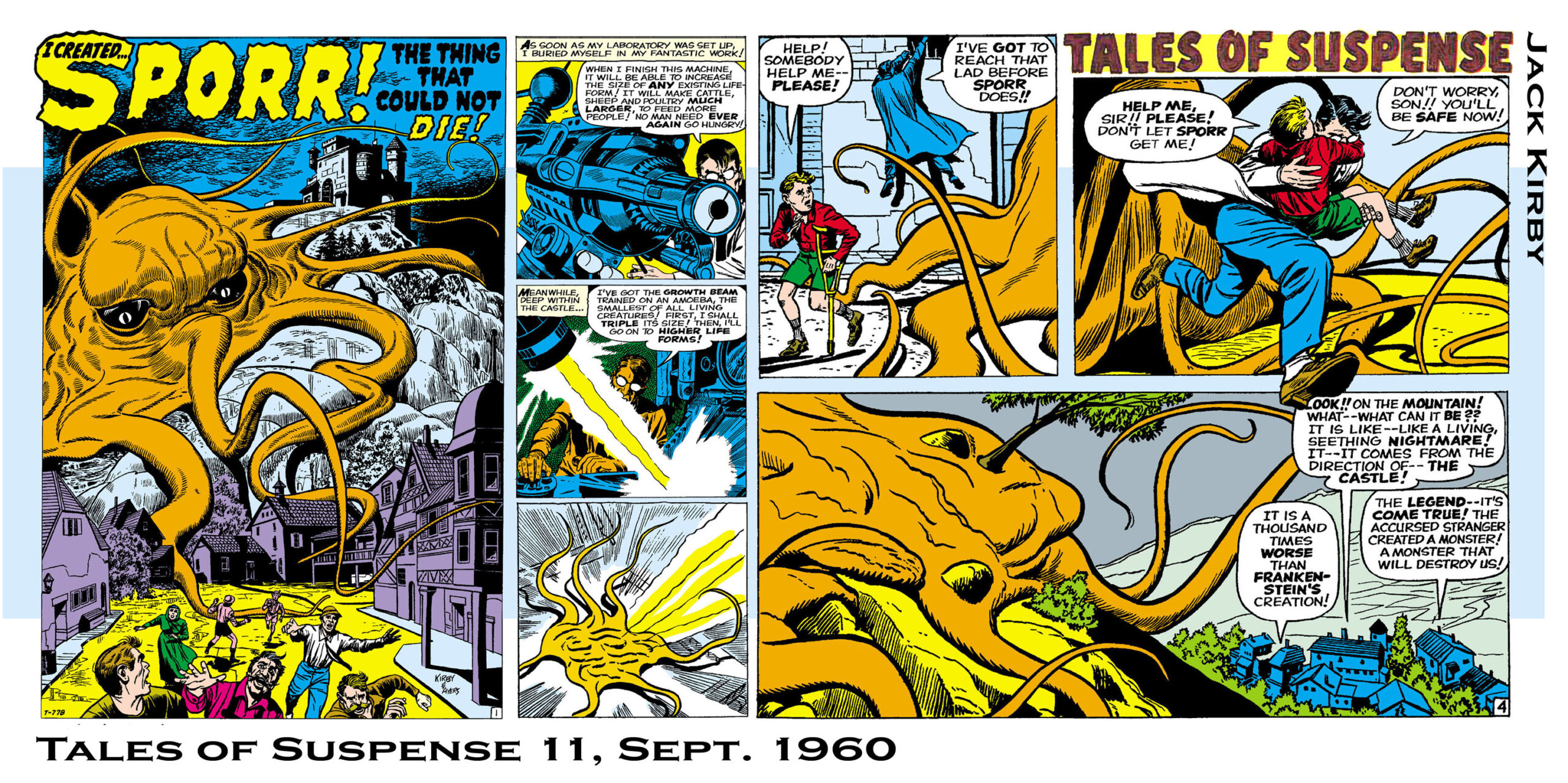
It crawled out of the Bible, and it ended up on the pages of what would become Marvel Comics.
Giant monsters became the staple of the company’s science fiction titles in the late 1950s, and Tales of Suspense 11 (Sept. 1960) treated us to I Created … Sporr! The Thing That Could Not Die! Sporr (who died, despite his advance billing) was an amoeba that, thanks to a growth ray, threatened to envelop a central Romanian village.
Sporr was also, pretty obviously, the movie monster, the Blob with some eyes and tentacles added. That 1958 film had been a big hit at the drive-in movies.
Released on a double bill with I Married a Monster from Outer Space, The Blob proved to be the more popular picture and marked the leading-man debut of Steve McQueen (who was paid $2,500 to star as the teenage hero). The soon-to-be-famous composer Burt Bacharach provided a lively title tune for the amorphous alien menace.
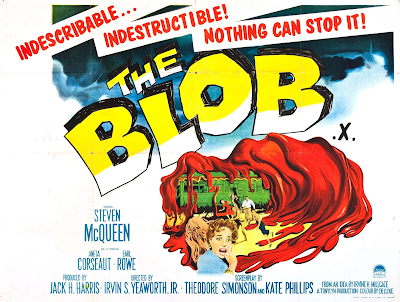 “Strong performances and ingenious special effects help The Blob transcend the schlock sci-fi and youth delinquency genres from which it originates,” notes the Criterion Collection.
Oddly enough, The Blob came from the Pennsylvania studio Valley Forge, which had made a couple of hundred religious movies but never a feature film.
“Their basic mission was to promulgate the Word,” producer Jack Harris recalled in Interviews with B Science Fiction And Horror Movie Makers by Tom Weaver. “They were doing that pretty well, but starving to death at the same time. I convinced them that we could take what facilities they had […] and come up with films that a lot of people would come and see. And if they did it right, we’d do it again; and the more notice they got, the more Word they’d be able to transmit…”
Harris said their menace became a blob because he wanted to make a creature feature without featuring some guy in a monster suit.
And if you wanted a metaphor, The Blob could supply that, too. In an era when the disgraced Sen. Joe McCarthy’s crusade was still fresh in everyone’s mind, a gigantic “red” menace that threatened to absorb and dissolve America probably had resonance.
The Marvel story reflected artist Jack Kirby’s love of 1930s Universal horror movies by moving the action to Dr. Frankenstein’s castle.
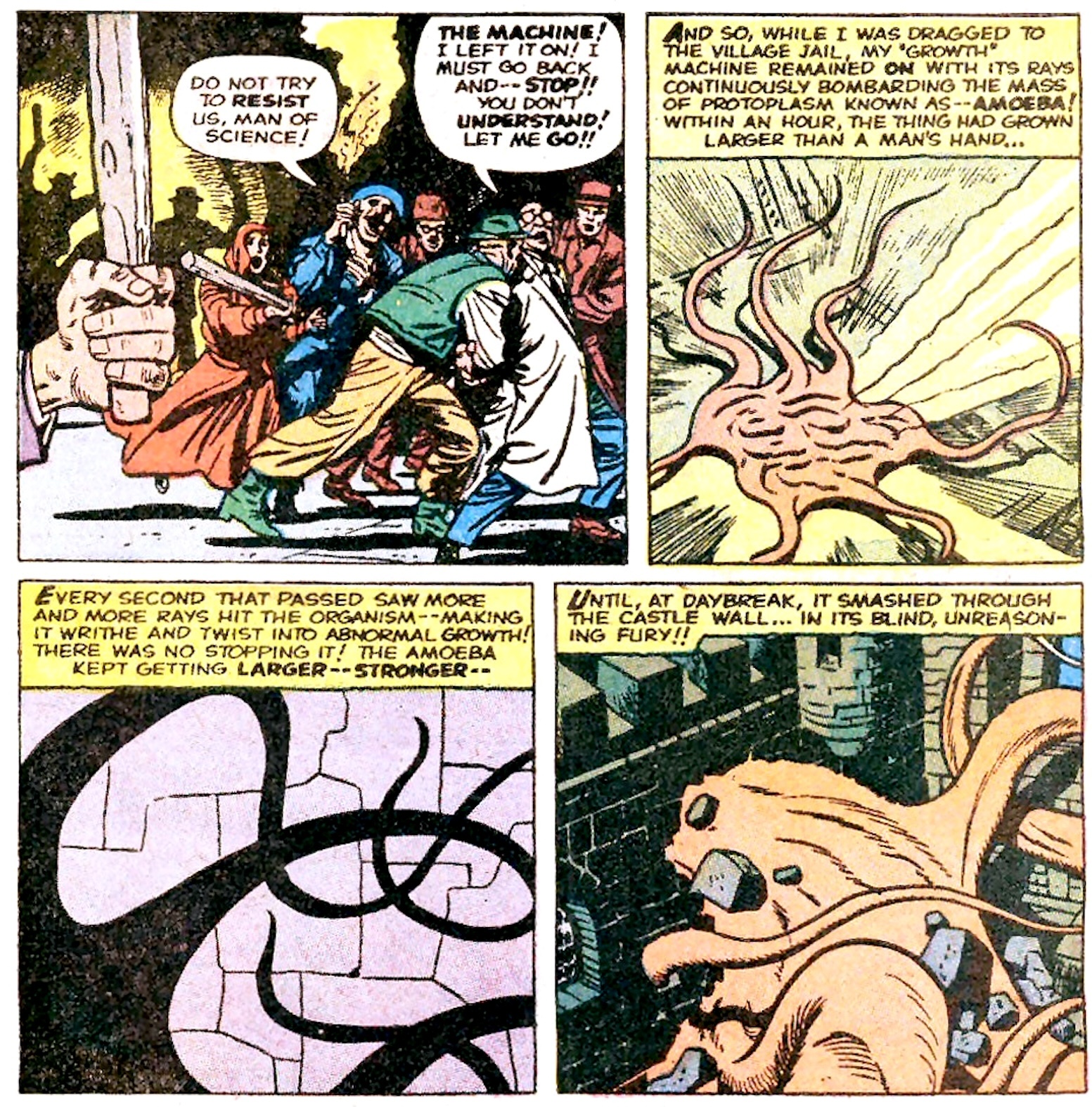
Ironically, it’s the terrified villagers themselves who unleash the monster this time. By attacking and jailing a scientist, they leave his growth ray unattended and create Sporr. The only thing they had to fear was fear itself, as it turns out.
The Transylvanian villagers try to destroy the invading creature with dynamite, but it easily re-forms itself following the explosion. It’s left to the scientist, the man of reason, to finish off the menace by escaping and using sugar to lure Sporr to his doom in quicksand.
“It’s far better this way,” the scientist reflects. “He was never meant to walk the earth, menacing other living beings! He has gone back — back to the source of life — back to where he belongs!”
The superhumanly powerful monsters that populated Marvel’s pages in the late 1950s were, in one sense, but a step away from the superhumanly powerful heroes who would revitalize the company and the industry in the 1960s. In some cases, such as the Thing and the Hulk, you could barely tell them apart.

About Author
