
One of the things that made Robert Mayer’s 1977 novel Superfolks work so well was that, somewhere behind the fantasy and humor, the reader sensed a familiar truth.
The protagonist, a Clark Kent figure called David Brinkley, has faded into middle age. With his physical powers in decline, he has abandoned his heroic identity and settled into suburbia. His frame is flabby, his concerns are mundane and his youthful dreams are now distant memories. His superhuman friends have retired or died. The world that had once exclaimed in excitement to see him soaring in the sky has moved on to new thrills, fresh headlines. He’s yesterday’s news.
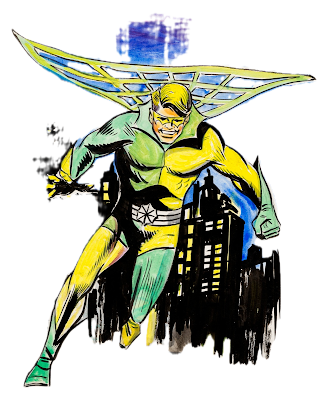 But Mayer wasn’t the first to contrast superheroic melodrama with the kitchen sink concerns of an ordinary American life. Archie Comics had also done that a decade before with its farcical revival of the Golden Age superhero the Web.
Think of 1966. The young creators of the comic book superheroes were by then middle-aged, paunchy, with their dreams of glory replaced by worries about the mortgage and dental bills. And one of them was the 52-year-old Jerry Siegel, the Cleveland-born co-creator of Superman. He and Joe Shuster had sold away the rights to that feature for $130, By 1966, wearied by financial worries and failed lawsuits to regain the rights to his creation, Siegel was taking writing jobs where he could find them. One of those places was Archie Comics.
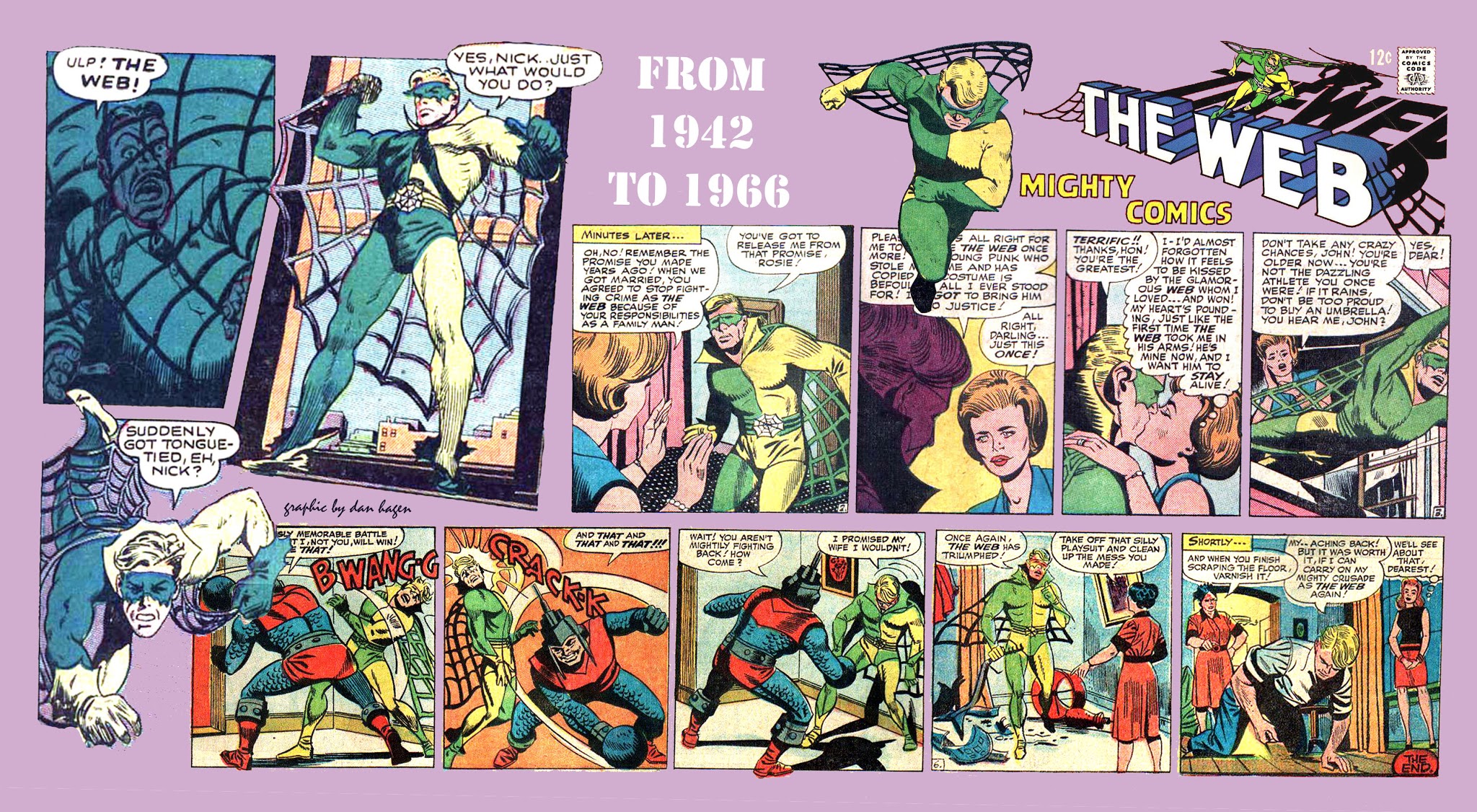
Artist John Cassone had created the Web in 1942 as a bespectacled criminology professor who prowled the darkened streets in a green and yellow costume, a jingoistic bruiser slugging it out with various brutal, fanged, hatchet-hurling Axis menaces.
In his first recorded adventure in Zip Comics 27 (July 1942), the Web rescued his student Rose Wayne from the Black Dragon, a Japanese torturer. In defiance of comic book convention, Rose immediately recognized her masked professor John Raymond.
Two decades passed. MLJ Comics renamed itself in honor of its most popular character, Archie Andrews, and then developed an offshoot, Mighty Comics — an awkward attempt to surf the wave of superhero revivals popularized by DC and Marvel.
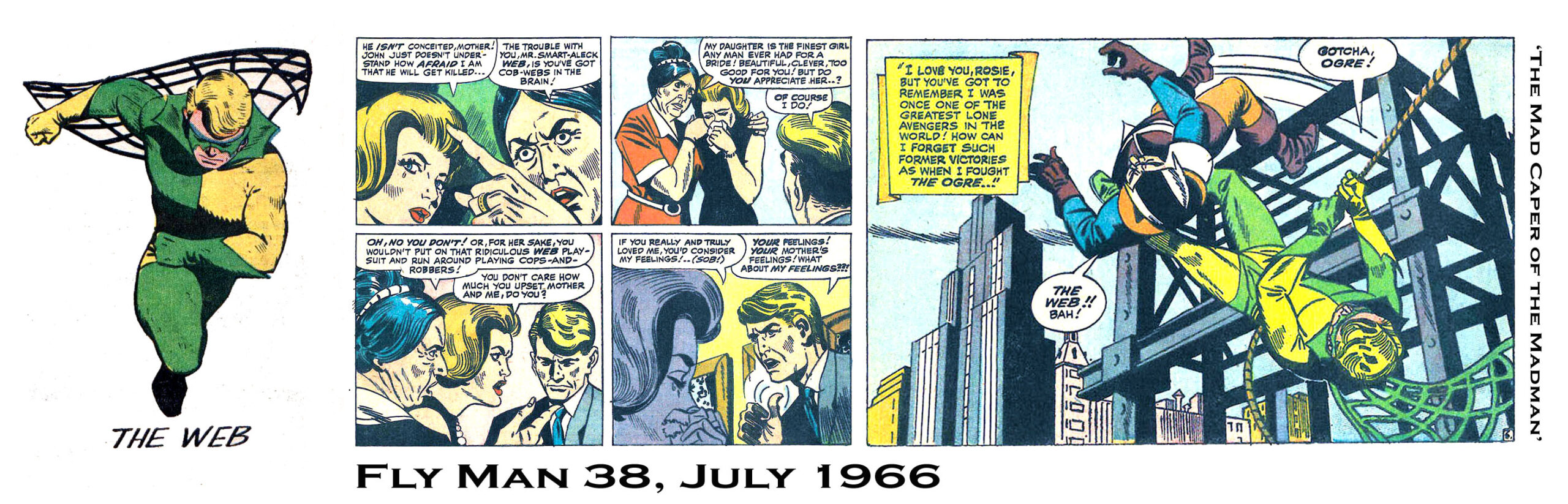
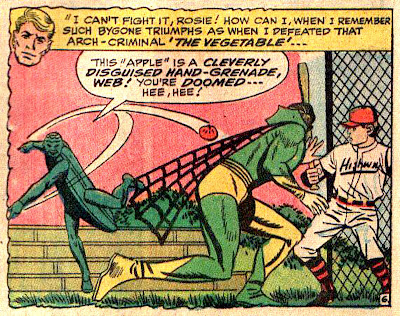 So in Fly Man 36 (March 1966), in a story written by the pseudonymous Siegel (“Jerry Ess”), Rose and John are revealed to be placidly married and the Web is long retired. Raymond’s latest adventure is mowing the lawn.
“Puff pant!” says the professor. “Oh, my aching back! When will they ever invent grass that grows only one inch high!”
But when he learns that a young crook disguised as the Web has engineered a prison break, Raymond opens a long-unused bookshelf in his den to retrieve his superhero costume from the 1940s.
“Oh, no!” his wife exclaims. “Remember the promise you made years ago! When we got married, you agreed to stop fighting crime as the Web because of your responsibilities as a family man!”
Raymond talks Rose into letting him make one last appearance as the Web in order to clear his name, and kisses her goodbye.
“I – I’d forgotten how it feels to be kissed by the glamorous Web whom I loved … and won!” Rose thinks. “My heart’s pounding, just like the first time the Web took me in his arms! He’s mine now, and I want him to stay alive!”
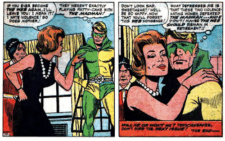 But she reveals none of those thoughts to her husband, whom she scolds. “Don’t take any crazy chances, John!” she says. “You’re older now … You’re not the dazzling athlete you once were! If it rains, don’t be too proud to buy an umbrella! You hear me, John?”“Yes, dear!” the Web replies as he leaps out the window.
The Web gets no respect from his impersonator, either. “The old has-been has dragged himself outta his arm chair!” the criminal thinks. “When word gets around that I’ve killed the original Web, every crook in creation will bow low to me in admiration!”
However, experience bests youth when the Web, having saved his imposter from being killed by a subway train, turns him over to police.
Back home, Raymond finds that Rosie isn’t interested in hearing about his new escapades, but wants him to take out the garbage and wash the windows. So secretly at night, while his wife’s asleep, Raymond begins doing push-ups to train for a revived career as a crime-fighter.
In subsequent issues of Fly Man and Mighty Comics, Siegel recounts the exploits and misadventures of the henpecked hero who must also put up with the taunts of his mother-in-law as he saves the city from miscreants like the Acro-bats, the Madman, Ironfist and Uglyman.
Raymond’s wife continues to fret over his heroics, and even leaks his secret identity to the media in an effort to end his crime-fighting career. When that doesn’t work, Rosie designs herself a superhero costume and appears as the mysterious Pow Girl, determined to protect her husband if she can’t discourage him.
In his teens, Siegel had co-created the world’s most influential superhero, a multi-media superstar who proved to be a money machine for his publishers. In his 50s, eking out a living as a freelancer, buffeted by a string of defeats, the embittered Siegel was writing about a superhero long past his prime who daydreamed about recapturing past glory.
Somewhere beneath all that heavy-handed humor sits a sad irony.
About Author
