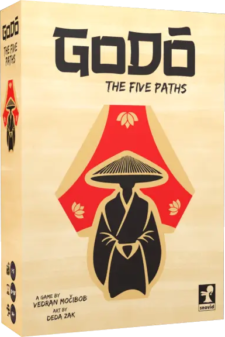
 When watching a how-to-play video online for GODŌ: The Five Paths, it seemed like it would hit the sweet spot for The Meeple Guild, as we tend to enjoy tile-laying games quite a lot.
The Japanese-inspired setting, a mysterious mountain temple where players take on the roles of monks seeking enlightenment by mastering five virtues: kindness, righteousness, respect, wisdom, and trust, also fits snugly with our group’s general interests.
Yet GODŌ ended up being something of a conundrum for our table. By the end of the session, there was no clear consensus on how much we actually liked it.
Because we enjoy tile-laying games so much, we’ve played many excellent ones over the years. It’s difficult not to compare every new entry in the genre against the classics we already love, and newer games can struggle under those comparisons.
What makes GODŌ particularly interesting is that there isn’t a single disappointing element. The rules are straightforward to grasp, the components are attractive, and overall, the package is solid.
Still, it failed to grab everyone at The Meeple Guild fully. Oddly enough, even after lengthy discussion, we were never entirely sure why this one didn’t rise closer to the top of the pile for us.
Gameplay centers around building the temple by placing triangular tiles that create colored paths between intersections. In that regard, it’s a fairly traditional tile-layer: players hold two tiles and place one each turn.
To move along those paths, players must “practice” a virtue by moving its token backward on their Journal, representing the idea that progress requires sacrifice. Once a virtue is fully mastered, movement along its paths becomes free. That push-and-pull system may be the strongest aspect of GODŌ. During the midgame, especially, it often feels like one step forward and two steps back.
Player tokens stop at intersections that provide various benefits, and chaining moves together can be satisfying, though at times it also feels slightly overpowered within the broader balance of the game.
From designer and publisher Snovid Games, GODŌ still feels like a game that may actually be better than our table’s final reaction suggested. Perhaps it simply suffered from being compared against too many beloved tile-layers already in our collection.
For players newer to the tile-laying genre, however, GODŌ will likely land a notch or two higher.
About Author
Calvin Daniels is a Saskatchewan-born, self-taught journalist. He is currently Editor of Yorkton This Week, with 35-years in the newspaper business.

GODŌ: The Five Paths
The Japanese-inspired setting, a mysterious mountain temple where players take on the roles of monks seeking enlightenment by mastering five virtues: kindness, righteousness, respect, wisdom, and trust, also fits snugly with our group’s general interests.
Yet GODŌ ended up being something of a conundrum for our table. By the end of the session, there was no clear consensus on how much we actually liked it.
Because we enjoy tile-laying games so much, we’ve played many excellent ones over the years. It’s difficult not to compare every new entry in the genre against the classics we already love, and newer games can struggle under those comparisons.
What makes GODŌ particularly interesting is that there isn’t a single disappointing element. The rules are straightforward to grasp, the components are attractive, and overall, the package is solid.
Still, it failed to grab everyone at The Meeple Guild fully. Oddly enough, even after lengthy discussion, we were never entirely sure why this one didn’t rise closer to the top of the pile for us.
Gameplay centers around building the temple by placing triangular tiles that create colored paths between intersections. In that regard, it’s a fairly traditional tile-layer: players hold two tiles and place one each turn.
To move along those paths, players must “practice” a virtue by moving its token backward on their Journal, representing the idea that progress requires sacrifice. Once a virtue is fully mastered, movement along its paths becomes free. That push-and-pull system may be the strongest aspect of GODŌ. During the midgame, especially, it often feels like one step forward and two steps back.
Player tokens stop at intersections that provide various benefits, and chaining moves together can be satisfying, though at times it also feels slightly overpowered within the broader balance of the game.
From designer and publisher Snovid Games, GODŌ still feels like a game that may actually be better than our table’s final reaction suggested. Perhaps it simply suffered from being compared against too many beloved tile-layers already in our collection.
For players newer to the tile-laying genre, however, GODŌ will likely land a notch or two higher.
About Author
Calvin Daniels
Calvin Daniels is a Saskatchewan-born, self-taught journalist. He is currently Editor of Yorkton This Week, with 35-years in the newspaper business.
See author's posts