 This review needs a significant disclaimer.
It should be understood up front that I have never enjoyed the classic Hex — I find it about as boring and uninteresting as any game I’ve tried, even after repeated forays into discovering why so many people rave about it.
So, I wasn’t expecting too much from Kanare Kato’s Borderland, even though several of his past designs have impressed me over time — including Stairs, Lines of Fixation, Meridians, Iago, and RosenKreuz.
According to the designer, Borderland combines Hex-like connective goals with Go-like territorial control. The objective is to create a border with your pieces, through a mix of placement and movement, so that your territory occupies more than half the board.
It’s also worth noting that Borderland was inspired by Dale Walton’s Make Muster, which was also published by Kanare Abstract.
Trevor and I found Borderland to lean much more toward Hex than Go, and — perhaps not surprisingly — Make Muster has been our least-liked game among those from Kanare Abstract not designed by Kato himself.
That said, Borderland rates reasonably well in limited rankings on BoardGameGeek.
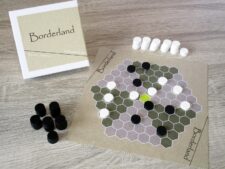
The game is played on a hexagonal board made up of 91 hexes. The goal is to form an unbroken chain of same-colored pieces that connects two non-adjacent sides of the board. When your border divides the board into two or more regions, all but the one containing the most opponent pieces become your territory. The player who controls more than half of the board wins.
On your turn, you may perform up to two actions: placing one piece and moving one piece. However, you can’t place twice in one turn, move a piece you just placed, or move the same piece twice.
When placing a piece, it must be at least one step away from all of your own pieces and at least two steps away from all of your opponent’s pieces — a restriction that makes blocking your opponent difficult and, frankly, more frustrating than engaging.
If a player creates a border but fails to meet the win condition, the game enters an Emergency Phase. During this phase, players can place pieces adjacent to the opponent’s stones and move the same piece twice in one turn. This feels a bit bolted on — perhaps an edge-case solution that rarely occurs but still complicates the design unnecessarily.
We own probably twenty games from Kanare Abstract, and while Queen’s Guard might previously have been our lowest-ranked, it at least held some interest as a historical curiosity. Unfortunately, Borderland now takes that bottom spot for us.
Of course, there always has to be a “last place” when ranking a publisher’s catalog, and I’m sure many will disagree — that’s the beauty of subjective taste. But for Trevor and me, Borderland simply didn’t connect.
About Author
Calvin Daniels is a Saskatchewan-born, self-taught journalist. He is currently Editor of Yorkton This Week, with 35-years in the newspaper business.

First Kanare Kato Creation to Miss the Mark With This Reviewer
It should be understood up front that I have never enjoyed the classic Hex — I find it about as boring and uninteresting as any game I’ve tried, even after repeated forays into discovering why so many people rave about it.
So, I wasn’t expecting too much from Kanare Kato’s Borderland, even though several of his past designs have impressed me over time — including Stairs, Lines of Fixation, Meridians, Iago, and RosenKreuz.
According to the designer, Borderland combines Hex-like connective goals with Go-like territorial control. The objective is to create a border with your pieces, through a mix of placement and movement, so that your territory occupies more than half the board.
It’s also worth noting that Borderland was inspired by Dale Walton’s Make Muster, which was also published by Kanare Abstract.
Trevor and I found Borderland to lean much more toward Hex than Go, and — perhaps not surprisingly — Make Muster has been our least-liked game among those from Kanare Abstract not designed by Kato himself.
That said, Borderland rates reasonably well in limited rankings on BoardGameGeek.
The game is played on a hexagonal board made up of 91 hexes. The goal is to form an unbroken chain of same-colored pieces that connects two non-adjacent sides of the board. When your border divides the board into two or more regions, all but the one containing the most opponent pieces become your territory. The player who controls more than half of the board wins.
On your turn, you may perform up to two actions: placing one piece and moving one piece. However, you can’t place twice in one turn, move a piece you just placed, or move the same piece twice.
When placing a piece, it must be at least one step away from all of your own pieces and at least two steps away from all of your opponent’s pieces — a restriction that makes blocking your opponent difficult and, frankly, more frustrating than engaging.
If a player creates a border but fails to meet the win condition, the game enters an Emergency Phase. During this phase, players can place pieces adjacent to the opponent’s stones and move the same piece twice in one turn. This feels a bit bolted on — perhaps an edge-case solution that rarely occurs but still complicates the design unnecessarily.
We own probably twenty games from Kanare Abstract, and while Queen’s Guard might previously have been our lowest-ranked, it at least held some interest as a historical curiosity. Unfortunately, Borderland now takes that bottom spot for us.
Of course, there always has to be a “last place” when ranking a publisher’s catalog, and I’m sure many will disagree — that’s the beauty of subjective taste. But for Trevor and me, Borderland simply didn’t connect.
About Author
Calvin Daniels
Calvin Daniels is a Saskatchewan-born, self-taught journalist. He is currently Editor of Yorkton This Week, with 35-years in the newspaper business.
See author's posts