There are a few publishers I never get tired of talking about, and one of them is Big Bang Comics! Last week, I covered Big Band Adventures 34, and this time I’m delving into issue 36. Now, inquiring minds might notice that I skipped over 35.
That was deliberate on my part, and THAT review will come soon! I wanted to point out that their comics are self-contained and fun! You can pick ANY of their comics up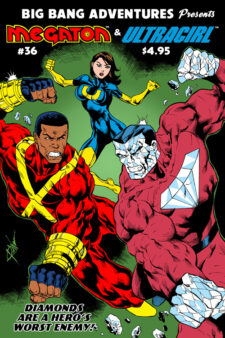 and not feel like you’re missing out! The best place to find their comics is over on Indy Planet.
Before we get into the review, there’s a fantastic video I pulled from the Fantastic Comic Fan podcast archives. Back in 2023, Big Bang ran a Kickstarter campaign. Michael Fitzgerald Troy was the guest, and it was an oversized tribute to Gary Carlson, Chris Ecker, and the classic Big Bang universe. Even though the campaign wrapped years ago, there’s still a ton of Big Bang lore to explore, from its Megaton roots to the heroes and history that shaped the indie comics landscape.
Big Bang Adventures #36 is one of those issues that shows exactly why Gary Carlson’s universe keeps finding new emotional angles inside its retro framework. On the surface, it’s a Megaton and Ultragirl team‑up against White Diamond, but the story is really about legacy, grief, and the weight of secrets — all wrapped in the bright, bombastic style that defines the Big Bang line. Carlson and Ray Mackay script a tale that feels like a Bronze Age annual: oversized stakes, a villain with a tragic past, and heroes forced to confront the ghosts of their predecessors. Ronald Williams’ art leans into that tone beautifully, giving White Diamond the kind of visual heft that makes every punch feel like it could crack the page.
The issue opens with a domestic beat that grounds everything: Christie Kelly, her mother’s house, a hungry cat, and Megaton showing up with pizza from Chicago. It’s a charming, almost sitcom‑like moment, and Carlson uses it to remind readers that Christie is still living in the shadow of her father’s “death,” a lie designed to protect her from the truth of Ultiman’s power transfer. When the news breaks that White Diamond has escaped custody, the tone shifts sharply. Christie’s reaction — “He’s one of my dad’s worst enemies. Or was before Dad died!” — lands with a sting because the reader knows the truth she doesn’t. Carlson has always been good at using the Kelly family to explore the emotional cost of superheroism, and this issue continues that thread with surprising tenderness.
White Diamond himself is a standout. The PDF’s character page lays out his history — the coal miner turned living bomb, the transformation into a diamond under impossible pressure, the misguided belief that Ultiman let his daughter die — and the story uses all of it. His rage is operatic, but rooted in something painfully human. When he screams that he “rotted behind bars knowing I’d never see my daughter again,” it’s not just villain bluster; it’s a man who lost everything and built his identity around the wrong conclusion. Carlson plays him as a tragic figure without softening his brutality, and Williams’ art sells the physicality of a villain who can go toe‑to‑toe with Ultiman.
Megaton’s involvement adds a layer of generational tension. Matt wants to protect Christie from her father’s rogues gallery, but he’s also carrying the burden of the lie Chris Kelly forced him to tell. The moment when he mutters “I hate lying” hits harder than expected, especially once White Diamond starts beating him senseless. Christie’s decision to return to her father’s Rocky Mountain Citadel — her childhood home — is one of the issue’s strongest scenes. The PDF’s pages show her confronting the past she’s been avoiding, accessing the Citadel’s computer, and learning the truth about White Diamond’s daughter. It’s a classic Big Bang move: a hero using legacy tech to uncover legacy pain.
And then Ultiman appears.
The reveal is handled with perfect Silver Age drama. White Diamond is mid‑rant, mid‑punch, mid‑meltdown, and suddenly the man he’s been screaming for stands in the doorway. “I hear that you’re looking for me.” It’s a simple line, but Carlson knows how to make Ultiman’s presence feel mythic. The ensuing confrontation isn’t just a fight; it’s a reckoning. Ultiman explains that he cured Jeanie, saved her life, and helped her and her mother start over. It’s the kind of compassionate heroism that defines the character, and the moment lands with real emotional weight. White Diamond’s reaction — a mix of shock, guilt, and despair — is one of the best beats the character has ever had.
The climax, involving the Cortex weapon and its countdown, is pure superhero melodrama, but the aftermath is where the issue shines. Christie grieves the robot duplicate of her father — “They just look and talk so much like him. They creep me out most of the time.” — is a beautifully strange, poignant moment. Big Bang has always embraced the weirdness of Silver Age tropes, but here it uses them to explore loss in a way that feels surprisingly modern. The final scene, Christie and Matt heading home to warm up the pizza if the cat hasn’t eaten it, is exactly the kind of human beat Carlson excels at. After all the explosions, revelations, and emotional upheaval, the story returns to something small and real.
Big Bang Adventures #36 is a strong entry in the line, not because it reinvents anything, but because it understands the emotional power of the tropes it loves. It’s a story about a villain who misunderstood the past, a hero who sacrificed everything, and a daughter trying to live with the consequences of secrets she never asked for. Wrapped in Williams’ energetic art and Carlson’s heartfelt scripting, it’s another reminder that Big Bang’s retro aesthetic isn’t nostalgia — it’s a lens for telling stories that still resonate.
About Author
