
Big Bang Comics is one of those rare outfits that remembers exactly what made superhero comics fun in the first place. Their universe is built on bright colors, clean heroics, secret identities, and that unmistakable Silver‑and‑Bronze Age charm — the kind of storytelling where moral centers matter, rogues have gimmicks instead of trauma essays, and every issue feels like it could have been pulled from a spinner rack in 1965. They aren’t parodying the past or chasing nostalgia; they’re continuing a tradition, treating classic superhero language as something worth preserving rather than reinventing.
 It’s a perfect fit for readers who miss that style — fans who want adventure without cynicism, heroes without corporate gloss, and worlds that feel hand‑crafted instead of committee‑designed. If you grew up on early Superman, Batman, Charlton oddities, or those wild 1960s anthology books, Big Bang will feel like coming home. And if you’re new to that era, their line is one of the easiest and most joyful ways to discover why those stories mattered in the first place. And the best place to get anything Big Bang is, of course, Indy Planet!
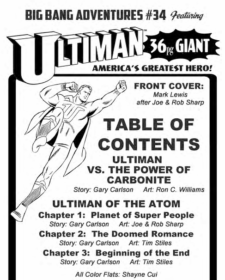
Big Bang Adventures #34 is one of those issues that remind you why Gary Carlson and Chris Ecker’s universe has lasted as long as it has: it’s built on affection, craft, and a deep understanding of what made mid‑century superhero comics sing. This installment is a full Ultiman showcase, but not in the modern “event” sense — it’s a celebration of the character’s lineage, his influences, and the creative voices who’ve shaped him across decades. The lead story, “Ultiman vs. The Power of Carbonite,” is pure Silver Age energy, right down to the bombastic villain introduction and the moral clarity that defines Ultiman’s world. Ron C. Williams’ art leans into that aesthetic with gusto, giving Mr. Carbonite the kind of visual punch that would’ve fit comfortably between a Curt Swan Superman story and a late‑50s Captain Marvel adventure. The moment where Carl yanks off the villain’s mask — “He looks like he’s made out of coal!” — is exactly the kind of earnest, melodramatic beat these stories thrive on. And Carlson’s script never forgets the emotional core: Ultiman’s refusal to kill, his instinct to protect, and his complicated relationship with his younger brother.
That relationship becomes even more interesting when the issue shifts gears into the long‑lost “Ultiman of the Atom” epic, finally presented in full color after years of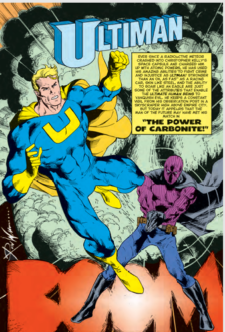 living as a black‑and‑white relic in Big Bang Universe #3. This is Carlson at his most nostalgic, channeling the structure and tone of “Superman’s Return to Krypton” and the multi‑chapter giants DC used to publish in the early ’60s. The premise is gloriously atomic‑age: Ultiman peers into a spectrometer and discovers that the ultranium atom is actually a microscopic planet populated by super‑powered beings. It’s the kind of idea that only works when executed with absolute sincerity, and Carlson commits fully. Joe and Rob Sharp’s art in the first chapter nails the Dick Sprang‑inspired look Carlson wanted, with clean lines, bold shapes, and a sense of theatrical staging that makes Ultranian society feel both futuristic and familiar. Tim Stiles picks up the baton for the remaining chapters, shifting the tone toward romance and tragedy as Ultiman falls for Zena‑Zee and races against time to save her world from destruction.
The doomed romance is the emotional heart of the issue. Carlson writes Ultiman with a vulnerability that rarely surfaces in his other adventures — a hero who finally finds someone who loves him not for his power, but for his weakness. The panel where Zena‑Zee cries in the Crystal Gardens, lamenting how little time they have, is one of the most affecting moments Big Bang has ever published. And the ending, with Zena sacrificing herself to send Ultiman home, lands with genuine weight. “I’ll never forget you, Zena‑Zee, the only girl I’ve ever loved!” is melodrama, yes, but it’s melodrama earned through the story’s structure and sincerity.
About Author
