
Continuity slips can wreck a comic—one panel shows a shattered arm, the next a flawless punch. To help you avoid those pitfalls, we’ve ranked the eight best Sudowrite alternatives for fiction writers who juggle sprawling story bibles and rotating teams. We’ll show how each tool stores, recalls, and shares canon, so issue eighty stays true to issue one.
How We Ranked the Best Sudowrite Alternatives for Fiction Writers
We scored each platform the way a comics editor red-lines a page: what still makes sense after three hard passes. Canon retention tops the rubric at 30 percent, with retrieval transparency close behind at 20 percent, because the slickest prose is worthless if a villain regrows a missing eye.
Context capacity earns 15 percent, yet bigger isn’t always safer. Google cautions that Gemini can “miss connections or details throughout large file(s)” when a prompt is overloaded, so any million-token claim drew healthy doubt.
We gave the remaining weight to ensemble control (10 percent), collaboration and hand-off tools (10 percent), price plus setup friction (10 percent), and privacy or ownership guarantees (5 percent).
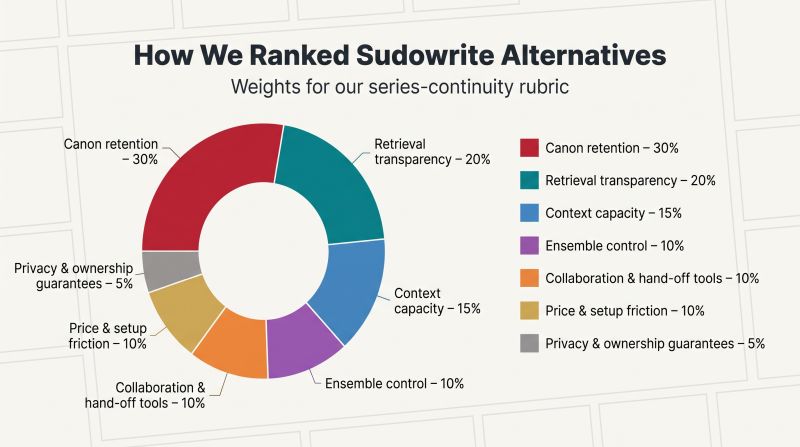
Picture it as a continuity stress test: the higher a tool scores, the more confidently you can hand it your universe bible and still sleep at night.
Quick Comparison: Eight Tools at a Glance
Need the gist fast? The grid below shows where each contender shines, and where it stumbles, so you can spot the option that already fits your workflow or flag the one you want to try next.
| Tool | Canon system | Maximum or model-dependent context | Multi-character support | Hand-off method | Best comics use | Biggest limitation |
| DreamGen | Scenario Codex | 5,000 – 30,000 tokens (plan based) | Role-Play Mode for full ensembles | Share the live Codex with your editor | All-in-one hosted writers’ room | No dedicated mobile app |
| Novelcrafter | Codex + Progressions | User-selected; model-driven | POV tracking, dialogue analysis | Team roles, Codex export | Formal series bible & editor hand-off | Requires BYOK setup |
| NovelAI | Lorebook triggers | Up to 8,192 tokens with Erato | Keys, aliases, Context Viewer | JSON or PNG Lorebooks | Inspectable lore injection | No live collaboration |
| SillyTavern + KoboldCpp | World Info & character cards | Hardware/model dependent | Group Chats, card sets | File-level sharing | Local, privacy-first sandbox | Steep install curve |
| Claude | Project RAG | Up to 1,000,000 tokens on current models | Large-cast digestion | Team viewer/editor roles | Continuity audits | No structured canon states |
| ChatGPT | Project memory | Varies by model | Works with voice sheets | Shared Projects | General drafting hub | Opaque retrieval |
| AI Dungeon | Story Cards stack | Model dependent; cards compete | Interactive NPCs | JSON export | Arc-exploration sandbox | Adventure shaped, not script shaped |
| Gemini | Custom Gems + uploads | Up to 1,000,000 tokens (paid) | Handles huge cast files | Drive document share | One-pass canon review | May miss scattered details |
Keep this cheat sheet handy; the deeper dives that follow will put each highlight in context.
1. DreamGen: Best Overall for a Hosted Multi-Character Canon Workflow
DreamGen feels less like a single app and more like walking into a writers’ room that already knows your universe. At its core is the Scenario Codex, a database that stores every scrap of lore: character backstories, location notes, even the prop planted for a payoff ten issues later. Enter a fact once, tag it, and the Codex keeps it on call for the exact panel that needs it.
Need to stress-test a six-character showdown? Switch to Role-Play Mode, assign each voice to the AI, let the cast argue, then pause any line to revise tone or pacing. When the dialogue lands, push it into Story Writing Mode and add action beats without losing canon continuity.
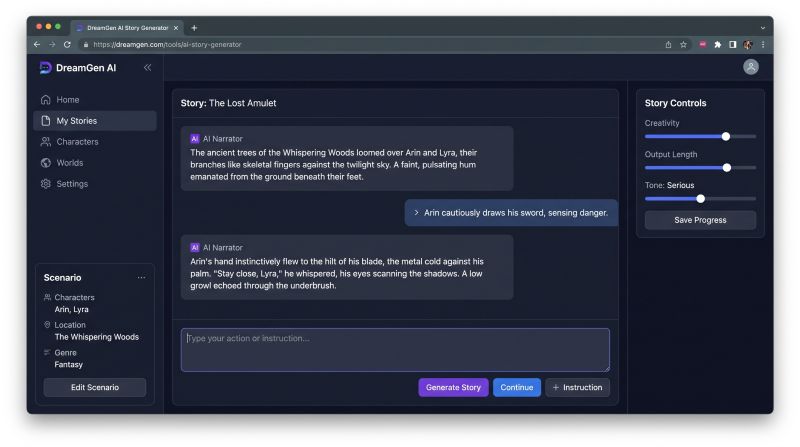
The hosted setup is a quiet superpower: no GPU quotas, no model mismatches, nothing to install before your editor can look at the same page you are. Two more helpers cut the blank-page problem: the Scenario Wizard builds a scenario collaboratively and iterates on your notes, and the Role-Play Assistant suggests plot developments and summarizes recent events when a thread runs long.
Context ranges from 5,000 tokens on the free tier to 30,000 tokens on Pro, and those windows stay open rather than draining a credit meter — the trap DreamGen’s own Sudowrite review documents in detail. Pricing climbs from a generous free tier through Starter and Advanced to Pro, which unlocks unlimited use of the first-party models. For most teams, it is the quickest route from a sprawling story bible to a continuity-safe script.
2. Novelcrafter: Best for a Formal Series Bible and Team Hand-Off
Novelcrafter treats continuity as a living system. Its Codex stores every character, prop, and power, then tracks how each element changes over time. Progressions pin the exact issue when a hero changes allegiance or gains a scar, so no one resurrects the wrong timeline later.
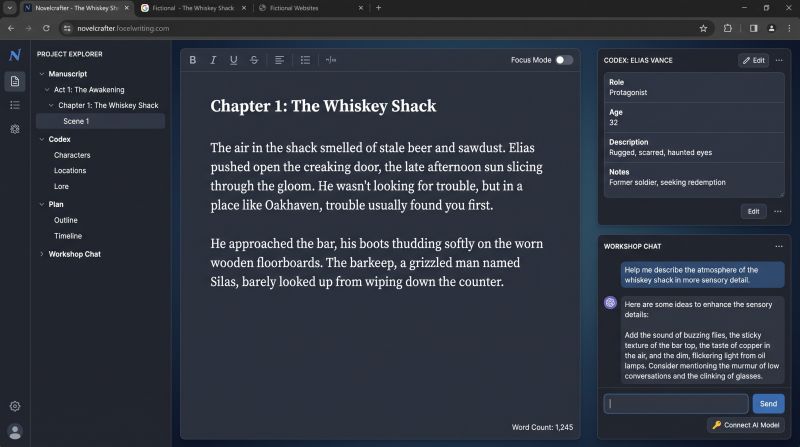
One toggle shares Codex entries across every book in a universe, so no more copy-pasting lore. Editors see the same truth you do, and automatic mentions flag plot threads the instant they appear in a script.
Collaboration is baked in. Invite a proofreader as a viewer, promote a co-writer to editor, or spin up a full team for a crossover. Role-based permissions keep the master canon safe.
You also control what the AI reads. Decide which Codex snippets and manuscript pages feed the model, then export the entire Codex for an offline backup.
Setup takes patience: you supply the model key, tweak context rules, and pay provider fees on top of $4–$20 monthly plans. If you need a bulletproof bible that survives artist swaps and late-night rewrites, Novelcrafter earns its silver medal.
3. NovelAI: Best for Triggered Lore Recall and Portable Lorebooks
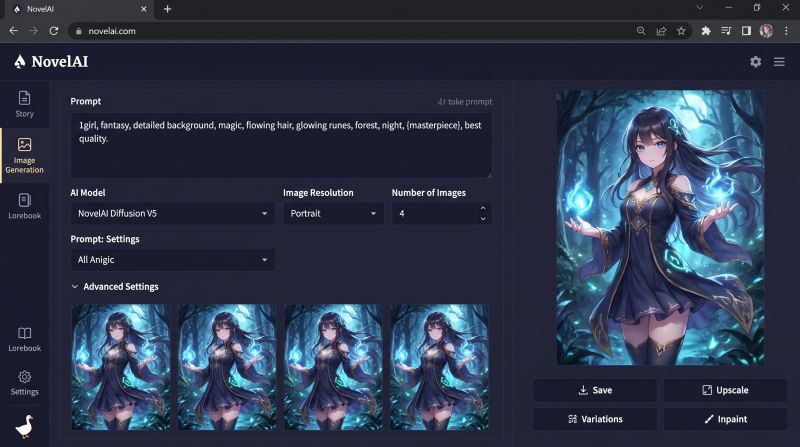
NovelAI’s Lorebook works like a gated reference shelf. Each entry is stored as “supplemental information that’s added to the AI’s context as the entry comes up in your story.” You attach a trigger key, and when that word appears in recent text, the matching lore slips into the prompt, nothing more, nothing less. Token budgets let you reserve space for crucial facts, while always-on flags keep cornerstone rules visible at all times. The Context Viewer shows exactly which snippets reached the model, so you never wonder whether the AI forgot or never saw the line.
The flagship Erato model offers an 8,192-token context window, ample for an issue script and supporting lore. When you finish, the whole project—story, Lorebook, Memory, Author’s Note—exports as JSON or even an embedded PNG Lorebook that another writer can drag straight into their own account.
The trade-off is solitude: no shared editor workspace, no live comments, and no role-based permissions. Teams pass files back and forth, which feels old-school next to Novelcrafter’s live Codex or DreamGen’s hosted room.
If you need surgical control over which canon facts reach each generation, NovelAI delivers. The Opus tier ($25 per month) gives you Erato and advanced Lorebook controls, letting your continuity land exactly when, and only when, the scene calls for it.
4. SillyTavern + KoboldCpp: Best for a Local, Custom Canon Stack
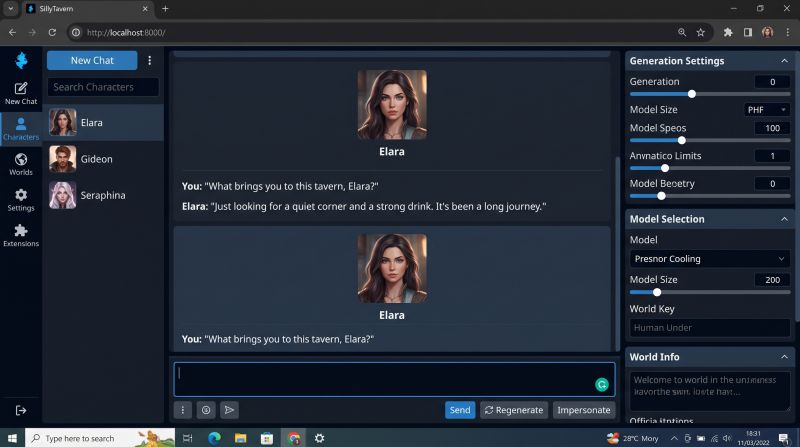
If you don’t want unreleased lore in the cloud, a SillyTavern front end plus a local KoboldCpp model is the privacy-first path. World Info files act as a lorebook that “only inserts relevant information … when keywords associated with the entries are present in the message.” You control activation depth, token budget, and even regex macros for battle scenes. Character cards store voice samples and quirks, while Group Chats let the whole cast speak without blending.
Because everything runs on your hardware, an NDA becomes a power cable: back up the Codex on an external drive and audit every token the model sees. The cost is setup time. Expect to:
- Install Python and Git
- Download a GGUF model (for example, a 7-B parameter Llama variant)
- Launch koboldcpp.py –model yourgguf
- Tune context sliders, usually 256–2,048 tokens depending on VRAM
Collaboration is file-based, so clear naming conventions and version control matter.
For studios that need to protect licensed IP, SillyTavern with KoboldCpp swaps convenience for absolute control. That extra effort often pays off.
5. Claude: Best for Reading Long Runs and Auditing Continuity
Claude excels at marathon reading. Anthropic’s current models carry context windows of up to 1 million tokens, and when a Project outgrows even that, retrieval-augmented generation pulls the relevant pages back in on demand.
That reach turns Claude into a continuity inspector. Ask it to list every time a secret identity slips or a healed scar reappears, and it returns line numbers, issue citations, and context snippets, all drawn from the files you provided.
Teams benefit from role-based sharing: an editor can comment without touching drafts, while a staff writer updates only assigned pages. No risky account sharing, no missing change logs.
Claude isn’t a structured bible. It treats characters, objects, and timelines as plain tokens; there are no keyed triggers or Progressions. Use it as the sharp-eyed auditor that catches canon cracks before readers do, then update your authoritative bible in DreamGen or Novelcrafter.
Claude Pro starts at $20 a month, with team plans priced per seat, a modest fee if you need a tireless continuity editor.
6. ChatGPT: Best for Shared General-Purpose Project Memory
ChatGPT slips into your team like a fast-learning intern. Projects bundle reference files, custom instructions, and chats behind one sidebar, and you can share a project with teammates while keeping project-only memory that walls off other conversations.
That boundary matters. Ask ChatGPT to polish banter between two heroes, and it won’t pull in notes from last week’s marketing deck. Drop voice sheets, a cast list, and the previous issue’s summary, and the model keeps pace without leaking secrets across channels.
The trade-off is opacity. Retrieval happens behind the curtain; you can’t see which sentence or earlier chat powered a reply, and there’s no keyed lore or timeline state. Continuity still depends on how neatly you curate the project files, and as the Legion’s tangled reboot history shows, even human editors lose that thread.
Treat ChatGPT as a flexible collaborator for drafting, brainstorming, and quick edits, not as the single source of canon truth. Pricing starts at $20 per month for Plus, with Pro and Enterprise plans adding higher-end models and longer context on the same project workflow.
7. AI Dungeon: Best for Interactive Issue and Arc Exploration
AI Dungeon is a sandbox for stress-testing plot twists. Its layered memory stack—Plot Essentials, Story Cards, Story Summary, and Memory Bank—lets you seed thousands of canon facts, then play what-if with branching scenes. Fire a trigger word and the matching Story Card moves into context, nudging the model toward the right lore beat.
That flexibility shines when you explore alternate arcs. Fork the adventure, tweak one variable, and watch the ripple in real time. Export the winning branch as JSON, then import it into your production tool once the experiment passes muster.
Production is where AI Dungeon shows seams. Context is rationed: after required elements, only about 25 percent of the remaining tokens go to matching Story Cards, another 25 percent to the Memory Bank, and the rest to history. When space runs out, lower-priority lore drops. Scripts also arrive in adventure prose, not panel format, so you’ll need a rewrite before sending pages to an artist.
Treat AI Dungeon as your narrative holodeck, not your final script factory. Paid memberships start at $14.99 per month for larger context and extra credits, a fair price if you value limitless what-if runs over production polish.
8. Gemini: Best for One-Pass Review of Huge Canon Dumps
Gemini’s headline feature is scale. The AI Pro and AI Ultra plans support a 1 million-token context window, roughly 1,500 pages of text. Upload every script, editorial note, and reference spreadsheet from an entire imprint, then ask for timeline checks, location consistency, or power-level drift in a single prompt.
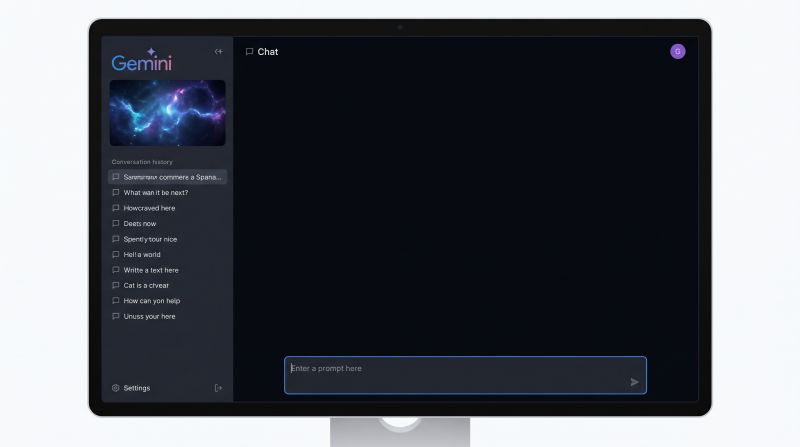
Size comes with a warning. Google notes that oversized files can cause the model to overlook scattered details, so capacity alone doesn’t guarantee perfect recall. Gemini also treats everything as plain text; it has no concept of characters, objects, or state changes over time.
Collaboration relies on standard Drive sharing rather than a comics-specific workspace, and after the review you’ll paste findings back into your primary bible. AI Pro starts at US $19.99 per month and AI Ultra at US $99.99, making Gemini a cost-effective broad-spectrum scanner, ideal for a final sweep but not for storing living canon.
Frequently Asked Questions
Which Tool Shows the Clearest Story-Bible Memory?
NovelAI. Its Lorebook acts as “a repository for supplemental information that’s added to the AI’s context as each entry comes up in your story,” and the built-in Context Viewer shows exactly which lore reached the model for each prompt.
Does a Bigger Context Window Guarantee Perfect Continuity?
No. Google notes that Gemini can still “miss connections or details throughout large file(s)” when a prompt is overloaded, so sheer size can’t protect your canon.
Which Platform Lets Me Reuse the Same Canon Across Multiple Books?
Novelcrafter. Its Codex lets you “define details once and share them across every book in your series,” then track changes with Progressions so one truth feeds every spin-off.
The Bottom Line for Serialized Comics Teams
Match the tool to the job. Use Gemini or Claude to audit a run that already exists, AI Dungeon to stress-test an arc before you commit to it, and a local SillyTavern stack when the lore cannot leave the building.
For the canon itself—the document your artist, your editor, and next year’s fill-in writer all work from—the deciding feature is how the tool stores it and how reliably it hands it back. Novelcrafter and NovelAI both do that well, and each asks something in return: an API key and an afternoon of setup, or working alone with no shared workspace. DreamGen puts the Scenario Codex, multi-character Role-Play Mode, and purpose-built fiction models in one hosted place with nothing to install, which is why it leads this list. If Sudowrite’s credit meter is what sent you looking for an alternative, start there.
About Author
