
Writers and GMs keep sharing the same horror story: “the AI forgets your story three hours in,”.
When the bot loses the plot, your world crumbles.
We put every major platform through a marathon test—pushing their memories, stress-testing filters, and double-checking value for money.
Only seven tools passed. They follow your rules, echo your tone, and hold characters steady so you can create instead of correct.
How We Ranked The AI Storytellers
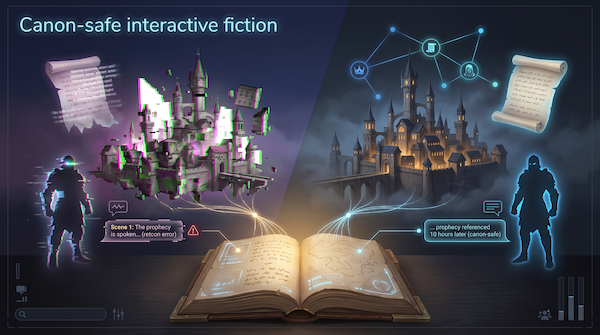
Each platform faced the same multi-chapter fantasy quest filled with recurring NPCs, timeline twists, and lore details that usually trip an AI.
After every turn, we asked a single question: does the story still match the canon we set five scenes ago? We then scored seven factors:
- Lore memory and continuity, 20 percent
- Writing quality and model breadth, 20 percent
- Creative freedom (how often filters derail the plot), 15 percent
- Interactivity extras—multiplayer, images, rule engines, 15 percent
- User experience and learning curve, 10 percent
- Pricing value over a month of regular play, 10 percent
- Bonus worldbuilding aids—wikis, APIs, maps, 10 percent
Tools that aced memory but priced casual writers out moved down, while a generous free tier couldn’t rescue an app that kept forgetting the protagonist’s name.
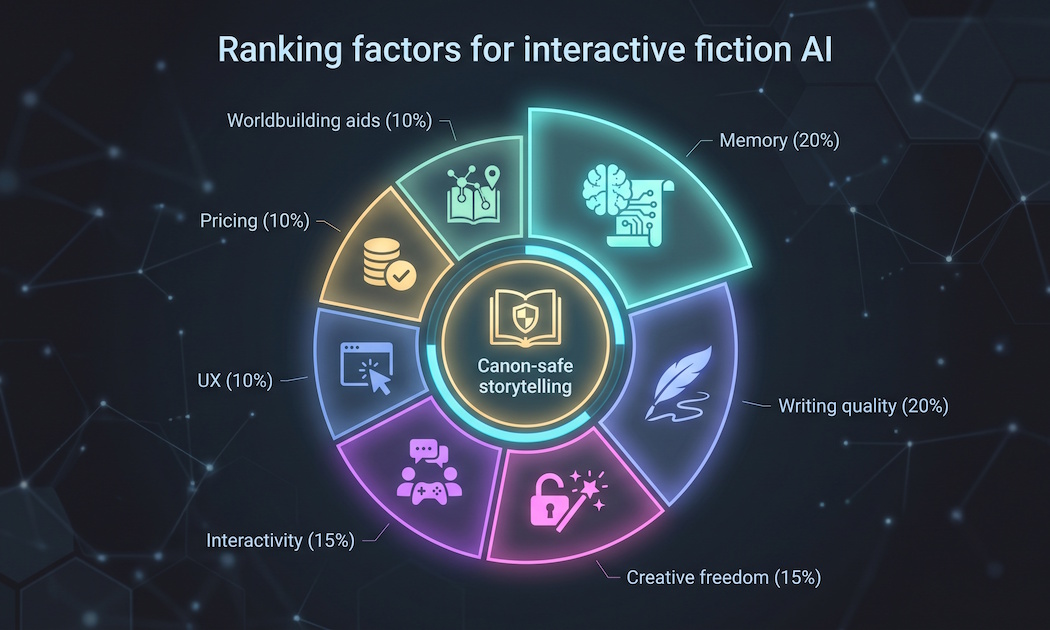
The final ranking puts lore-safe storytelling first and creature comforts second, so “best” means one thing above all: the AI never rewrites the history you’ve already penned.
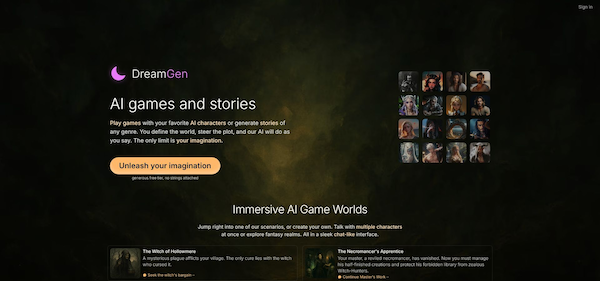
1. DreamGen – Best For Immersive Role-Play With Persistent Lore
Boasting over 1 million registered users and 5,000 Discord members, DreamGen feels less like a chatbot and more like a dungeon master who has studied your campaign bible cover to cover.
Its standout feature is the Scenario Codex, a built-in wiki where you lock in character bios, location histories, and every rule that governs your magic system. Because those notes feed every future prompt, the AI never “forgets” that silver burns werewolves or that the capital sits on a cliff. Draft-centric platforms such as Sudowrite also bundle a Story Bible, but testers found its memory faded once projects grew past novella length and each new revision burned through paid credits. That contrast is why reviewers praise the mix of a larger context window and Codex as “meaningfully better world memory than most hosted tools,” according to MythX.ai.
During a 20-chapter quest, DreamGen quoted an offhand prophecy from chapter three, verbatim, ten hours later. That recall matters when you’re juggling politics, prophecies, and player twists.
DreamGen supports both SFW and NSFW content, so your gritty siege, tender romance, or eldritch horror stays intact; public scenarios remain strictly SFW—same source, same promise.
Its in-house models, including GLM 4.7 and Lucid Max, are tuned for fiction and deliver vivid prose with natural dialogue. If the AI slips, you can edit any turn retroactively, preventing small glitches from snowballing into canon.
Pricing sits in a sweet spot: a generous free tier for weekend writers (about 2,000 RP messages per month on Lucid Base) and a Pro plan that offers 330,000 tokens of context, enough to keep an entire novella in active memory.
If you want an AI co-author that writes, remembers, and respects every law of your world, DreamGen is the clear first pick.
2. NovelAI – Best For Fiction Writers Who Demand Consistency
Think of NovelAI as a quiet co-author who never slips on the details.

Its Lorebook acts like a private encyclopedia: tag a name, location, or rule once, and the AI resurfaces that snippet whenever it sees the trigger. The result is chapter-to-chapter continuity that rivals a human editor. Reviewers sum it up: “Instead of a game loop you get a text editor that continues your prose in your style, with a Lorebook for keeping world and character facts consistent.”
Because NovelAI treats every prompt as literature in progress, the prose stays polished and on-voice. We have watched it mimic noir, epic fantasy, or first-person diary after a single sample paragraph.
Creative freedom is broad. The platform runs an uncensored text model, so you set the themes and tone without sudden filter fades. Privacy is strict: stories live encrypted on your device, a comfort if you plan to publish.
Quality is not free. After a short trial, you will need a subscription, roughly ten to twenty dollars per month. Serious writers see that as cheaper than an editor; hobbyists decide if an always-on muse is worth a streaming service.
If you already maintain color-coded spreadsheets of royal bloodlines, NovelAI will feel like home. It remembers every heraldry symbol, lets you steer the style, and never scolds you for going off-canon.
3. FableAI – Best For Collaborative Campaigns That Don’t Drift
Sometimes worldbuilding is a team sport. FableAI lets everyone pull up a chair, choose a character, and shape the narrative together without loosening the story’s spine.

The platform tracks each decision in a persistent memory layer. When you end a session, your choices are stored as concrete game state—items held, alliances forged, wounds suffered—and surfaced the next time you log in. The company phrases it plainly: AI that remembers.
That promise matters. You can run a months-long campaign, step away for a week, and return to NPCs who greet you by title, not “stranger.” Plot threads pick up right where you dropped them.
Co-op play stays smooth. Each player types actions in turn while the AI handles narration and side characters. Behind the scenes, light RPG logic keeps combat fair and abilities consistent, so no one suddenly sprouts powers that break your lore.
FableAI leans fantasy by default, yet you can import any setting. We tested a homebrew political thriller, and the memory system still tracked every debt, secret, and treaty clause.
There is a daily turn cap on the free tier. Pay once you are hooked. If group storytelling is your jam, the subscription buys you something rare: shared continuity without a human dungeon master guarding canon.
4. Friends & Fables – Best For Full Campaigns With Real Rules
Friends & Fables blends large-language modeling with the Player’s Handbook.

Every narrative beat follows the official D&D 5e rule set: hit points, saving throws, spell slots, the works. If a villain ended last session with 3 HP, the AI cannot restore them to full health without cause, so continuity stays intact.
Memory is built in. The platform compresses each session into long-term storage and retrieves those notes on demand. Reviewers call it “an automated system that compresses and retrieves long-term memories, so campaigns can genuinely run for months without falling apart,” according to MythX.ai.
The flow feels familiar. You and your party type actions, “Franz,” the AI DM, narrates outcomes, rolls virtual dice, and updates the tactical map. Because game state is rule-driven, lore contradictions surface the moment they would break a stat block or spell.
Content policy strikes a balance. Private games permit mature themes up to an M rating, while public modules stay PG-13. That lets you explore darker plots without sudden censor blur.
Cost comes later. A daily free allotment covers one-shots, while longer campaigns shift to a paid tier that costs less than hiring a human DM.
Choose Friends & Fables when you want an always-on storyteller and the reassuring crunch of rulebooks that keep your world logical.
5. Mythx AI – Best For Visual Immersion In Your Story World
Most AI games paint with words. Mythx adds the picture.
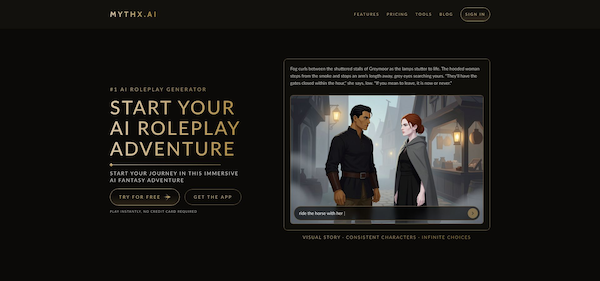
Every scene you play triggers a fresh, AI-generated image that mirrors the text and anchors the lore. Characters keep the same face, scars, and armor from prologue to epilogue, fixing the age-old “wait, weren’t his eyes green?” issue. The team calls it “an image for every scene, with characters that stay consistent.”
The payoff is immediate. When the citadel first appears on screen, spires leaning over a blood-red sea, you and the AI now share one concrete vision. That shared reference cuts down on drift; neither side forgets what the place looks like.
Behind the curtain, Mythx tracks key descriptors as tags. Those tags feed both the text model and the image pipeline, so a raven-haired ranger stays raven-haired whether she is dueling on a bridge or sipping tea in chapter ten. We changed outfits mid-quest, and the AI updated the attire yet preserved her distinct scar and posture in every new picture.
Play flow stays simple. You type an action—pierce an orc or flirt in the tavern—narrative text rolls out, a matching illustration pops in, and you continue. The visuals load quickly enough to keep momentum without staring at wheels.
Memory-wise, Mythx sits between NovelAI and DreamGen: larger than basic chatbots, not as cavernous as DreamGen’s pro tier. What it loses in raw tokens it makes up for with the visual loop; once something is pictured, the AI rarely contradicts it.
You get a free browser tier with daily image credits, then a mid-priced subscription that opens unlimited scenes. If you think in pictures—or your players snooze at text walls—Mythx turns every line of dialogue into a living storyboard you can trust.
Conclusion
The best interactive-fiction AIs honor one rule above all: your canon is sacred. Whether you prize long-term memory (DreamGen), polished prose (NovelAI), shared continuity (FableAI), strict mechanics (Friends & Fables), or cinematic visuals (Mythx), each of these platforms keeps your lore consistent so you can focus on telling unforgettable stories.
About Author
