
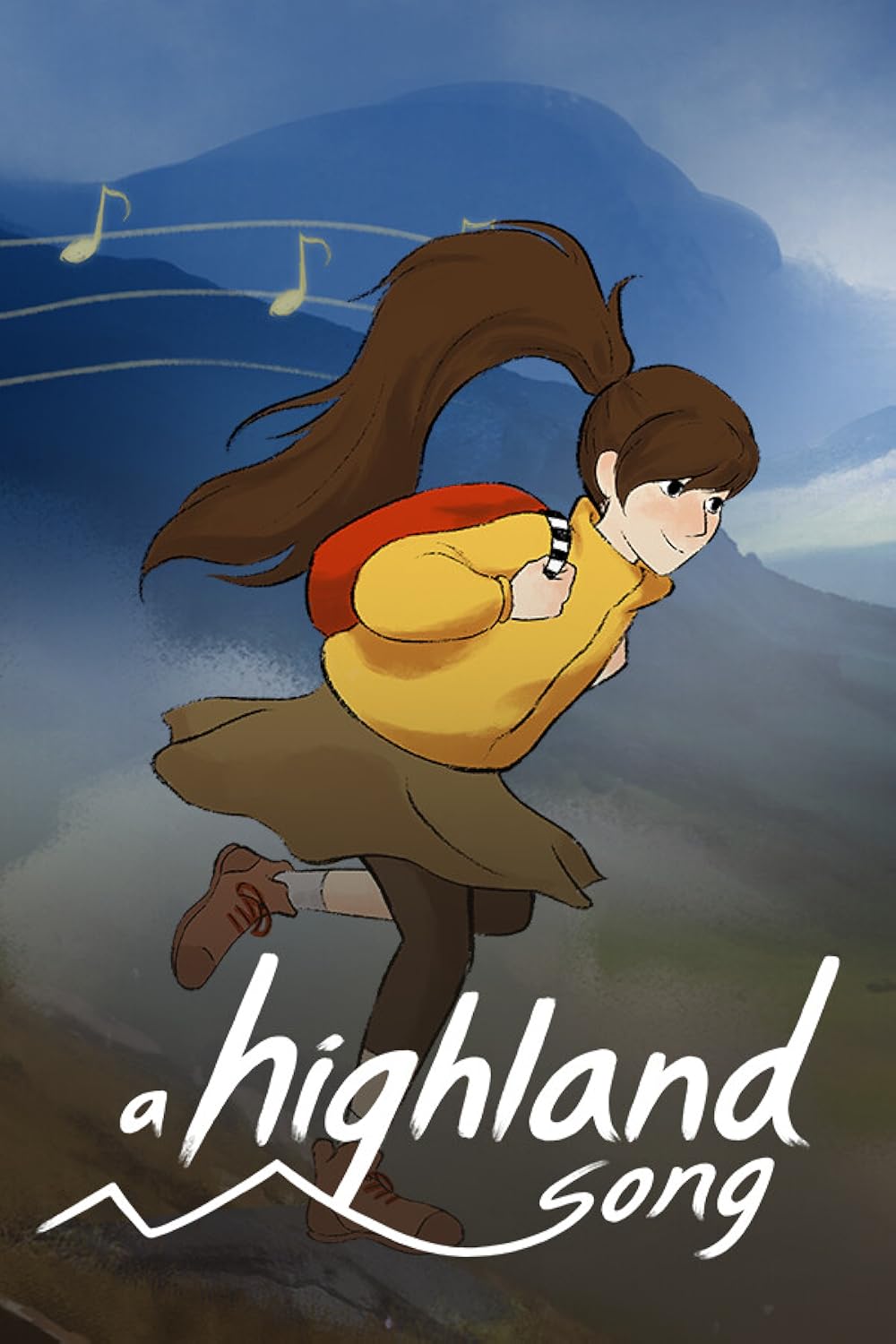
 To describe the game briefly, A Highland Song is something like Dear Esther with gameplay. Dear Esther, if you’ve forgotten, was the first mainstream “walking simulator,” where the player wanders an island and more or less randomly stumbles upon fragments of someone’s letters.
The game, by making its protagonist move at a leisurely pace, encourages players to imagine what these fragments might ultimately form and what actually happened to the characters. But in the end, it still avoids giving a direct answer, leaving the ending open and the details unclear. The letters in Dear Esther are written in a deliberately ornate language, and their aesthetic content outweighs the factual. Personally, I’m even inclined to view the entire game primarily as a work of combinatorial poetry.
Dear Esther and A Highland Song have much in common. First, the setting: the northern Scottish highlands, gloomy skies, wind whistling in your ears, and a lighthouse as the destination of the journey.
Second, the literary focus: even though A Highland Song is far from being Inkle’s chattiest game, there is plenty of text, and it is, as always, from the studio, talentedly written (though the narrative is much more straightforward compared to Dear Esther).
Third, magical realism: in Dear Esther, what happens doesn’t always obey everyday logic, and in A Highland Song, the main heroine, Moira, frequently discovers that local legends and beliefs didn’t arise from nowhere.
Looking for good old classic games and proven hits? You’ll find them all here — play live at Casino Click. A brand players trust.
There are also plenty of differences, and the most striking one is the mood: in Dear Esther, it’s melancholic and depressive, while in A Highland Song, it’s inviting, sweet, and friendly — what in English is called “wholesome.” Additionally, A Highland Song has mechanics beyond walking. On her way to the lighthouse, Moira, risking her health, climbs boulders (mechanically reminiscent of the recent Zelda games) and crawls through caves. On relatively flat terrain, movement turns into a simple rhythm game — you need to press buttons in time while folk music with bagpipes plays in the background.
The only thing better than mountains are mountains you haven’t visited yet.
The key feature of A Highland Song, besides its quality writing and the charming accents of its characters, is how it encourages you to perceive space. To complete it, you need to cross several mountain ranges, finding passes from one to another. You want to do this quickly: Moira is running to her uncle, who asked her to hurry — but there are many available paths, and even if you’re late, nothing fatal happens.
inkle’s games have never focused on difficulty: even if you fall from a great height in A Highland Song, the game simply takes away a few hit points and returns you to the top. Running out of health isn’t a tragedy either, quite the opposite (I won’t go into details – spoilers). So, completing the game from start to finish poses no real problem. But A Highland Song is primarily not about a journey to the end credits at any cost through endless Scottish rain and wind, but about the friends we meet along the way and the peaks we climb.
This mechanic is interesting because it makes you act against typical gaming habits.
Mainstream action games — imagine, say, a recent Tomb Raider — push you to constantly break down on-screen objects into ludic categories: this is cover (it doesn’t matter if it’s a house wall, a boulder, or a crate); these are supplies (collect them for later use); this is a note (read it to better understand the plot); these are collectibles (gathered for trophies); and this tree is just decoration. The functional component of an object overshadows the rest, and anything non-functional gets filtered out. It’s a kind of “Predator vision.”
A Highland Song, on the contrary, suggests scanning the space with “herbivore vision”: taking in as much as possible with your eyes and remembering it, constantly zooming the camera out, because there are no extraneous details in its world — even the smallest details help identify places in the drawings.
Overall, A Highland Song deserves praise for how successfully it breaks itself into layers for completionists. You can finish it in 3–4 hours without much effort, check it off your backlog, and forget about it.
You can aim to meet every NPC and visit every peak – you can’t see everything interesting in one go. To fill your catalogue, Moira will have to run from home to the lighthouse multiple times (the landscape doesn’t change from run to run).
The third level is collecting all the maps and finding out the names of the peaks. On each one, you can also leave an offering – for that, you need to learn the local folklore, understand what items these should be, and find them along the way, for which the game rewards you with more content. You can stop at any stage and at any moment: the mountains aren’t going anywhere.
About Author
