I recently had Amit on the podcast to talk about Edenfrost. You can also read a condensed interview with Amit.
Edenfrost arrives with the kind of confidence you don’t usually see in a creator‑owned debut. From the first pages, it’s clear Amit Tishler isn’t easing into his world so much as opening a door that’s already built. The Russian Civil War isn’t just a backdrop; it’s a living pressure system that shapes every choice the characters make. Tishler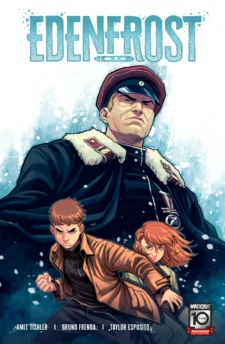 threads folklore, trauma, and the fragile bond between siblings with a precision that refuses to flatten the historical moment. The supernatural element isn’t a genre flourish or a convenient escape hatch. It’s a pressure point, a way of externalizing fear and memory without ever letting the fantasy overwhelm the human stakes. The golem mythology is treated with a seriousness that feels earned, and the emotional weight of the story never gets lost even when the supernatural erupts. Edenfrost understands that magic is most effective when it complicates the world, not when it simplifies it.
Bruno Frenda’s art is the book’s quiet engine. His pages carry a painterly chill, the kind of atmosphere that makes the cold feel like a character pressing in from the margins. There’s a restraint to his storytelling that gives the book its shape. Violence is depicted without glamor, and the supernatural never tips into spectacle. Instead, Frenda leans into mood—smoke, snow, shadows, and the constant sense that the world is collapsing faster than the children can run. His compositions linger just long enough to let the silence between panels do the talking. It’s the kind of visual storytelling that trusts the reader to feel the weight of what isn’t said. The book’s emotional beats land harder because the art refuses to shout. It’s a rare thing in a market that often mistakes noise for intensity.
As a trade, Edenfrost reads like a complete statement. Tishler’s script is tightly paced and uninterested in the usual genre shortcuts. He trusts the reader to sit with ambiguity, to understand that not every question needs an immediate answer, and that the emotional truth of a moment can be more important than the mechanics of the plot. Frenda’s art complements that approach perfectly, giving the story room to breathe without ever losing momentum. The result is a debut that feels personal without becoming insular, and mythic without losing its humanity. Mad Cave has published plenty of strong creator‑owned work, but Edenfrost stands out as one of the line’s most assured entries—a book that knows exactly what it wants to say and how it wants to say it.
About Author
