
Amit Tishler recently joined me on the podcast to talk about Edenfrost, his historical fantasy series from Mad Cave Studios. The comic follows Jewish siblings Alex and Yuli as they flee a pogrom during the Russian Civil War, protected only by a mysterious Golem whose power may be the key to their survival — what follows is a lightly edited transcript of that conversation.
FCF: Welcome back to the podcast. I have a first-time guest, and as always, I want to know your origin story. Amit, what got you into comic books and made you a lifelong fan?
Amit Tishler: I started my career as a production artist. I used to be an animator for TV and for games. If anybody is in traditional animation, comics are almost always the starting point because when you are the kid sitting in the back of the classroom drawing instead of listening to whatever the teacher has to say, you’re not a filmmaker yet, but you have a skill. You’re like, “Hey, I can draw better than other people. I love doing this.” That’s the first touchpoint for you to actually do more, not just drawing random things, but trying to tell stories, and comics is the first medium that inspires you to do it and the one you start practicing because it’s feasible.
I became a comic fan pretty early in life. I’m a multimedia person—TV, animation, film, video games, and of course comic books. I am immersed in everything, and I wear it on my sleeve. Comics were a big passion point also because of where I grew up. Scarcity was always a factor for this medium in my home country There weren’t a lot of places to buy comic books back in the 80s and 90s. Now there are comic bookstores over there, but back in the day, you had to go on one hell of a journey downtown just to get a new issue of Uncanny X‑Men. Thanks to having to work this hard just to get a single issue, there was a sense of ownership and excitement tied to the entire experience.
Professionally, I went into animation. That was the starting point for me in production. But even throughout all my years jumping between animation, video games and new media, comics was always something that I loved, consumed, and interested in. It became an actual career focus pretty late in the game because I took a very bizarre career path—from a production artist to startup co‑founder, to a creative director for interactive entertainment… I went through so many different periods in my professional career and that really expanded my skillset and view of the media landscape. But comics never went away. My focus was always, “I want to tell my own stories.” I’ve gotten shows optioned before, but TV is a tricky beast. Even if you manage to sell something or get it optioned, that doesn’t mean it’s going to get made.
An opportunity eventually showed up for me to get back into my original content creation after me and my co‑founders sold our company, and I went, “Back to foundation, back to origins.” That strategy ended up taking flight, and I’ve been keeping at it ever since.
FCF: How did your upbringing in Israel shape your artistic voice?
Amit Tishler: That is a very complicated question. It is unavoidable that your own personal history or your family’s history will impact your storytelling, but I don’t consider myself someone who leans into tribalism. Edenfrost, my debut book, very much talks about this. I am opposed to accepting identity as something that’s mainly dictated by things you haven’t earned and can’t control. It’s not that these things doesn’t impact who you are, but my point of pride was always, “This is who I am despite or outside of all of these things.”
I never try to force things from my past into my writing. I only tell stories I’m interested in telling, about characters I connect to. I want my stories to have universal appeal. But despite all of that, it doesn’t really matter—my own opinions, my own values and emotional drivers, any friction I’ve had in my life, where I was born, my immigrant story of moving to the West, all of that shaped who I am. I don’t try to actively harness it. I just let it flow into my work naturally.
FCF: Tell the fans about Edenfrost and how you wound up doing it at Mad Cave.
Amit Tishler: I always look for a statement to drive my stories and find an interesting mechanism to make it work. Luckily for me, Mad Cave Studios saw what I was trying to achieve and supported it, which started an ongoing creative collaboration on multiple titles.
Edenfrost was unique because I usually keep my own family history separate from my narrative work. I usually like to delve into things that are more fantastical, but Edenfrost was an exception because I had something to say about the topic of identity. The statement that drove Edenfrost was about the weaponization of identity, and how identity is nothing more than a mental construct. I wanted to warn of how its weaponization can be used to hurt or target any group of people and the entire book was framed around this statement. Identity is a label that’s generally arbitrary and extremely malleable. It is one of the most dangerous philosophical tools that regimes or individuals can use to inflict harm, drive prejudice, or empower themselves, and yet – in modern society we both criticize this result, but work very hard to fuel it. That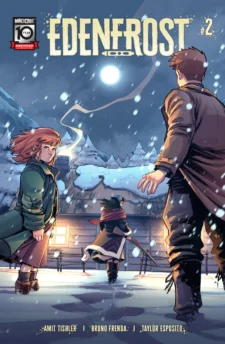 contradiction is very human, and it fascinates me.
I wanted to tackle this topic without being preachy. The easiest way was going back to family history. My grandparents are all Holocaust survivors. Their stories are full of tragedy and trauma, and I wanted to capture a hint of that, but in the context of my own statement. Despite the supernatural elements in it, the story is not religious. There’s a reason the characters are not framed as such. Everything is happening during the Russian Civil War, which I felt was a much closer equivalent to what we are experiencing today in terms of political and social trends than World War II. I picked the pogroms, the battle between the Red Army and the White Army, and the place of the Jewish people of Eastern Europe during that time as the background conflict that sets the world ablaze.
The interesting thing is that a lot of people in the Jewish communities were not religious. They were just like, “Hey, we’re Ukrainian.” Or “Hey, we’re Polish.” And all of a sudden you’re told you are the other. It doesn’t matter how you behave. It’s for others to determine. That is a big part of the character journeys in Edenfrost. The idea that your view of yourself matters less than how others view you. You can feel whatever you want about your own identity, but what truly determines your fate is what the people think. If identity is indeed a mental construct, this notion on its own has serious psychological and societal implications and we, as intelligent behind, have to constantly question that.
FCF: What type of fan would enjoy Edenfrost? And why should superhero‑centric readers give it a chance?
Amit Tishler: Edenfrost tells the story of two kids, Alex and Yuli Low, who are trying to survive the Russian Civil War using the mystical power of a very unique interpretation of what a golem is. Anybody who likes historical fantasy will enjoy it. The vibe and visual fidelity that Bruno Frenda brought to the table is inspired by things like Attack on Titan and Fullmetal Alchemist. It’s very manga‑inspired. If you’re into intense, sometimes dark, emotionally entrenched storytelling, this is for you.
It’s not a superhero story, but it is a powerful one. It’s very character‑driven and its very uncompromising. I built a unique magic system for it, so if you’re thinking “big rocky giant,” you’re in for a surprise, because there’s a lot more to it. If you’re into historical fantasy that doesn’t handhold you, that focuses on thrill, action, tragedy, and emotion, this is definitely for you.
FCF: Tell the fans about the artist and his contribution.
Amit Tishler: Bruno Frenda is a legend. This was one of his earliest projects and it’s still one of the most beautiful books I’ve ever gotten the honor of working on. Bruno is incredible in how he elevated the existing character designs. I tend to be extremely specific in how I write my scripts and design my art guides, so he didn’t have to iterate that much, but the quality and the way he framed drama were always spot on.
Initially, Mad Cave gave me a list of artists. When I saw his work, I thought, “This guy gets me.” He had a Fullmetal Alchemist fan art piece that was gorgeous. He knows how to build strong scenes and strong expressions. He’s the full package—sketch to color. There was an immediate sync. He gets what I want the audience to feel. He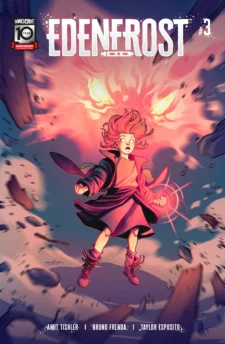 creates powerful moments that are both emotionally written and visually striking. What more could I ask for?
FCF: Mad Cave is different from other publishers. Would you agree?
Amit Tishler: I would absolutely agree. They’re a relatively newer publisher and they’re not afraid to experiment. One of Mark London’s philosophies is that he wants content for everyone—manga, horror, everything. They’re very open to trying unique things. You end up with a diverse collection of works from very different voices. They take creative risks, which is rare. I think they are an important anomaly in this industry and should be cherished and supported for that.
FCF: How do you balance humor and serious work?
Amit Tishler: Sometimes I write solo, sometimes with Elliot Sperl. My range is wide, and I try not to sit on my laurels. I’ve been working in entertainment for more than 15 years, but as a creator, I’m still new. I haven’t been pigeonholed by my own work yet, so I try everything.
Inherently, I like to g pretty dark. I gravitate toward heavy, tragic stories despite being a goofball in real life. But when you’re telling a story, you need to think about the best mechanism to serve them. Sometimes drama is the right way. Sometimes comedy is better. I stick to a “form follows function” philosophy. I ask myself, “What is the best way this message can be conveyed?” and that usually forces me to try different things.
But I do have a signature style. Even in my comedic work, you’ll see bittersweetness, and a hint of uncertainty. I’m not a big fan of closure and my personal sensibilities seep into everything I do, whether it’s comedy or not. I think all of this leads to a pretty healthy way to develop my own creative voice and keep it somewhat consistent across genres.
FCF: Amit Tishler from Edenfrost from Mad Cave Studios, thank you for joining me.
Amit Tishler: Thank you so much.
About Author
