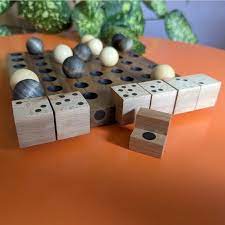
 KNJO proved oddly difficult for both me and my usual abstract-strategy partner, Trevor, to form a firm opinion on. The experience feels like a tale of two games.
On one hand, the edition we tested comes from Wood Ideas (www.woodideas.store), a workshop in Odesa, Ukraine, specializing in wooden games—always a plus in my books. Their catalog offers an impressive range, though so far we’ve only handled KNJO by designer Erick Reyes.
Wood Ideas’ build is solid, though not on the level of the “Cadillac” craftsmanship seen in wooden games from Clemens Gerhards, makers of table showpieces like ConHex, Aronda, Avverso, Flügelrad, and Fendo. Nor is it quite as practical and tightly finished as the smaller wooden productions from David McCord and New Venture Games.
KNJO looks good overall, but the aesthetics are a mixed bag. The board would benefit from beveled top edges, and the black wooden balls are unevenly colored, which is distracting. The magnetic movement cubes, however, are excellent—well-hidden magnets and clean design—and the modernist number symbols add a welcome bit of flair.
As for gameplay, KNJO is another entry in the crowded “make four in a row” category, though it adds some fresh ideas. Each player has six wooden spheres on the board, and movement depends on the numbered magnetic row tiles. Pieces move orthogonally, and—counterintuitively—may revisit the same spaces, a rule that speeds things up but slightly undermines the tactical feel. Holes in the grid add further constraints, while the post-move swapping of two number blocks introduces a clever layer of strategy.
There is freshness here, enhanced by the wooden presentation, but KNJO remains grounded in a genre that’s been thoroughly explored. The result is a game that’s certainly good, occasionally clever, but held back from greatness by the limits of its familiar core.
About Author
Calvin Daniels is a Saskatchewan-born, self-taught journalist. He is currently Editor of Yorkton This Week, with 35-years in the newspaper business.

Wooden Version Adds to the Appeal of KNJO
On one hand, the edition we tested comes from Wood Ideas (www.woodideas.store), a workshop in Odesa, Ukraine, specializing in wooden games—always a plus in my books. Their catalog offers an impressive range, though so far we’ve only handled KNJO by designer Erick Reyes.
Wood Ideas’ build is solid, though not on the level of the “Cadillac” craftsmanship seen in wooden games from Clemens Gerhards, makers of table showpieces like ConHex, Aronda, Avverso, Flügelrad, and Fendo. Nor is it quite as practical and tightly finished as the smaller wooden productions from David McCord and New Venture Games.
KNJO looks good overall, but the aesthetics are a mixed bag. The board would benefit from beveled top edges, and the black wooden balls are unevenly colored, which is distracting. The magnetic movement cubes, however, are excellent—well-hidden magnets and clean design—and the modernist number symbols add a welcome bit of flair.
As for gameplay, KNJO is another entry in the crowded “make four in a row” category, though it adds some fresh ideas. Each player has six wooden spheres on the board, and movement depends on the numbered magnetic row tiles. Pieces move orthogonally, and—counterintuitively—may revisit the same spaces, a rule that speeds things up but slightly undermines the tactical feel. Holes in the grid add further constraints, while the post-move swapping of two number blocks introduces a clever layer of strategy.
There is freshness here, enhanced by the wooden presentation, but KNJO remains grounded in a genre that’s been thoroughly explored. The result is a game that’s certainly good, occasionally clever, but held back from greatness by the limits of its familiar core.
About Author
Calvin Daniels
Calvin Daniels is a Saskatchewan-born, self-taught journalist. He is currently Editor of Yorkton This Week, with 35-years in the newspaper business.
See author's posts