
I have been a TwoMorrows fan since—well, pretty sure– when it all began back in the late ’90s. And I often cover the latest TwoMorrows ’ publications over in my regular column. But this time I switched it up because I’m delving into some fantastic comic book history.
Many fans are fine with reading whatever new comics come out every week and dipping into back issues, without looking—so to speak—under the hood. I think those fans are missing out by not delving into what makes comics what they are today and then.
Recently, I started talking comics with someone who knew nothing about them, and for about twenty minutes, like a monkey on a banana high, I rattled off comic lore. I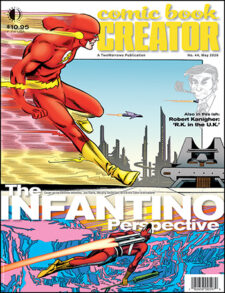 can go on endlessly about comic book history, but I can’t remember where I set my car keys ten minutes ago! Go figure!
I tend to take a different approach to my comic lore: I don’t often take sides on anything. Instead, I try to encourage fans to think outside the box by offering a different perspective. While I do believe fans have every right to have their opinions, I just want them to see different sides. Like many things in life, comic history and the creators who made comics what they are today are not always black-and-white.
Take Carmine Infantino, about whom, literally, books have been written. One could go on endlessly about his massive contributions not only to DC Comics but to the industry as a whole. For episode 188, Ross Aitken from Stop! Let’s Team Up! Podcast joined me to discuss his tenure as publisher of DC during the 1970s. I liked what we did with the show; I used it as the first episode of my spin-off podcast, Comics Fantastic History.
So, when the latest issue of Comic Book Creator 44 came out—with a focus on Infantino—of course, I had to pick it up! I give John Morrow tons of credit: he has the best editors around, and he puts out some fantastic magazines! I had editor Jon B. Cooke on the show last summer—and a bunch of TwoMorrow’s people, including John Morrow himself! Those shows are still worth a listen!
In his intro to the issue, he stated: “About the Carmine Infantino section, herein, I gotta be honest and say I had hoped to write an in-depth essay on the man’s tenure as editorial director and then publisher of DC Comics between 1967-76, but I recognize the subject is just too big to condense into this issue along side the “Nuff Said” interview. I think you could expand that into ANYTHING, Infantino!
What makes this interview especially unique is that it was part of a 2000 radio show that aired for four hours. (Note to self: look online to see if the full interview is out there, because this is something I would gladly spend 4 hours on!) It was condensed down into this issue and is nearly 30 pages long! Comic book nirvana for this comic book geek. And, yes, I did learn a few new things about one of the most iconic legends in comic books.
The issue, at a whopping 84 pages (How does Cooke do it?), isn’t all Infantino! The issue doesn’t only go back into the past, with a nice piece on Joe Hill—that’s only part one of the interview! There’s an interview with Jack Katz, who did the iconic classic The First Kingdom—a comic I need to find and read. It’s that good!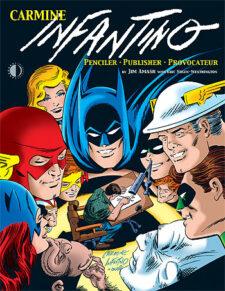
Wait! Yes, there’s even more! If you thought you knew everything about Dave Cockrum—I bet you didn’t know there was an interview with him about his Aurora Model Kit art. The same goes for the Robert Kanigher piece, which is something very cool. You’ll have to read the issue to find out exactly what makes it so cool! Again, hats off to Cooke for putting out another fantastic issue! It’s one of my favorite magazines to read, and I always look forward to the latest issue. Check it out: Pretty sure you’ll be hooked yourself!
Two Morrow even has a book on Infantino that will exceed any fan’s expectations when delving into this icon. Carmine Infantino: Penciler, Publisher, Provocateur is a reminder of just how much one creator can shape the direction of an entire medium. Infantino wasn’t just the artist who helped define the sleek, modern look of the Silver Age — he was the architect behind the visual language that made The Flash, Batman, and DC’s 1960s renaissance feel fast, stylish, and unmistakably new. The book digs into that legacy with the kind of depth only TwoMorrows attempts anymore, tracing Infantino’s evolution from boundary‑pushing penciler to DC’s publisher, where he championed experimentation, bold design, and a willingness to shake the industry out of its complacency. It paints a portrait of a creator who wasn’t afraid to provoke, challenge, and reinvent and, in doing so, reminds readers that the history of comics isn’t just built on characters — it’s built on the visionaries who refused to let those characters stand still.
About Author
