This is a game where writing a review has been rather challenging.
On the one hand, this is not a particularly great game.
There are many abstract strategy games, and this one is just not that deep, with forced capture decisions often seeming too limited.
However, there is also the history of Kolowis Awithlaknannai (Stone That Kills).
The game is of unknown origin in terms of when it was created, but it is a game of the Zuni Indians of New Mexico.
Board Game Geek dates the game at around 1500, but how accurate that might be is unclear. The version of Stone That Kills that is being reviewed here is from
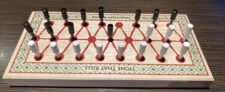
www.newventuregames.com, and is a two-player strategy game that is of interest in large part due to the roots of this game being in a North American First Nation dating back centuries. As you move your pieces, you can’t help but think that others were playing the same basic game in front of a native lodging so many years in the past. There is something rather gratifying as a gamer to know that a hobby enjoyed today has been part of North American history for so long.
It is the heritage of this one that makes this game worth having.
Now, in this case, you have a nice wooden board and pegs in a small size, so it will look nice on the desk, and it is compact enough to take on road trips.
The small rule set provides a bit of background on the game that is interesting, too.
“The game is very similar to Checkers (draughts) and the Alquerque family of games because pieces hop over one another to capture them. It is thought that the Spanish had brought Alquerque to the American Southwest in the 1500s, and the natives were inspired to create their variation more linearly.”
The play here is simple.
“Each player has a set of 12 pegs of a distinct color, and these pegs begin the game filling the holes on each side of the board and then in from the right end on the center row. The result is that each side and half the center row is all one color of pegs, and the center hole is unoccupied,” details the rules.
“Players take turns either moving a peg or jumping an opponent’s peg to capture it.”
Early in a game, moves are limited and often forced, so you are battling for the best position mid-game to lead to late-game dominance.
This would not be a game one could recommend in the face of some many modern abstract strategy games, but thanks to its history, it is a game you are likely to enjoy having.
About Author
Calvin Daniels is a Saskatchewan-born, self-taught journalist. He is currently Editor of Yorkton This Week, with 35-years in the newspaper business.

There is a charm in exploring heritage games
About Author
Calvin Daniels
Calvin Daniels is a Saskatchewan-born, self-taught journalist. He is currently Editor of Yorkton This Week, with 35-years in the newspaper business.
See author's posts