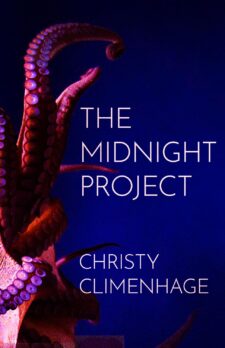
The Midnight Project is the debut novel from Canadian author Christy Climenhage.
In some respects, a reader might expect a debut to be quite good simply because the author has had near-unlimited time to formulate their ideas and get them onto the page before the book ever hits a bookstore shelf. In this case, Climenhage absolutely aces the effort. This is particularly gratifying because she has created a thoroughly credible sci-fi storyline.
The core idea here is not entirely new. The book takes place on Earth in the not-too-distant future, at a time when humankind has basically botched things beyond the point of no return. Climate change is ravaging the planet, key pollinator bees are going extinct, and a fierce, bio-engineered species is infesting urban streets. It is a mess that, given current circumstances, seems all too realistic—even though Climenhage writes vaguely regarding the hard science of the future and how exactly things derailed.
But in the face of a pending global collapse, a man of unlimited resources convinces a couple of scientists to create a new species—one that is human at its core—capable of living in the deepest trenches of Earth’s oceans.
Reading this, I was reminded of a presentation I covered years ago. Around the year 2000, I listened to Dr. Lowell Catlett, a futurist and economist from New Mexico State University. Catlett titled his presentation, “The Future is So Bright You’re Going to Need Shades.” In it, he talked about a future where farmers might raise goats with high-value cheetah skins thanks to bio-engineering. My sci-fi-loving side has long held onto that thought, and in a fundamental way, The Midnight Project builds on that exact concept.
Again, Climenhage doesn’t bog the story down with dense, speculative science detail. This is less about the technical “how” and more about what might be possible when wrapped in a disturbing reality: humankind tends to be greedy. We tend to think more of ourselves today than about a future for everyone tomorrow. When things seem too good to be true, you usually have to watch out for the bogeyman looking to get rich and save only himself.
So, when science succeeds, will it actually be allowed a future? Therein lies the central question of The Midnight Project, and it makes for a wonderfully compelling story.
If you are looking for dense, hard sci-fi, this book might not be for you. But if you want a story that asks urgent questions about our current trajectory—questions we need to be finding answers to today—then this one is a fine choice.
About Author
Calvin Daniels is a Saskatchewan-born, self-taught journalist. He is currently Editor of Yorkton This Week, with 35-years in the newspaper business.

The Midnight Project
The Midnight Project is the debut novel from Canadian author Christy Climenhage.
In some respects, a reader might expect a debut to be quite good simply because the author has had near-unlimited time to formulate their ideas and get them onto the page before the book ever hits a bookstore shelf. In this case, Climenhage absolutely aces the effort. This is particularly gratifying because she has created a thoroughly credible sci-fi storyline.
The core idea here is not entirely new. The book takes place on Earth in the not-too-distant future, at a time when humankind has basically botched things beyond the point of no return. Climate change is ravaging the planet, key pollinator bees are going extinct, and a fierce, bio-engineered species is infesting urban streets. It is a mess that, given current circumstances, seems all too realistic—even though Climenhage writes vaguely regarding the hard science of the future and how exactly things derailed.
But in the face of a pending global collapse, a man of unlimited resources convinces a couple of scientists to create a new species—one that is human at its core—capable of living in the deepest trenches of Earth’s oceans.
Again, Climenhage doesn’t bog the story down with dense, speculative science detail. This is less about the technical “how” and more about what might be possible when wrapped in a disturbing reality: humankind tends to be greedy. We tend to think more of ourselves today than about a future for everyone tomorrow. When things seem too good to be true, you usually have to watch out for the bogeyman looking to get rich and save only himself.
So, when science succeeds, will it actually be allowed a future? Therein lies the central question of The Midnight Project, and it makes for a wonderfully compelling story.
If you are looking for dense, hard sci-fi, this book might not be for you. But if you want a story that asks urgent questions about our current trajectory—questions we need to be finding answers to today—then this one is a fine choice.
About Author
Calvin Daniels
Calvin Daniels is a Saskatchewan-born, self-taught journalist. He is currently Editor of Yorkton This Week, with 35-years in the newspaper business.
See author's posts