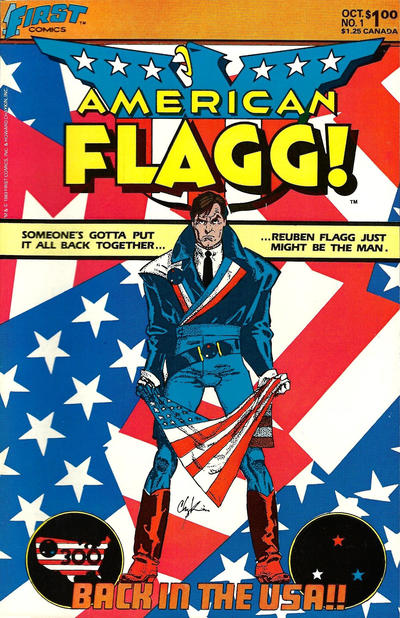
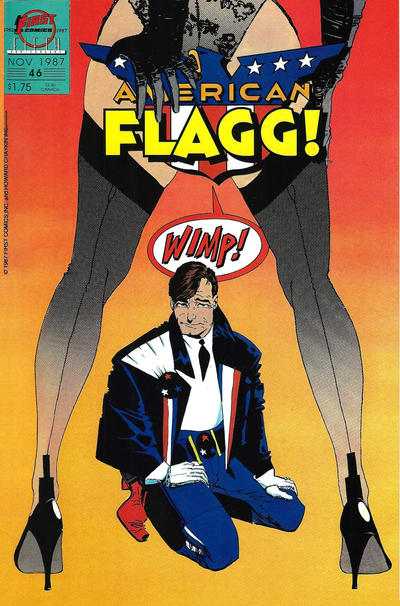
 American Flagg! was conceived ground-up for First Comics in Evanston, Illinois. Launched in October 1983, it served as First’s star title.
Chaykin, along with letterer Ken Bruzenak and colorist Lynn Varley, used the title to experiment with radical graphic design:
-
Dense Layouts: Heavy narrative density featuring background TV dialogue, tickers, advertisements, and overlapping panels.
-
Integrated Lettering: Bruzenak’s dynamic sound effects and logos were drawn directly into the background art rather than pasted over it.
-
Predictive Satire: A scathing critique of Reagan-era consumerism, corporate media manipulation, and cable TV proliferation.
Chaykin handled writing and art duties solo for the legendary first 12 issues. Due to the grueling monthly workload, he later brought on guest artists and writers (including Alan Moore, J.M. DeMatteis, and Steven Grant). The original series ran for 50 issues through 1988, followed by a 12-issue sequel run (Howard Chaykin’s American Flagg!) before First Comics shuttered.
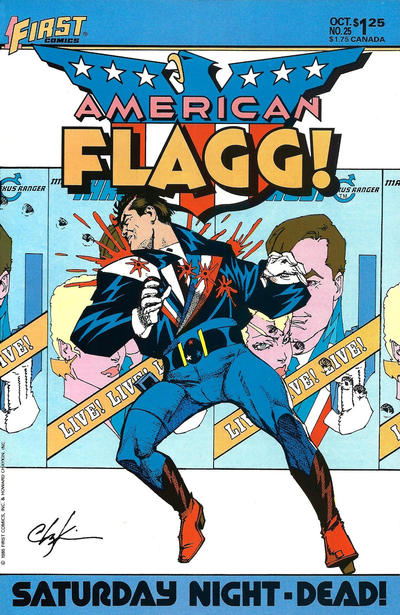 The series takes place in a gritty, dystopian near-future:
-
The Domino Year (1996): A series of worldwide geopolitical and environmental collapses forced the U.S. government and corporate elites to abandon Earth and set up shop on Mars.
-
The Plex: What remains of the United States on Earth is owned and operated by The Plex—an all-encompassing mega-corporation that manages the population through mega-shopping malls (“Plexmalls”), weaponized consumerism, legal violence, and tranquilizing media broadcasts.
-
Plexus Rangers: The corporate-funded militia tasked with keeping order, enforcing state-sponsored commercialism, and policing street violence.
The protagonist, Reuben Flagg, is a former television star. He spent years playing “Mark Sunrise,” the star of a hit video show, until he turned 30 and was replaced by a smoother, non-aging computer hologram.
Losing his deferment, Flagg is drafted into the Plexus Rangers and assigned to Mall Metroplex Chicago—one of the most chaotic, corrupt assignments on Earth.
| Trait / Feature | Details |
| Personality | Naively patriotic, charming, cynical, and an unabashed womanizer. |
| Aesthetics & Tastes | Loves 1930s jazz, classic cinema, and old-school heroism in a world that has forgotten all three. |
| Combat Ability | Expert marksman, tactical pilot, and former stuntman. |
| Sidekick | Raul, a talking, sapient housecat equipped with cybernetic gloves that give him opposable thumbs. |
At its core, American Flagg! is a high-octane mix of cyberpunk sci-fi, hardboiled noir, and media-driven political comedy.
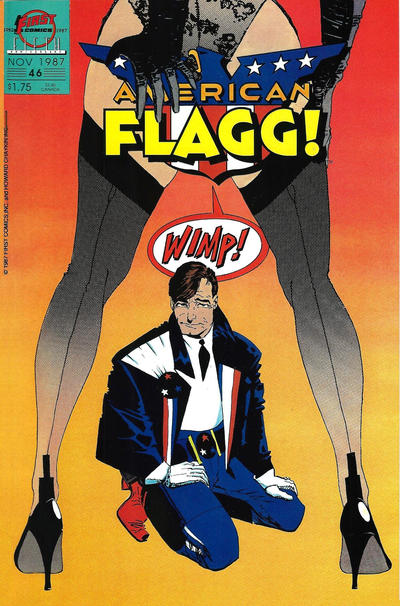 Upon arriving in Chicago, Flagg realizes that the weekly riots and gang wars tearing the city apart aren’t random—they are intentionally instigated by subliminal signals hidden inside Plex television broadcasts to drive up weapon sales and keep the populace addicted to fear.
Flagg inherits an illegal pirate television network, Q-USA, from a murdered resistance leader. Using Q-USA, Flagg hijacks the airwaves to broadcast uncensored movies, real sports, and propaganda-busting truth, slowly dismantling the corporate stranglehold on the public’s minds.
Unlike traditional squeaky-clean heroes, Flagg constantly finds himself embroiled in complex love triangles with the dangerous, powerful women running Earth—including Mandy Krieger (a brilliant technician), C.G. Markova (a lethal jet pilot), and Gretchen Holstrum.
American Flagg! proved that mainstream comic books could handle sophisticated political commentary, adult sexuality, and complex, non-linear graphic storytelling. Creators like Warren Ellis, Brian Michael Bendis, and Frank Miller have frequently cited Chaykin’s work on the series as a primary inspiration for the modern era of comic storytelling.
About Author
