
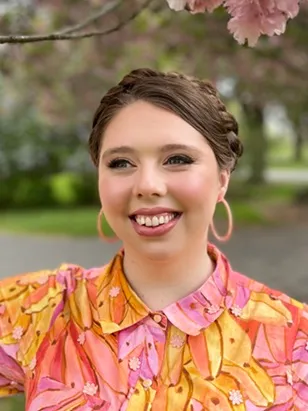
First Comics News: Why do a reimagining of Medusa?
Grace DeSmarais: There has always been an innate part of myself that has been fascinated by maligned women of mythology. I used to read and reread Rebecca Guay’s Goddesses: A World of Myth and Magic, as well as collections of myths. I would use the pictures to tell my own stories to my little sister.
In my college days, there used to be (and I am sure still is) a popular meme of Medusa/Blind Woman that would get reblogged everywhere. That meme always lingered in the back of my mind as an angry queer young woman obsessed with mythology.
When I realized there was no full-length graphic novel about them, I knew I had to try to make one. I was tired of tragic queer stories, and I was exhausted by the continued depictions of Medusa in which Perseus always murders her.
I wanted to make something different. More importantly, I wanted to make a book that was a love letter to my fifteen-year-old self. Medusa as a character was the natural fit.
1st: Who is Cyrene?
Grace: Cyrene (sy-ree-nee) is an original character.
For Medusa’s love interest, I wanted a name that was not already so deeply associated with another Greek myth as to be distracting. However, I also wanted a name with meaning, something to be an Easter egg for those passionate about history and classics.
I chose Cyrene because it is the name of both a Thessalian princess-turned-queen and an ancient Greek colony.
Princess Cyrene was a huntress as well as a ruler. She is mentioned in a few classical works, but nothing so obvious as to distract a contemporary reader.
The city of Kyrene (Latinized to Cyrene) is located on the northern tip of modern Libya. It was a principal city in the Hellenistic world, demonstrating the great reach of Greek culture and colonization across the Mediterranean.
The name is the best of both worlds.
 1st: Why do Medusa and Cyrene fall in love?
Grace: I’d hate to spoil the book!
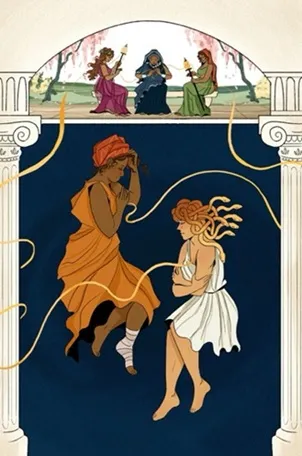
What I can share is that I use a golden thread motif to illustrate the kind of indescribable feeling of connecting with someone you barely know. That innate pull that transcends explanation.
1st: Is Perseus the hero or villain in this book?
Grace: We are all familiar with Perseus as a hero. I was completely uninterested in perpetuating his idealized masculine triumph.
He is an amalgam of men I have met in my own life. The kind of men who believe the ends justify the means. I like to think that his ending is a familiar one to many women.
1st: Why will readers love the character of Medusa?
Grace: I hope readers will love her because she captures what it feels like to be trapped by circumstance and fear. Through the story, she sheds her past to move toward her own joy.
This is a reclaiming of Medusa’s tragedy into a sweet romance, one that hopefully resonates.
1st: Why did you decide to use Greek mythology over some other mythology?
Grace: Medusa is in Greek mythology. The two are intrinsic to one another. That’s the primary reason.
The second is that I am most familiar with Greek and Roman mythology. I had a variety of illustrated mythology books as a child and teen. I was immersed in Greco-Roman canon before any other. As many authors have said before, you write what you know.
 1st: What is your favorite genre to write and draw, and why?
Grace: Fantasy is my favorite genre to read; thus, there was a natural appeal to creating work in the space.
In terms of what excites me to draw, I’ve always had a passion for history and specifically art history. Using reference and research materials helps me bring the project to life.
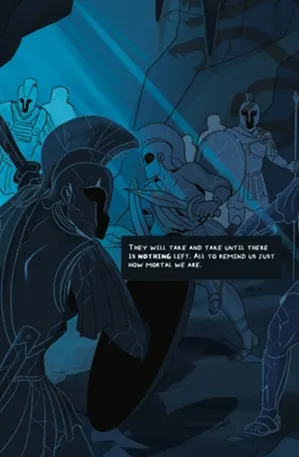
In Song for Medusa, I studied Pre-Raphaelite paintings, classical sculpture, and Hellenistic architecture, which made the process of creation so much richer. All of it is scaffolding for the visual tone of the book.
1st: What one published work of yours are you most proud of?
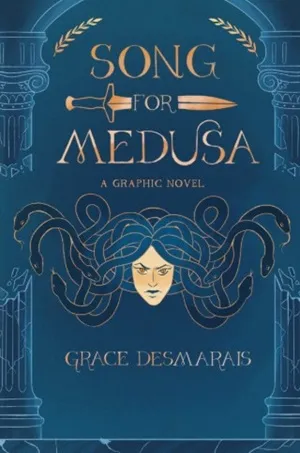
Grace: Right now, it’s Song for Medusa. This is my debut book. I had the idea in my head since 2022, when I released a mini-comic version. Now it’s here. A full graphic novel.
This book is only the beginning. I want to get better. Write more complicated stories. For now, though? I can’t imagine being prouder of anything else I’ve made.
 1st: What is Cat Campaign?
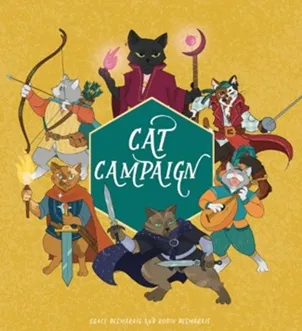
Grace: Cat Campaign is a role-playing game where players embody cats trying to rescue their bumbling humans.
I collaborated with my husband, Robin Desmarais, to create a simpler dice system that is accessible to younger players. Cat Campaign is a great entry-level RPG for those young gamers who aren’t quite ready for Dungeons & Dragons but really want the experience of dice and improvisational storytelling.
1st: Why should someone join your newsletter?
Grace: The newsletter is designed for cartoonists of all skill levels and abilities to find interdisciplinary arts opportunities. I collate a curated list of submissions, grants, residencies, and resources into one monthly newsletter. I do not use AI for any of the newsletter.
It’s based on another newsletter that I subscribed to early in my career that helped me get started in comics.
If you are an aspiring cartoonist reading this, I’d recommend it.
1st: How do you feel about cats?
Grace: I love all animals. I have a special fondness for my first tiny black cat, Lala. She lived until she was twenty-six. She was the daintiest little kitty you’ve ever met. She was my familiar, and I still don’t think I’m ready for another cuddly companion. Yet.
1st: Is romance, or should it be, an important part of life?
Grace: I think everyone has different values regarding romance.
For me, romance is an important part of my life. My relationships, both past and present, inspire much of my work. The stories I read to unwind are romance novels. The fan fiction I write when I am in a creative funk is relationship-based.
I believe much of life is learning how to connect with the people around you. Romance and the intimacy that can bloom in relationships, both platonic and otherwise, are worthwhile pursuits.
 1st: What is the most magical thing that has happened to you?
Grace: Writing, illustrating, and publishing a book is pretty magical.
It’s a bizarre experience to spend nearly four years thinking about an idea, then spend two years actually sitting down to write and draw that story. Finally holding that book is transcendent.
To be on the other side of a debut graphic novel is a flurry of emotions. The word magic encapsulates them all.
1st: What advice do you have for your many fans?
Grace: For those aspiring to be cartoonists, I’d say to keep drawing no matter the amount of rejection. Part of the creative process, regardless of the medium, is about resilience.
When I first started in comics, it was so hard to find opportunities. I remember spending hours digging online and applying desperately to festivals. The newsletter I’ve made is my way of paying back this vibrant community. If you are an aspiring cartoonist, the newsletter is there for you, and I believe in your journey too.
About Author
