
 During the 1980s, independent comic book publishers were challenging the dominance of Marvel and DC Comics by introducing new characters, innovative storytelling, and material aimed at older audiences. First Comics was among the leaders of this movement, publishing memorable titles such as American Flagg!, Nexus, Badger, Grimjack, and Jon Sable, Freelance. Among its more unusual offerings was Whisper, a gritty action series featuring a female ninja operating in a dangerous world of espionage, organized crime, violence, and betrayal.
Created by writer Steven Grant and artist Rich Larson, Whisper combined martial arts action with elements of crime fiction and psychological drama. At a time when female superheroes were frequently defined by their relationships with male heroes, Whisper was the central figure in her own complicated and often brutal adventures.
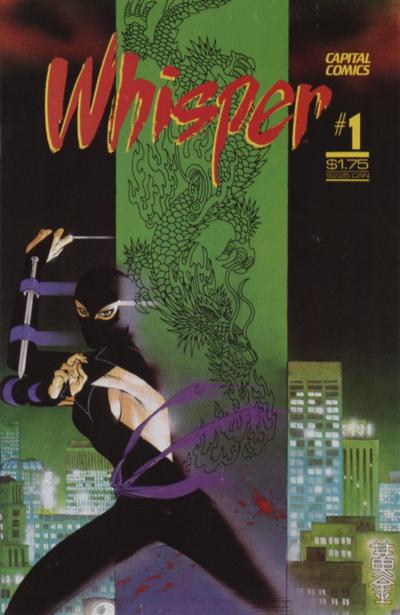
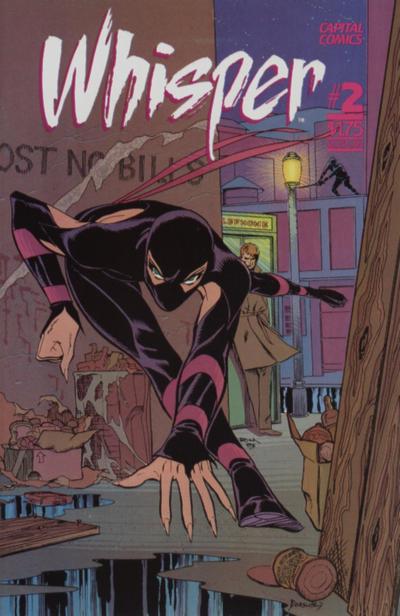
Whisper made her debut in 1983 through Capital Comics, the independent publisher responsible for introducing Nexus and Badger. Unfortunately, Capital’s publishing operation collapsed after releasing only two issues of Whisper, leaving the character’s adventures unfinished.
First Comics subsequently picked up the property, bringing Grant and Larson’s creation back to readers in the 1985 Whisper Special. The oversized one-shot included a recap of the earlier adventures and a substantial new story, allowing readers to become acquainted with the character.
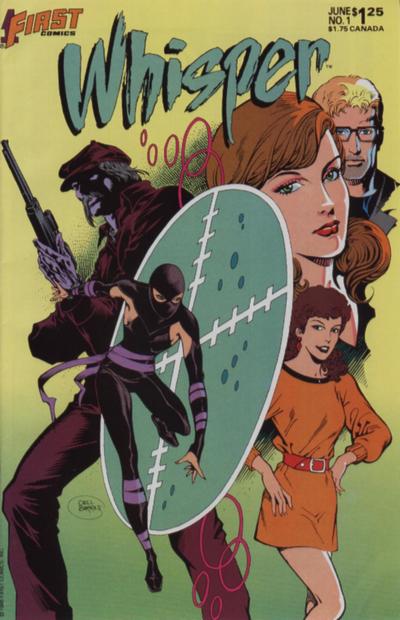
 Whisper then appeared in First Adventures, an anthology that also featured Dynamo Joe and Blaze Barlow and the Eternity Command. These appearances helped establish the character with First Comics readers before the publisher launched a new ongoing Whisper series in June 1986.
Behind the mask of Whisper is Alexis Devin, a highly trained martial artist whose life becomes entangled in a dangerous world of secret organizations, professional killers, and criminal conspiracies.
Unlike traditional costumed superheroes, Whisper possesses no superhuman abilities. Her greatest weapons are her training, agility, intelligence, and willingness to do whatever is necessary to survive. She relies on stealth, hand-to-hand combat, and an assortment of weapons rather than fantastic powers.
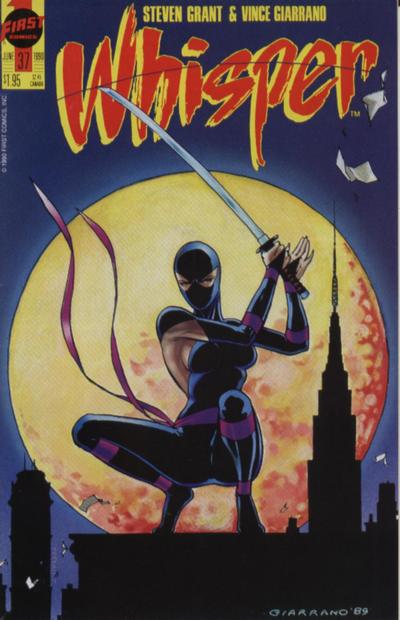
Her distinctive black costume, accented with purple, makes her instantly recognizable. Yet beneath the mask is a complicated woman who must navigate a world in which trust can be fatal and the distinction between allies and enemies is not always clear.
What makes Whisper particularly interesting is that she is not presented as an invincible crimefighter. Her adventures have consequences, and the violence surrounding her frequently carries a personal cost.
The character belongs more to the tradition of espionage thrillers and martial arts adventure than the brightly colored superhero stories dominating the comic book market. While her costume might suggest a superhero, the situations she encounters are considerably less forgiving.
 Writer Steven Grant brought considerable experience to Whisper. His credits included work for Marvel Comics, where he collaborated with Mike Zeck on the influential 1986 Punisher limited series.
Grant’s interest in crime, violence, and morally complicated protagonists made him particularly well suited to Whisper’s adventures. Rather than relying exclusively on elaborate battles between heroes and villains, he developed stories involving intrigue, manipulation, personal relationships, and the consequences of living a dangerous double life.
One of the more distinctive aspects of Whisper was its willingness to explore the psychological effects of violence. Alexis Devin was not simply a masked adventurer who defeated criminals and returned to an ordinary life. Her experiences shaped her personality, relationships, and understanding of the world around her.
This approach helped separate Whisper from the growing number of ninja-themed characters appearing throughout popular culture during the 1980s.
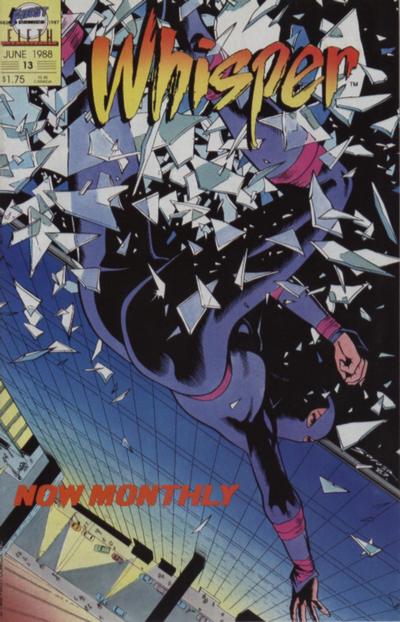 Although Rich Larson helped establish Whisper’s original appearance, the ongoing series featured several talented artists who brought different approaches to the character.
Norm Breyfogle, who would later become widely recognized for his work on Batman, illustrated several early issues. His expressive figures and energetic action sequences were particularly appropriate for a series built around martial arts.
Other artists associated with the series included Dell Barras, Steve Epting, and Vince Giarrano. Epting, who later became known for his work on Captain America, helped bring a cinematic quality to the later adventures. Giarrano illustrated the final storyline, World Gone Crazy.
The changing artists gave the comic different visual identities while Grant’s scripts maintained a consistent sense of danger and uncertainty.
The 1980s witnessed an explosion of interest in ninjas across American popular culture. Martial arts films, television programs, toys, and comic books all embraced the mysterious assassins of Japanese legend.
Marvel Comics had Elektra, while independent publishers introduced their own interpretations of the masked martial artist. Whisper entered this crowded field with a distinctive approach.
Although martial arts remained central to the series, Grant increasingly incorporated political conspiracies, intelligence operations, criminal organizations, and psychological conflict. Government agencies were not necessarily trustworthy, and the people claiming to represent law and order could be every bit as dangerous as the criminals Whisper encountered.
 Alexis’s personal life was equally turbulent. Her relationship with Kirk Mallinder and her friendship with Lesa Lorenson provided connections to a world beyond the mask, but those relationships were threatened by the dangerous circumstances surrounding her.
As the series progressed, Alexis adopted the identity of Diane Young, illustrating how thoroughly her experiences had transformed her life.
These developments made Whisper something more ambitious than a conventional action comic. It was a story about survival, identity, and the difficulty of escaping a violent past.
First Comics published 37 issues of the ongoing Whisper series between June 1986 and June 1990, an impressive run for an independent title that had already survived the collapse of its original publisher.
The series concluded with issue #37, featuring the final chapter of the five-part storyline World Gone Crazy. Written by Steven Grant with artwork by Vince Giarrano, the concluding issue was titled First, We Take Manhattan.
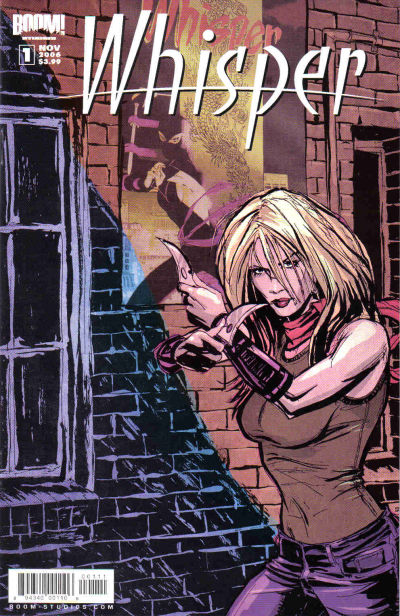
Whisper returned to comic book stores in November 2006 when BOOM! Studios published a single-issue revival of the character. Written by original series creator Steven Grant, with artwork by Jean Jacques Dzialowski, colors by Sunder Raj, and lettering by Ed Dukeshire, Whisper #1 featured a 22-page story titled “Hydrophobia.” The issue brought back Dyan Young, the mysterious martial artist and vigilante who had previously appeared in the pages of First Comics. Featuring a cover by Kody Chamberlain, the $3.99 comic was published as a one-shot rather than the beginning of an ongoing series. Although the BOOM! Studios revival never continued beyond its debut issue, it demonstrated that Grant’s creation still had life beyond her original 1980s adventures.
While Whisper never achieved the widespread recognition of some of First Comics’ better-known properties, it developed an identity of its own within the independent comics movement.
Looking back, Whisper represents an interesting period when independent publishers were willing to experiment with genres and storytelling approaches that did not always fit the traditional superhero formula.
 The series combined the popularity of martial arts action with the darker themes of crime fiction and political thrillers. It also demonstrated that a female lead could carry an extended, action-oriented comic book series without relying on an established superhero franchise.
For readers interested in the history of First Comics, Whisper deserves a place alongside Grimjack, American Flagg!, Nexus, and the publisher’s other groundbreaking titles.
Its combination of memorable characters, accomplished artwork, and Steven Grant’s uncompromising storytelling makes it a fascinating example of the creativity that characterized the independent comic book industry during the 1980s.
More than four decades after her debut, Alexis Devin remains a reminder of an era when independent comics were pushing boundaries, exploring different kinds of heroes, and proving that compelling adventures did not always require superpowers.
Whisper might not be the most famous character to emerge from First Comics, but her adventures are well worth rediscovering.
About Author
