
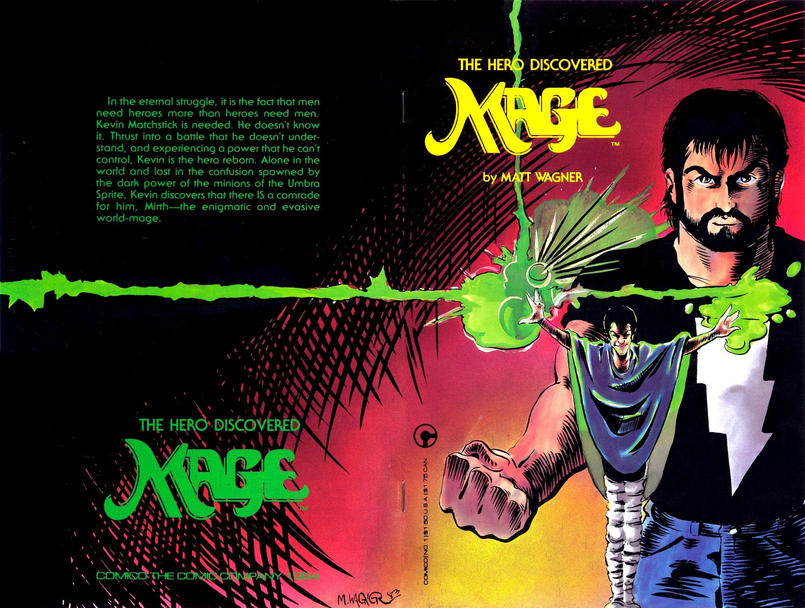
 When discussing the great independent comics of the 1980s, MAGE deserves a place near the top of the list. Created by Matt Wagner, the series blended superheroes, Arthurian legend, urban fantasy, mythology, and autobiography into something that felt unlike almost anything else being published at the time.
At the center of it all is Kevin Matchstick, an ordinary man who slowly discovers that there is nothing ordinary about him.
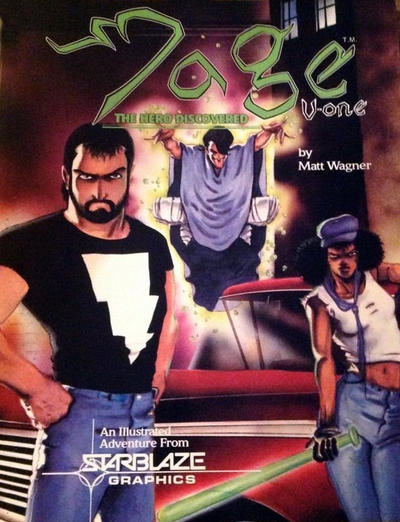
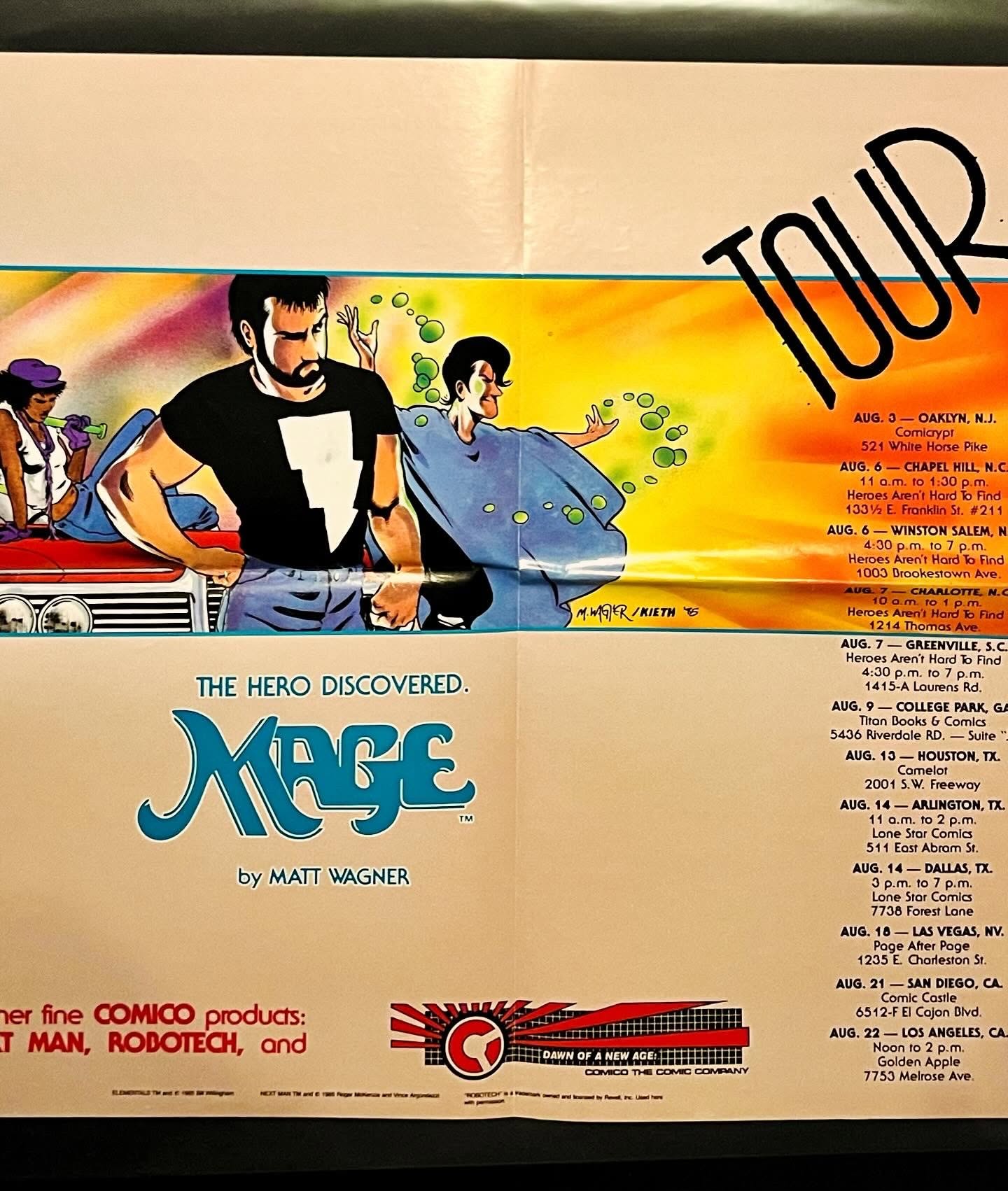
First published by Comico in 1984, Mage began as a 15-issue limited series later known as MAGE: THE HERO DISCOVERED. The original series ran from May 1984 through December 1986
Kevin begins the story as a cynical young man without much direction. His life changes after he encounters the mysterious wizard Mirth, who insists that Kevin has a larger destiny.
That destiny turns out to be enormous.
Kevin is the modern incarnation of the Pendragon, the legendary heroic figure associated with King Arthur. His version of Excalibur is not a sword, however. It appears as an enchanted baseball bat capable of unleashing tremendous mystical power.
It is one of the wonderfully strange ideas that makes Mage work so well.
Wagner takes ancient mythology and places it directly into the contemporary world. Instead of knights riding horses through medieval England, Kevin travels through city streets, bars, apartments, and neighborhoods while battling creatures drawn from mythology and folklore.
Yet Mage is not simply an Arthurian superhero story.
It is also about accepting responsibility.
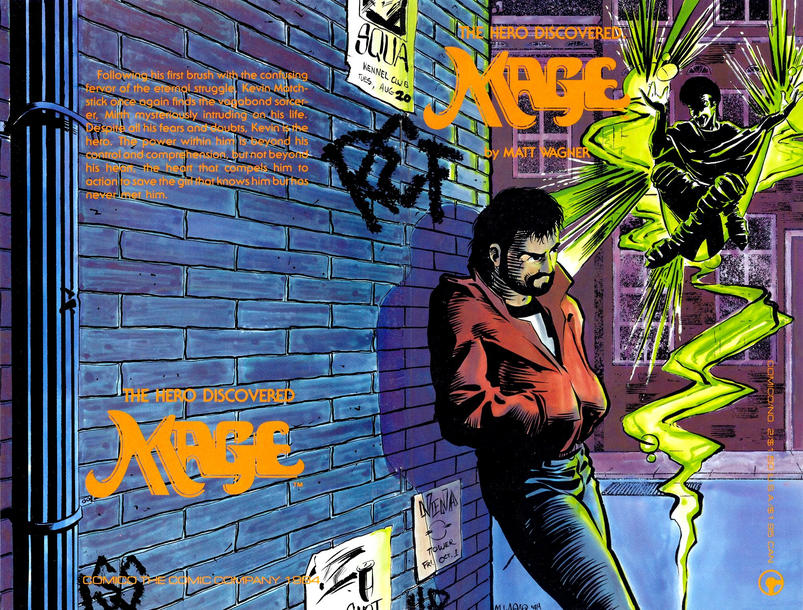 The first series follows Kevin as he gradually realizes that Mirth may actually be telling the truth.
Kevin encounters supernatural enemies including the Umbra Sprite and his monstrous servants, the Grackleflints, while forming relationships with characters such as Edsel. Early issues establish the mixture of fantasy, superhero adventure, and ordinary human relationships that would define the series.
Kevin initially resists almost everything Mirth tells him.
That resistance becomes one of the central ideas of the entire saga.
Kevin possesses enormous power, but possessing power does not automatically make someone a hero. He has to decide whether he is willing to accept the responsibility that comes with it.
That struggle made Kevin different from many traditional superheroes.
There is no secret headquarters.
There is no elaborate costume.
There is no carefully constructed superhero identity.
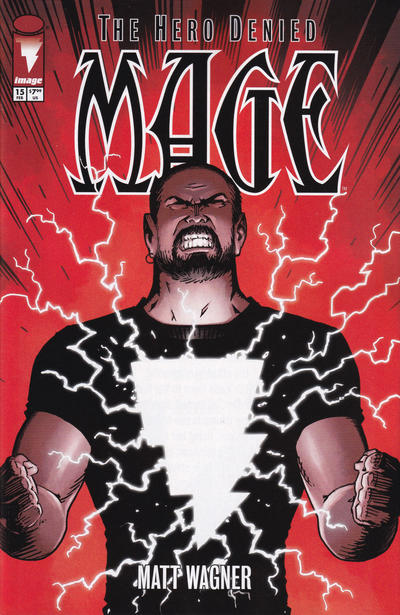
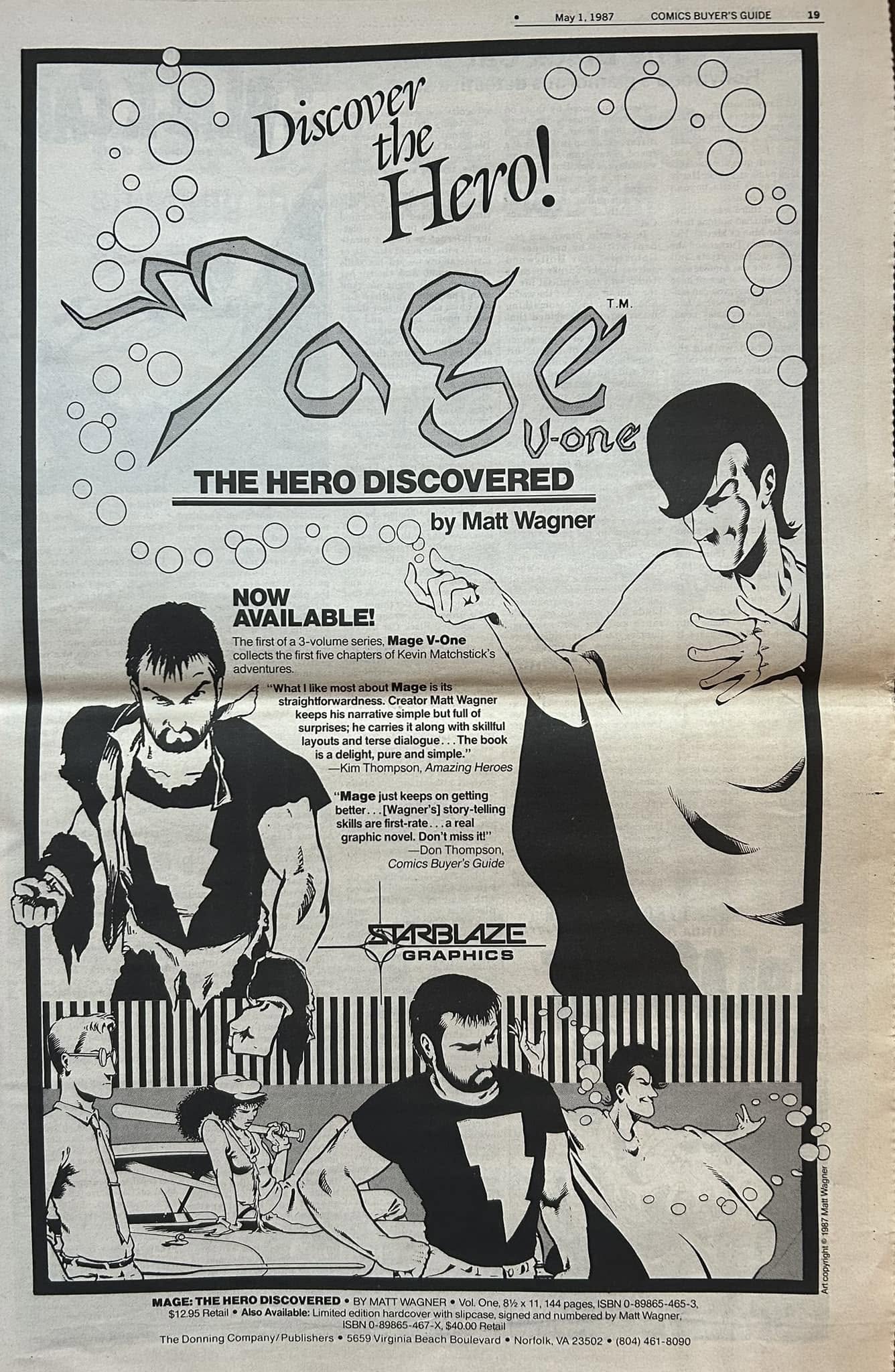
Kevin usually looks like a regular guy wearing a black shirt with a white lightning bolt across the chest.
He just happens to be carrying Excalibur disguised as a baseball bat.
The simplicity of the design helped make Kevin immediately recognizable.
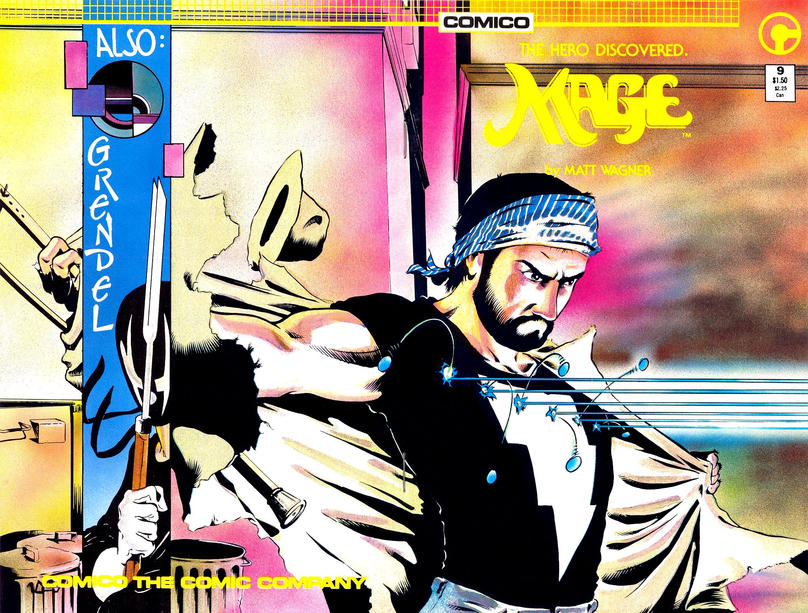 There is another reason Kevin feels unusually human.
He was deliberately modeled on Wagner himself.
Wagner has described Mage as an allegorical autobiography, with Kevin acting as a fictional version of his creator. Wagner said the character developed after he drew a self-portrait that looked more brooding and world-weary than previous versions of himself. That image helped inspire Kevin Matchstick
The fantasy therefore operates on two levels.
On the surface, Kevin battles monsters.
Underneath, Wagner is exploring his own experiences with growing up, relationships, responsibility, creativity, disappointment, and maturity.
That autobiographical element would become increasingly important as the series continued.
Wagner has also connected the structure of Mage to the concept of the Hero’s Journey, particularly the mythological ideas popularized by Joseph Campbell. Wagner explained that Kevin’s development as a hero mirrors his development as a human being.
That becomes especially interesting because Wagner did not tell the entire story at once.
He allowed both Kevin and himself to grow older between chapters.
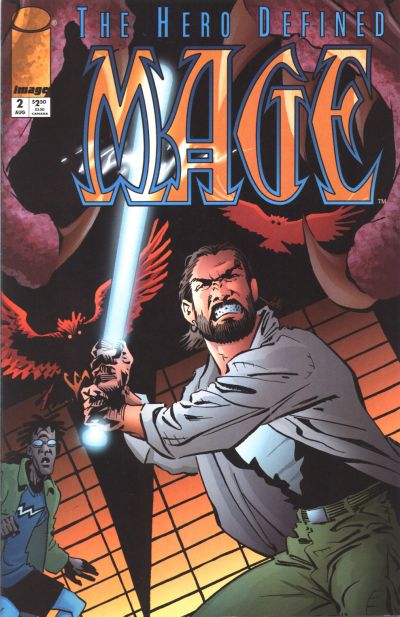 More than a decade after the original series, Kevin returned.
MAGE: THE HERO DEFINED began at Image Comics in 1997. An issue #0 appeared in July 1997, followed by issues #1 through #15. The series concluded in October 1999
Kevin was no longer discovering that he was a hero.
Now he had to determine what being a hero actually meant.
The scope of the story expanded considerably.
Kevin encounters other individuals who also seem connected to legendary or mythological archetypes, including characters such as Joe Phat, whose identity is tied to the Coyote figure of Native American mythology.
The world suddenly appears larger than Kevin originally understood.
Arthurian mythology is only one piece of something much bigger.
Wagner was effectively creating a world in which humanity’s heroic legends could manifest themselves again through contemporary people.
Kevin may be the Pendragon, but he is not necessarily the only legendary figure walking around.
The idea fits perfectly with one of the central concepts behind Mage.
Heroes do not exist only in ancient stories.
Every generation creates its own versions.
 Then Kevin Matchstick disappeared again.
For years.
Fans knew that Mage had been conceived as a trilogy, but the third chapter remained unfinished.
That became part of the mythology surrounding the series itself.
Readers who discovered Kevin during the 1980s were now considerably older. So was Matt Wagner.
When the final chapter eventually appeared, Wagner used that passage of time rather than pretending it had never happened.
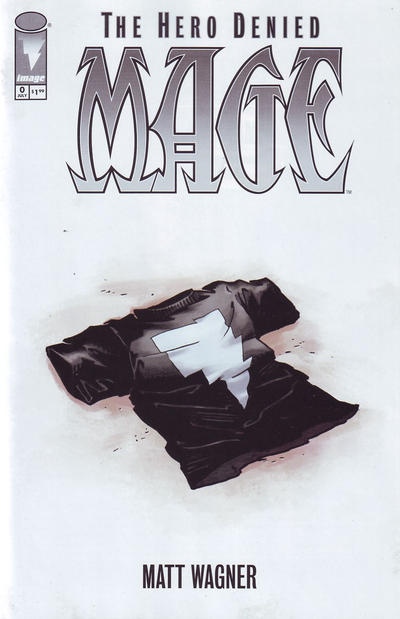 In 2017, Image Comics published MAGE: THE HERO DENIED, the third and final chapter of the trilogy.
The series began with issue #0 in July 2017, followed by a 15-issue limited series beginning in August.
Kevin was older.
His priorities had changed.
He had a family.
And perhaps most importantly, he no longer particularly wanted to be the Pendragon.
The story begins approximately ten years after the events of The Hero Defined. Kevin has largely stopped using his powers and has attempted to leave his heroic destiny behind. Unfortunately, supernatural forces have not forgotten him
This created a very different version of Kevin Matchstick.
The young man in The Hero Discovered had to learn that he was a hero.
The man in The Hero Defined had to understand what being a hero meant.
The older Kevin in The Hero Denied has something entirely different to protect.
His family.
Suddenly the consequences are much more personal.
Using Excalibur does not merely attract enemies to Kevin. It potentially exposes the people he loves to those enemies as well.
That changes the nature of heroism.
Kevin is no longer simply asking whether he should fight.
He has to consider whether fighting may endanger the very people he is trying to protect.
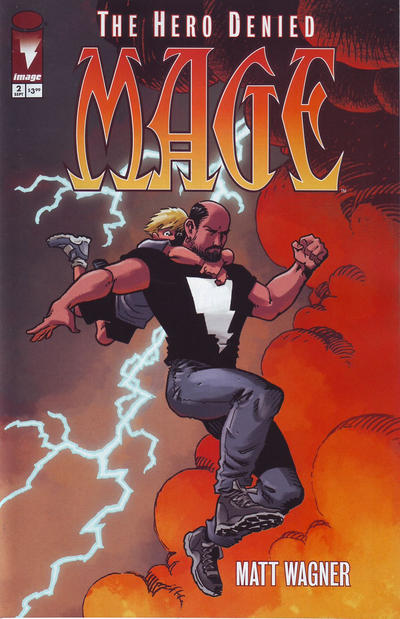 The final issue, MAGE: THE HERO DENIED #15, arrived on February 27, 2019.
It was an oversized 56-page finale featuring an eight-page gatefold, bringing Wagner’s saga to a conclusion roughly 35 years after the original series began.
That extraordinary publication history is part of what makes Mage unusual.
Most comic-book characters remain roughly the same age indefinitely.
Kevin Matchstick did not.
Readers watched him move through different stages of life because Wagner himself was moving through those stages.
The result is something closer to a fictional biography disguised as a superhero fantasy.
 Mage is also fascinating to examine visually.
The Matt Wagner drawing The Hero Discovered was still developing the style that would eventually become instantly recognizable.
His storytelling becomes increasingly confident as the original series progresses.
By The Hero Defined, Wagner’s page composition, character acting, and visual storytelling had changed dramatically.
By The Hero Denied, another transformation had occurred.
Wagner himself has noted that the differences are intentional. Because the books represent different stages in Kevin’s life and Wagner’s own life, the artwork naturally reflects the creator he was at the time each chapter was produced.
Read consecutively today, the trilogy becomes something of a visual record of an artist’s career.
It would be easy to describe Mage as a superhero reinterpretation of King Arthur.
That description is accurate.
It is also incomplete.
Mage is about mythology.
It is about friendship.
It is about aging.
It is about responsibility.
 It is about accepting talents that you may not fully understand.
And ultimately it is about determining what being a hero means at different stages of life.
That is why Kevin Matchstick works so well.
He has incredible power, but power is rarely his biggest problem.
Kevin’s biggest problem is usually Kevin.
He questions himself.
He gets angry.
He makes mistakes.
He wants to walk away.
Sometimes he does walk away.
Then circumstances force him to decide what kind of man he wants to be.
There may be monsters, magic, wizards, mythological avatars, and an enchanted baseball bat, but underneath everything Mage remains surprisingly human.
 Matt Wagner is probably best known to many readers as the creator of Grendel, another enormously influential independent comic.
But Mage may be his most personal creation.
Image Comics itself described the series as Wagner’s allegorical autobiography when promoting the conclusion of the saga.
And that may ultimately explain why the enormous gaps between installments actually strengthened the story.
Wagner could not have created The Hero Denied in 1984.
He had not lived that part of the story yet.
Kevin Matchstick needed to get older.
So did Matt Wagner.
Across The Hero Discovered, The Hero Defined, and The Hero Denied, readers are given three different examinations of heroism.
First you discover the hero.
Then you define the hero.
Eventually you have to decide whether you can continue being the hero.
That journey took 35 years to complete.
For MAGE, it was worth the wait.
About Author
