 During the early 1980s, independent comic book publishers began challenging the dominance of Marvel and DC Comics. New creators were introducing superhero universes that offered something different from the familiar adventures of the Avengers and the Justice League. Among the most ambitious of these independent titles was Justice Machine, a superhero team created by writer and artist Mike Gustovich.
First published by Noble Comics in June 1981, Justice Machine combined traditional superhero action with science fiction, political intrigue, and questions about authority and personal responsibility. Although the series never achieved the mainstream recognition of some of its contemporaries, it became an important part of the independent comics movement.
What made Justice Machine particularly interesting was its central premise. These were not ordinary superheroes who had come together to fight crime. They were agents of a powerful government who gradually discovered that the society they had sworn to protect was not nearly as benevolent as they believed.
It was a concept that allowed Gustovich to explore the difference between following the law and doing what was right.
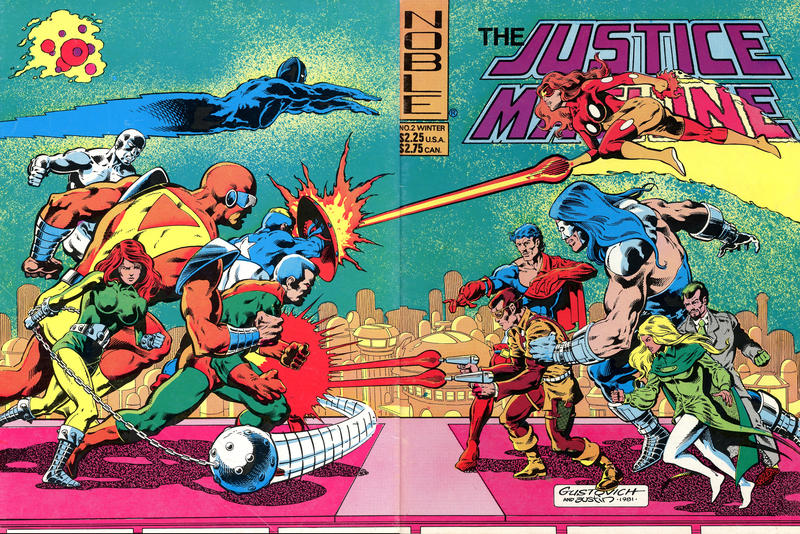 Mike Gustovich introduced the Justice Machine through Noble Comics, a small independent publisher he helped operate.
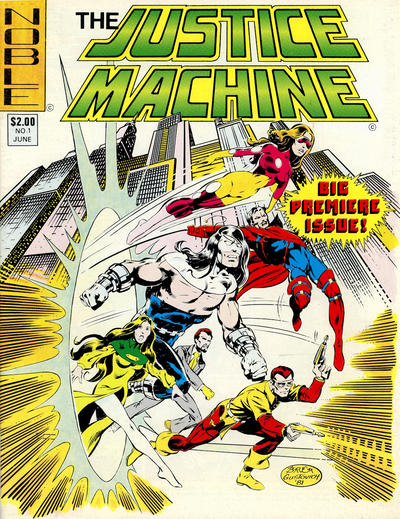
The first issue appeared in June 1981, featuring a cover penciled by superstar artist John Byrne and inked by Gustovich. At a time when Byrne was one of the most popular artists in comics, his participation gave the fledgling independent publication an impressive introduction.
The original series ran for five issues between 1981 and 1983. The first three were published in a magazine-sized format before the title switched to the traditional American comic book dimensions.
Gustovich wrote and illustrated the adventures, developing a distinctive cast of heroes and establishing the futuristic society from which they originated.
Unlike Marvel’s Avengers or DC’s Justice League, the Justice Machine did not begin as independent heroes who voluntarily assembled to combat evil.
They were government operatives from a technologically advanced world called Georwell.
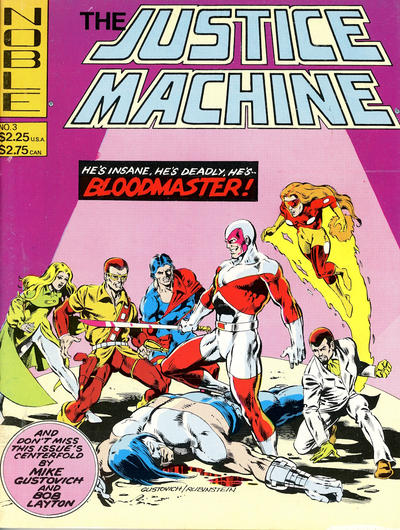 Their mission was to enforce the laws of their society, eliminate threats to the government, and maintain order.
Unfortunately, maintaining order and delivering justice were not necessarily the same thing.
The planet Georwell appeared to be a highly advanced civilization that had seemingly eliminated many of the problems associated with contemporary society.
Its citizens benefited from sophisticated technology, an organized government, and a powerful system of law enforcement.
The Justice Machine represented the very best of that system.
At least, that was what its members believed.
Beneath Georwell’s seemingly ideal society was an authoritarian government that controlled information, suppressed opposition, and branded political dissenters as criminals.
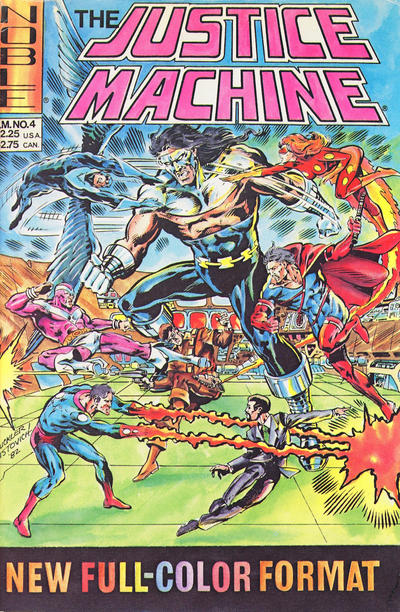 The Justice Machine had been trained to believe that the government was always right.
As the members encountered evidence of corruption and oppression, they were forced to reconsider everything they had been taught.
The resulting conflict became the emotional foundation of the series.
These characters were not simply fighting supervillains. They were confronting the possibility that they had spent their lives serving the wrong side.
That moral dilemma helped distinguish Justice Machine from many of the superhero comics being published at the time.
The original team featured six principal members, each with distinct abilities, personalities, and responsibilities.
CHALLENGER
Challenger, whose real name is Jaiime Conrad, serves as the team’s leader. A disciplined and capable fighter, he represents the qualities of courage, determination, and leadership that make the Justice Machine such an effective organization.
His greatest challenge, however, is not an enemy he can defeat in combat. It is the realization that his loyalty to Georwell may conflict with his own sense of right and wrong.
DIVINER
Tessei Molleng A-Conrad, better known as Diviner, brings extraordinary mental abilities to the team.
Her powers and intelligence make her one of its most valuable members, while her relationship with Challenger adds another dimension to the group’s internal dynamics.
BLAZER
Mitrian Fynn, known as Blazer, is one of the team’s powerful female members.
Her energy-based abilities make her a formidable combatant, but her personality and personal relationships prevent her from becoming merely another costumed powerhouse.
TITAN
Jemin Osk, the massive hero known as Titan, provides the Justice Machine with extraordinary physical strength.
He fills the traditional powerhouse role, but his family relationships and personal concerns give him responsibilities beyond the battlefield.
DEMON
Gabel Nevin, known as Demon, is among the team’s more unusual members.
His distinctive appearance and abilities help provide the group with a visual identity that separates it from more conventional superhero teams.
TALISMAN
Talisman completes the original lineup, contributing his own abilities and perspective to the group’s missions.
Together, the six heroes represent a formidable organization, but their greatest strength ultimately comes from their ability to think independently and question the authority they once accepted without hesitation.
One of the defining developments in Justice Machine occurs when the team’s members discover the truth about Georwell.
The government they believed they were protecting begins to view them as a threat.
Eventually, the heroes find themselves stranded on Earth, branded as traitors by the authorities they once served.
This reversal transforms the fundamental premise of the series.
The Justice Machine are no longer simply elite government agents carrying out assignments. They become outsiders attempting to survive in an unfamiliar world while confronting the consequences of their former loyalties.
Earth also introduces them to a very different society.
Although our world has its own corruption, violence, and injustice, its citizens possess freedoms and opportunities unfamiliar to people raised under Georwell’s authoritarian system.
The contrast creates opportunities for character development, political commentary, and traditional superhero adventures.
The name Justice Machine takes on an entirely different meaning.
Instead of being a machine that enforces government policy, the team begins to understand the importance of fighting for genuine justice.
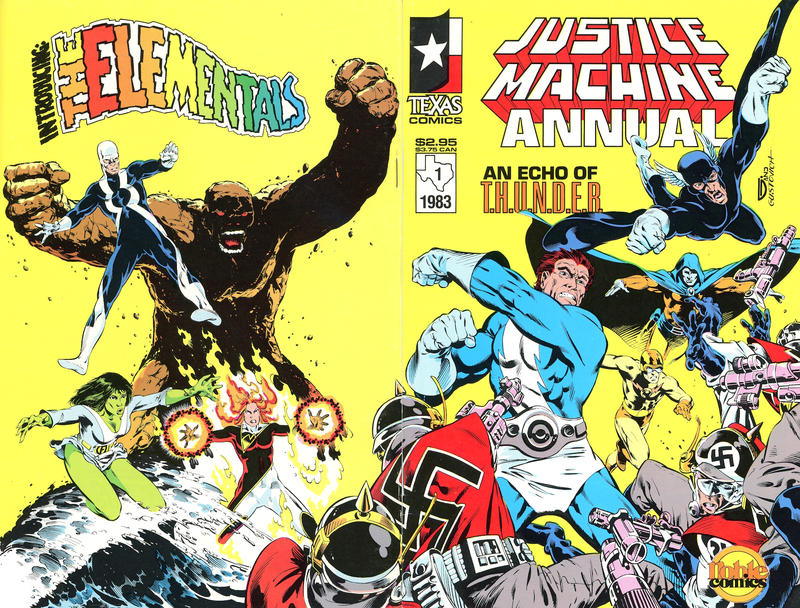 When Noble Comics ceased publishing in 1983, the Justice Machine appeared to have reached the end of its adventures.
However, a new publisher, Texas Comics, licensed the property and released Justice Machine Annual #1 in 1983.
The annual became one of the most historically interesting independent superhero comics of the decade.
It featured a crossover between the Justice Machine and the T.H.U.N.D.E.R. Agents, the legendary superhero organization originally published by Tower Comics during the 1960s.
The story brought together two generations of independently published superheroes.
Even more significantly, the annual featured the first appearance of Bill Willingham’s Elementals.
The Elementals would eventually become one of the most critically admired independent superhero teams of the 1980s, particularly during their subsequent run at Comico.
That makes Justice Machine Annual #1 an important collectible for fans of both properties.
Unfortunately, Texas Comics folded after publishing the annual, leaving the Justice Machine searching for another home.
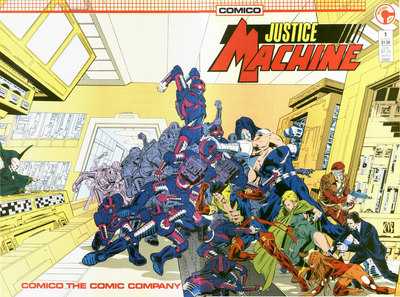 The Justice Machine experienced its greatest period of commercial success after moving to Comico: The Comic Company.
Comico had established itself as an important independent publisher through titles such as Grendel, Mage, Elementals, and Robotech.
In 1986, the company published the four-issue miniseries Justice Machine Featuring the Elementals.
Written by Bill Willingham and illustrated by Mike Gustovich, the miniseries brought the two teams together while establishing a new direction for the Justice Machine.
The crossover helped introduce Gustovich’s characters to readers already familiar with the Elementals.
Its success led to an ongoing Justice Machine series beginning in January 1987.
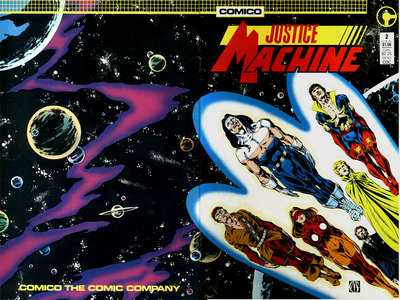 Writer Tony Isabella, known for creating Black Lightning at DC Comics, helped guide the team through its new adventures.
Isabella’s experience with superhero storytelling made him an excellent choice for the series. His scripts emphasized the individual personalities of the characters while developing the political and social conflicts surrounding Georwell.
Gustovich continued contributing artwork, providing visual continuity between the original independent series and its new incarnation.
The Comico title eventually ran for 29 issues, concluding in 1989.
Other writers associated with the series included Doug Murray and Michael Eury.
For many readers, the Comico run remains the definitive version of Justice Machine.
It combined traditional superhero adventure with more sophisticated characterization and an ongoing storyline that rewarded regular readers.
At its commercial peak, the title reportedly sold more than 70,000 copies per issue, an impressive achievement for an independent superhero property.
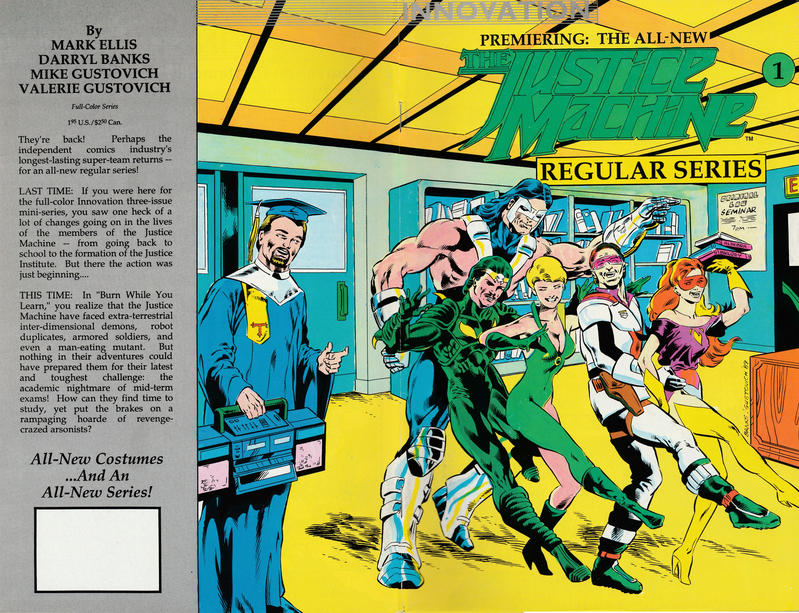 Following financial difficulties at Comico, Justice Machine found another publisher in Innovation Comics.
Writer Mark Ellis became one of the most important creative voices associated with the property.
Working with artists including Darryl Banks, Ellis helped redefine the team’s direction while remaining faithful to the concepts established by Gustovich.
Innovation launched The New Justice Machine as a three-issue miniseries in 1989, followed by another ongoing series in 1990.
The creative team expanded the mythology surrounding Georwell and developed new conflicts involving the Justice Machine’s past.
Ellis emphasized the science-fiction elements of the property, using the team’s history to explore political manipulation, alternate realities, and questions about identity.
Darryl Banks brought a dynamic visual approach that suited the increasingly ambitious stories.
The partnership between Ellis and Banks would continue beyond Innovation.
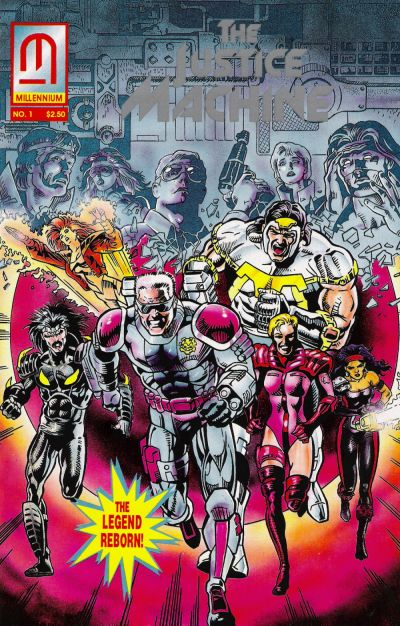
In 1992, the Justice Machine resurfaced at Millennium Publications with a new series that lasted two issues.
This version further explored the team’s origins, including revelations about the true nature of Georwell.
Unfortunately, the difficult comics market of the early 1990s prevented the series from developing into a longer-running success.
Nevertheless, the Innovation and Millennium stories remain important chapters in the team’s history.
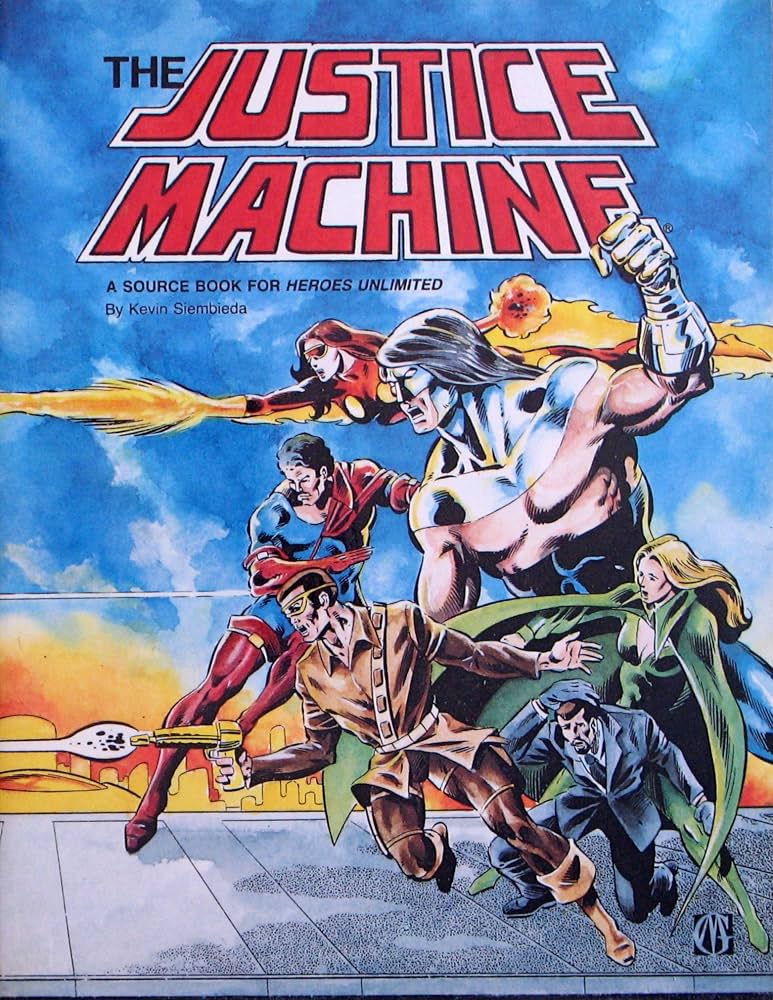 One of the more unusual aspects of the Justice Machine’s history was its expansion into tabletop role-playing games.
In 1985, Palladium Books published The Justice Machine, a 144-page sourcebook for its Heroes Unlimited role-playing game.
Written by Kevin Siembieda, the book expanded upon the characters, technology, politics, and history of Georwell.
It included artwork by Gustovich and other comic book artists.
The sourcebook gave readers an opportunity to explore the Justice Machine universe beyond the stories appearing in the comics.
Players could create their own adventures involving the futuristic society, its heroes, and its enemies.
For dedicated fans, the publication offered substantial background material that helped establish Georwell as a fully realized fictional world.
It also demonstrated the potential of independent superhero properties to expand into other forms of entertainment.
 Although the title disappeared from regular publication during the 1990s, the Justice Machine was never completely forgotten.
Mark Ellis eventually acquired the property from Mike Gustovich and continued exploring opportunities to revive the characters.
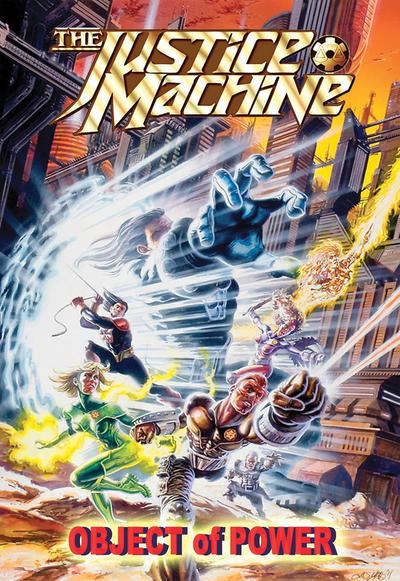
In 2014, Bluewater Productions released Justice Machine: Object of Power, a graphic novel written by Ellis with artwork by David Enebral and Ivan Barriga.
The project introduced another chapter in the team’s history and offered longtime fans a chance to revisit the characters.
Although the Justice Machine has never enjoyed the continuous publication history of Marvel or DC’s flagship superhero teams, its repeated revivals demonstrate the lasting appeal of Gustovich’s creation.
Looking back at the independent superhero movement of the 1980s, Justice Machine deserves recognition for several important reasons.
First, the series was an early example of a creator-developed superhero universe operating outside the traditional major publishers.
Today, creator-owned and independently published superhero comics are familiar parts of the industry. In 1981, however, the direct market was still developing, and publishing an original superhero team independently presented considerable financial and logistical challenges.
Gustovich demonstrated that an ambitious superhero concept could exist beyond Marvel and DC.
Second, the series approached superhero morality from an interesting perspective.
Its characters were initially representatives of an oppressive political system. They genuinely believed they were serving justice because they had been taught to equate government authority with moral righteousness.
Their transformation into independent heroes required them to question their own assumptions.
 It was a remarkably effective foundation for a superhero series.
Third, Justice Machine occupied an important place in the development of the independent superhero genre.
Its connections to the T.H.U.N.D.E.R. Agents, Elementals, and Hero Alliance helped establish relationships among characters and properties from different publishers.
These crossovers demonstrated the possibilities of independent superhero storytelling without the restrictions of a single corporate universe.
Finally, the title maintained a recognizable identity despite moving through several publishing companies.
From Noble Comics to Texas Comics, Comico, Innovation, Millennium, and Bluewater, the Justice Machine survived because creators continued to believe there were worthwhile stories to tell about
About Author
