
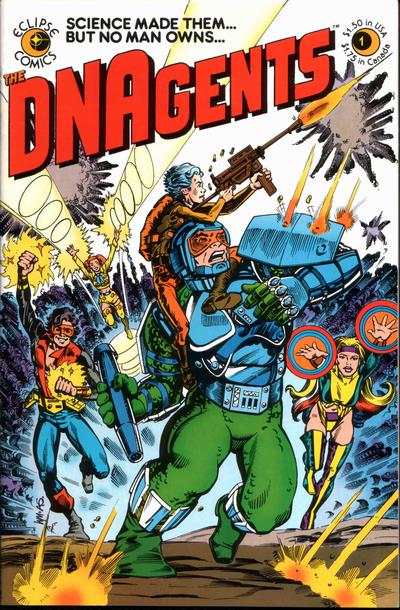
 Long before genetically engineered superheroes became a familiar part of comic book storytelling, DNAgents was exploring what might happen if a corporation could manufacture its own team of super-powered human beings.
Created by writer Mark Evanier and artist Will Meugniot, DNAgents debuted from Eclipse Comics in March 1983. The original series ran for 24 issues through July 1985 before continuing as The New DNAgents, which added another 17 issues.
The concept was straightforward, but it provided Evanier and Meugniot with plenty of room to explore.
The DNAgents were not mutants, aliens, or ordinary people who happened to acquire powers. They were created from the ground up.
The Matrix Corporation used genetic engineering to produce five super-powered beings who appeared to be teenagers. Their creators viewed them as valuable corporate assets. The DNAgents, however, quickly began developing personalities, friendships, desires, and ideas of their own.
That raised the question at the heart of the series: If someone creates a human being, does that mean they own them?
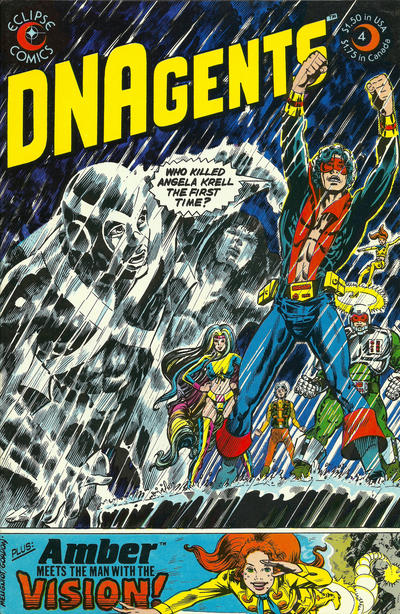 The first issue, appropriately titled “Born Orphans,” introduced the five original DNAgents: Amber, Rainbow, Sham, Surge, and Tank.
Matrix Corporation president Lucius Krell initially sends the newly created heroes on a mission involving the kidnapping of his daughter, although the situation proves to have been orchestrated by Krell himself. The team is later placed under the supervision of trainer Tawny Shepherd and enrolled at Beechgrove University.
It allowed Evanier to combine superhero adventure with something resembling a coming-of-age story.
The DNAgents possessed physically mature bodies and extraordinary powers, but emotionally they were essentially newborns. They had to learn how people behaved, how relationships worked, and eventually how to decide what they wanted their own lives to become.
That gave the series considerably more depth than simply watching five colorful superheroes fight villains every month.
Each member brought something different to the group.
Amber possessed powerful mental abilities.
Rainbow could manipulate light and energy.
Sham was a shapeshifter who could alter his appearance.
Surge was the team’s energetic powerhouse, possessing tremendous speed and electrical abilities.
Tank, as his name suggested, supplied the group’s raw physical strength.
Their personalities were every bit as important as their powers. The characters did not simply function as employees of Matrix. They gradually became a family.
And families do not always do what they are told.
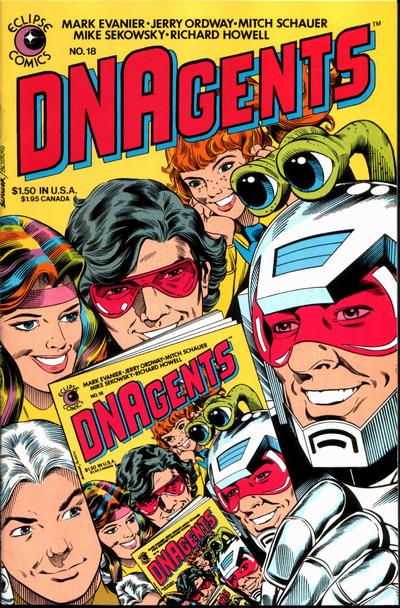 The creation of DNAgents is also an interesting chapter in the development of independent comics during the 1980s.
Both Marvel and DC reportedly showed interest in the property, but Evanier and Meugniot wanted to retain television and merchandising rights. With both creators experienced in animation and television, they believed DNAgents had potential beyond comic books.
Agent and publisher Mike Friedrich presented the project to several publishers, with Eclipse ultimately becoming its home because of the creative freedom the company offered.
That decision placed DNAgents squarely within a growing movement toward creator-owned comics.
Eclipse Comics was one of the important independent publishers of the period, offering readers books that could look and feel like mainstream superhero comics while operating outside Marvel and DC.
DNAgents was particularly suited to that environment.
The book offered the costumes, superpowers, villains, secret laboratories, and action readers expected from superhero comics, but its central conflict involved corporate ownership, genetic manipulation, personal freedom, and the question of whether artificially created people possessed the same rights as anyone else.
For a colorful superhero comic published in 1983, those were surprisingly forward-looking subjects.
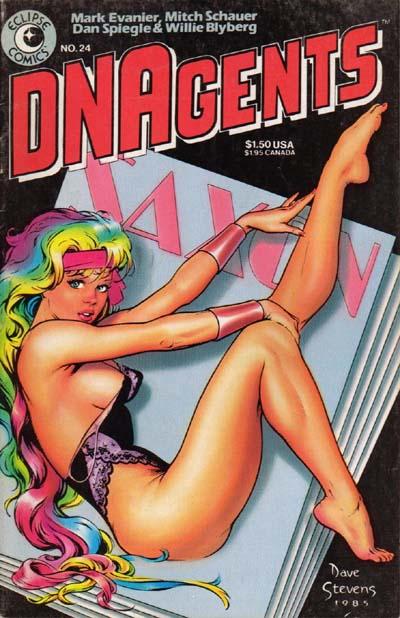 Will Meugniot established the visual identity of the DNAgents and drew the first 14 issues before moving on to other work.
Meugniot had extensive experience in animation, something clearly reflected in his character designs. The DNAgents were colorful, distinctive, and immediately recognizable as individuals.
Other artists eventually contributed to the series, including Richard Howell, Dan Spiegle, Jerry Ordway, Mitch Schauer, and others. The final issue of the original series even featured a cover by Dave Stevens.
When the book was relaunched as The New DNAgents in 1985, Mitch Schauer became its principal artist.
Later issues are also notable for featuring early professional work by Erik Larsen, years before Larsen became one of the founders of Image Comics and achieved long-running success with Savage Dragon. Larsen became the regular artist for the final five issues of The New DNAgents.
The DNAgents universe also produced one of Eclipse’s memorable secondary characters.
Crossfire first emerged from the pages of DNAgents.
The original Crossfire appeared in DNAgents #4, while Jay Endicott, the man who would become the Crossfire featured in his own series, debuted in DNAgents #9.
Endicott was a Los Angeles bail bondsman who took over the identity of a murdered criminal called Crossfire. Rather than use the costume for crime, Endicott became a superhero, taking advantage of Crossfire’s criminal reputation to infiltrate the underworld.
The character proved popular enough to receive his own series, again written by Mark Evanier, with artwork primarily by Dan Spiegle.
Crossfire ultimately ran for 26 issues and developed a strong connection with the DNAgents through Crossfire’s relationship with Rainbow.
There was also a four-issue Crossfire and Rainbow limited series, further expanding the shared universe.
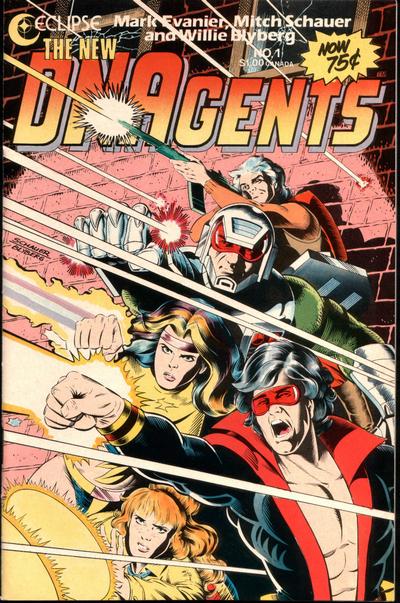 After the original DNAgents ended with issue #24 in 1985, Eclipse did not abandon the characters.
Instead, the publisher relaunched the title as The New DNAgents.
Although the cover numbering restarted at #1, Eclipse also maintained the original numbering. Therefore, The New DNAgents #1 was simultaneously considered the 25th issue of the overall series.
The continuation ran from October 1985 through March 1987 for 17 issues, bringing the combined run to 41 issues.
The relaunch continued developing the heroes as individuals rather than simply treating them as a superhero unit.
By this point, they had moved well beyond the innocent creations readers met in “Born Orphans.” Their experiences had given them identities, relationships, fears, ambitions, and an increasingly complicated relationship with the people responsible for creating them.
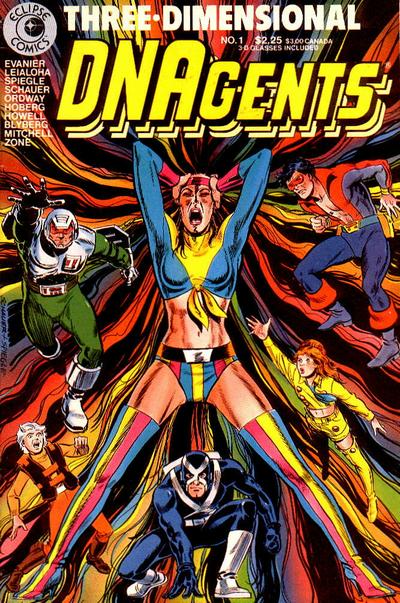 Looking back at DNAgents today, perhaps the most interesting aspect is how contemporary its basic premise still feels.
Genetic engineering has become an increasingly common subject in both science and popular culture. Questions about biotechnology, artificial life, corporate ownership of scientific discoveries, and the rights of beings created through technology have become staples of modern science fiction.
DNAgents was asking variations of those questions more than four decades ago.
Yet Evanier and Meugniot never forgot that they were making a superhero comic.
There were villains.
There were fights.
There were costumes.
There were romantic relationships, cliffhangers, guest stars, strange experiments, and all the other ingredients expected from a good superhero series.
The more serious ideas existed underneath the adventure.
That balance is part of what makes the series interesting to revisit.
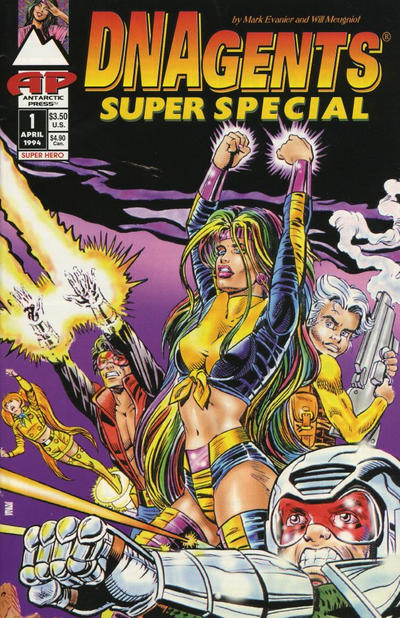 DNAgents never became one of the enormous superhero franchises of the 1980s, but it earned an enduring place in independent comics history.
It was a creator-owned superhero property at a time when creators were increasingly questioning the traditional relationship between publishers and the people who created the characters appearing in their books.
It helped launch Crossfire.
It featured work from an impressive collection of artists.
And, most importantly, it created five superheroes whose greatest battle was ultimately not against a costumed villain.
It was for ownership of their own lives.
Amber. Rainbow. Sham. Surge. Tank.
They were created in a laboratory.
They were intended to be corporate property.
Instead, they became heroes.
They became individuals.
They became the DNAgents.
About Author
