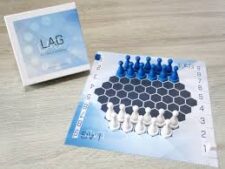
 Over time, well, Trevor and I have played an extensive stack of games from Kanare_Abstract.
The range of games all share a few characteristics. They come in small boxes, feature cloth boards and nice playing pieces, and are designed for two players. They are ideal games to take to a coffee shop for friends to explore over a cup of something hot.
And throughout the various games, there have been many pleasant surprises, including today’s review game, LAG, by designer Takuro Kawasaki.
This one is a brilliantly simple game that, at first blush, doesn’t seem like it will offer a great deal. Then you play it a time or two, and subtle strategies begin to percolate to the surface.
As the Kanare_Abstract website (kanare-abstract.com) explains, LAG reimagines traditional traversal games, such as Halma (1884) and Chinese Checkers (1893), with a fresh twist.
Pieces move toward the opposite side of the board, with no backward moves allowed. That seems rather simple, but there is an interesting wrinkle here.
The distance a piece can move is determined by the number of separate groups of your pieces on the board. In the initial setup, each player begins with a single group.
As the game progresses and formations break apart, the number of groups changes, directly affecting how far your pieces must move.
When the active player can no longer make a move, the game ends, and the player with fewer objects wins. This includes situations where all of a player’s pieces have already crossed the board.
If both players have the same number of objects, the active player who ended the game wins.
Along the way, pieces can jump over others, and if they land on an opponent’s piece, that piece is captured.
Capturing an opponent’s piece to break up their formations and increase the distance they must move is certainly something to consider. It can seriously hamper their options, as longer moves are simply more difficult to manage.
There is an interesting balance between advancing your own pieces and disrupting your opponent’s formations. A move that looks advantageous at first can create problems a turn or two later.
The game has a bit of the feel of two snails sneaking up on each other in its early stages.
By the middle of the game, it becomes something of a dodge dance as the opposing sides meet, with players trying to navigate around one another while looking for opportunities to capture pieces.
Late in the game, the focus shifts toward gathering your scattered pieces into fewer groups to reduce the distance they are required to move.
And it all happens rather quickly on the small board.
What makes LAG interesting is how much strategic thought emerges from such a straightforward set of rules. There is no complicated system to learn, yet the changing formations create decisions that are not immediately obvious when you first sit down to play.
It is the sort of game where experience quickly makes a difference, as you begin to recognize opportunities and potential problems that were easy to overlook in your first few plays.
LAG is more game than you will initially realize, and definitely a fine coffee-break option for two.
About Author
Calvin Daniels is a Saskatchewan-born, self-taught journalist. He is currently Editor of Yorkton This Week, with 35-years in the newspaper business.

Lag Is a Deceptively Strategic Game
The range of games all share a few characteristics. They come in small boxes, feature cloth boards and nice playing pieces, and are designed for two players. They are ideal games to take to a coffee shop for friends to explore over a cup of something hot.
And throughout the various games, there have been many pleasant surprises, including today’s review game, LAG, by designer Takuro Kawasaki.
This one is a brilliantly simple game that, at first blush, doesn’t seem like it will offer a great deal. Then you play it a time or two, and subtle strategies begin to percolate to the surface.
As the Kanare_Abstract website (kanare-abstract.com) explains, LAG reimagines traditional traversal games, such as Halma (1884) and Chinese Checkers (1893), with a fresh twist.
Pieces move toward the opposite side of the board, with no backward moves allowed. That seems rather simple, but there is an interesting wrinkle here.
The distance a piece can move is determined by the number of separate groups of your pieces on the board. In the initial setup, each player begins with a single group.
As the game progresses and formations break apart, the number of groups changes, directly affecting how far your pieces must move.
When the active player can no longer make a move, the game ends, and the player with fewer objects wins. This includes situations where all of a player’s pieces have already crossed the board.
If both players have the same number of objects, the active player who ended the game wins.
Along the way, pieces can jump over others, and if they land on an opponent’s piece, that piece is captured.
Capturing an opponent’s piece to break up their formations and increase the distance they must move is certainly something to consider. It can seriously hamper their options, as longer moves are simply more difficult to manage.
There is an interesting balance between advancing your own pieces and disrupting your opponent’s formations. A move that looks advantageous at first can create problems a turn or two later.
The game has a bit of the feel of two snails sneaking up on each other in its early stages.
By the middle of the game, it becomes something of a dodge dance as the opposing sides meet, with players trying to navigate around one another while looking for opportunities to capture pieces.
Late in the game, the focus shifts toward gathering your scattered pieces into fewer groups to reduce the distance they are required to move.
And it all happens rather quickly on the small board.
What makes LAG interesting is how much strategic thought emerges from such a straightforward set of rules. There is no complicated system to learn, yet the changing formations create decisions that are not immediately obvious when you first sit down to play.
It is the sort of game where experience quickly makes a difference, as you begin to recognize opportunities and potential problems that were easy to overlook in your first few plays.
LAG is more game than you will initially realize, and definitely a fine coffee-break option for two.
About Author
Calvin Daniels
Calvin Daniels is a Saskatchewan-born, self-taught journalist. He is currently Editor of Yorkton This Week, with 35-years in the newspaper business.
See author's posts