
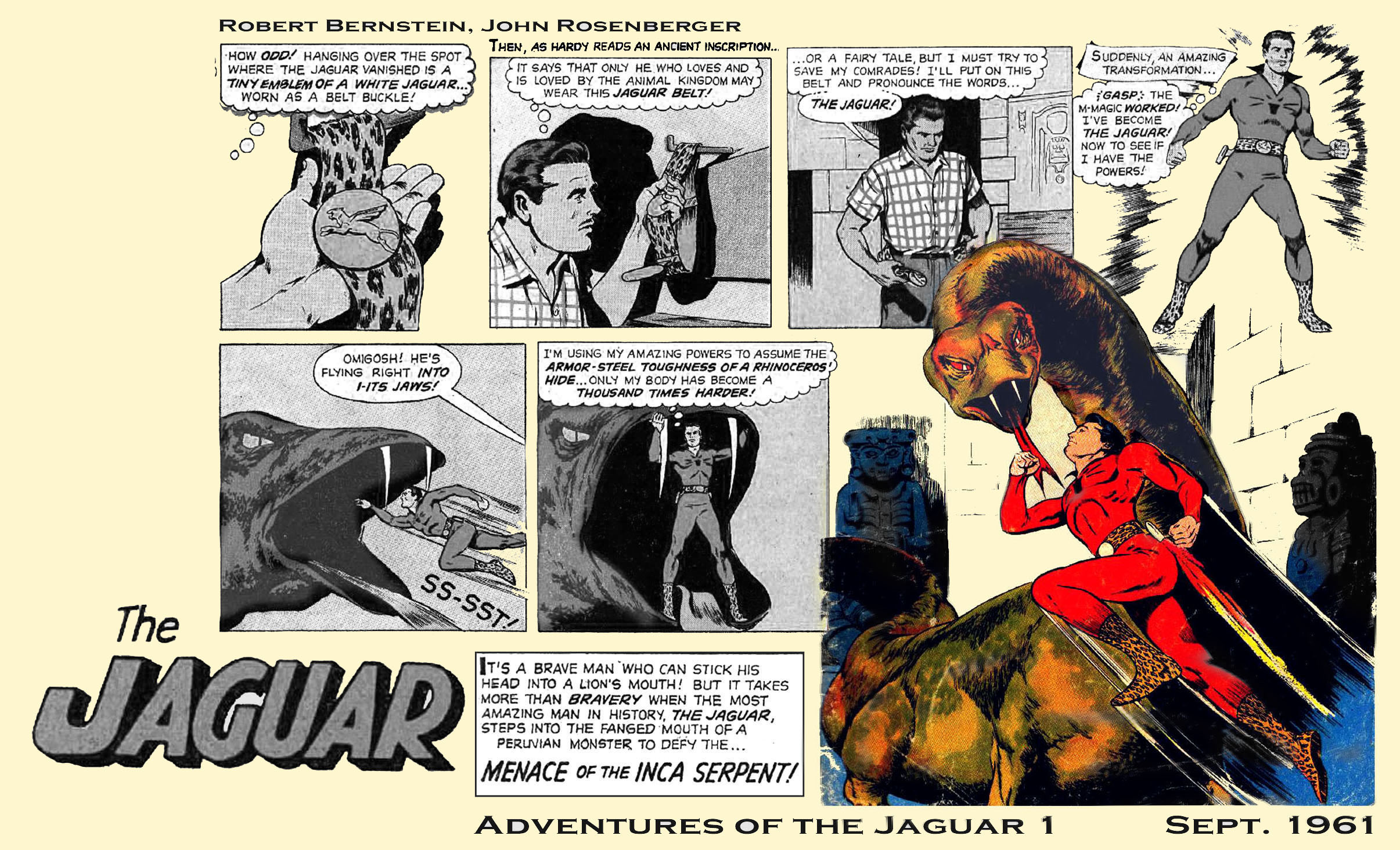
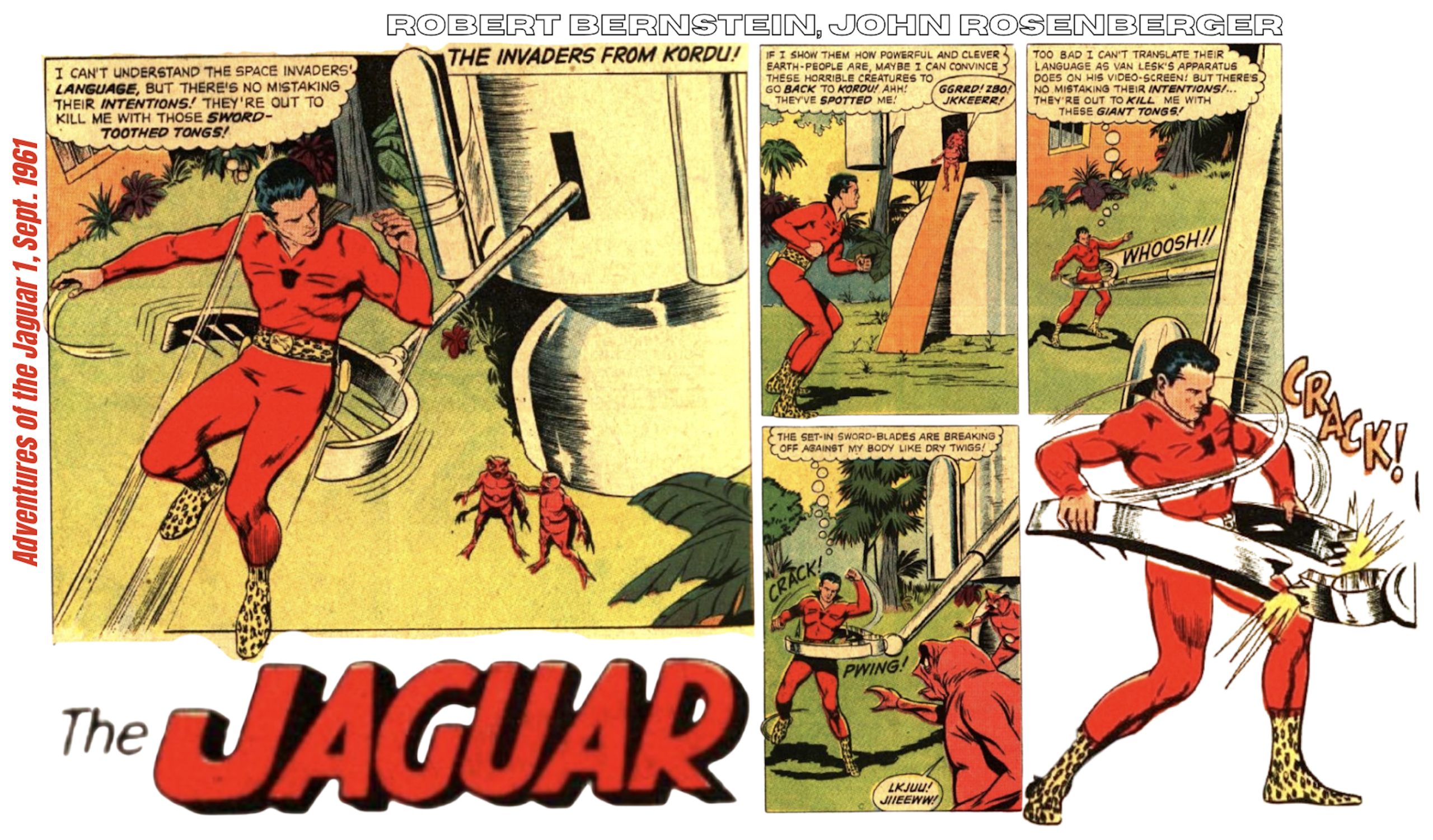
A new superhero soaring through the air? A giant reptilian monster on a rampage? Red-skinned aliens invading Earth?
I’m in.
So I was happy to buy the first issue of The Adventures of the Jaguar (Sept. 1961), which appeared on the stands in June 1961 — a nice present for my 7th birthday.
And yes, even at that age I could recognize the character as being heavily derivative of Archie Comics’ other superhero, the Fly. But the Jaguar also shared the artist John Rosenberger with the Fly, and I enjoyed his clear, clean-lined work.
“It really does seem as though the character was created just to fill a space — he’s a simple knock-off of the Fly himself, but with the powers of all mammals rather than the more exotic and interesting ones of all insects,” observed comics historian Don Markstein. “He uses a magic belt instead of a magic ring, is a zoologist named Ralph Hardy instead of a lawyer named Thomas Troy, and unlike the Fly, has no female counterpart.”
Empowered by Incan magic and/or super-technology, Hardy flies with the aid of his “nucleon-energy belt” rockets and defeats an ancient serpent.
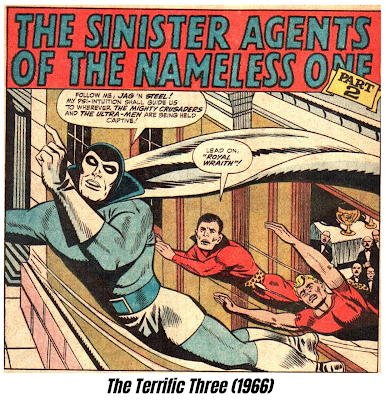 The Jaguar’s exploits, penned by Robert Bernstein, appeared for 15 issues in his own title and as back-page stories in Archie comedy titles like Laugh and Pep.
A little later, when the Archie superheroes formed the Mighty Crusaders, the Jaguar reappeared for a single issue as a member of a rival super-team, the Terrific Three. Mr. Justice and Steel Sterling were the other two.
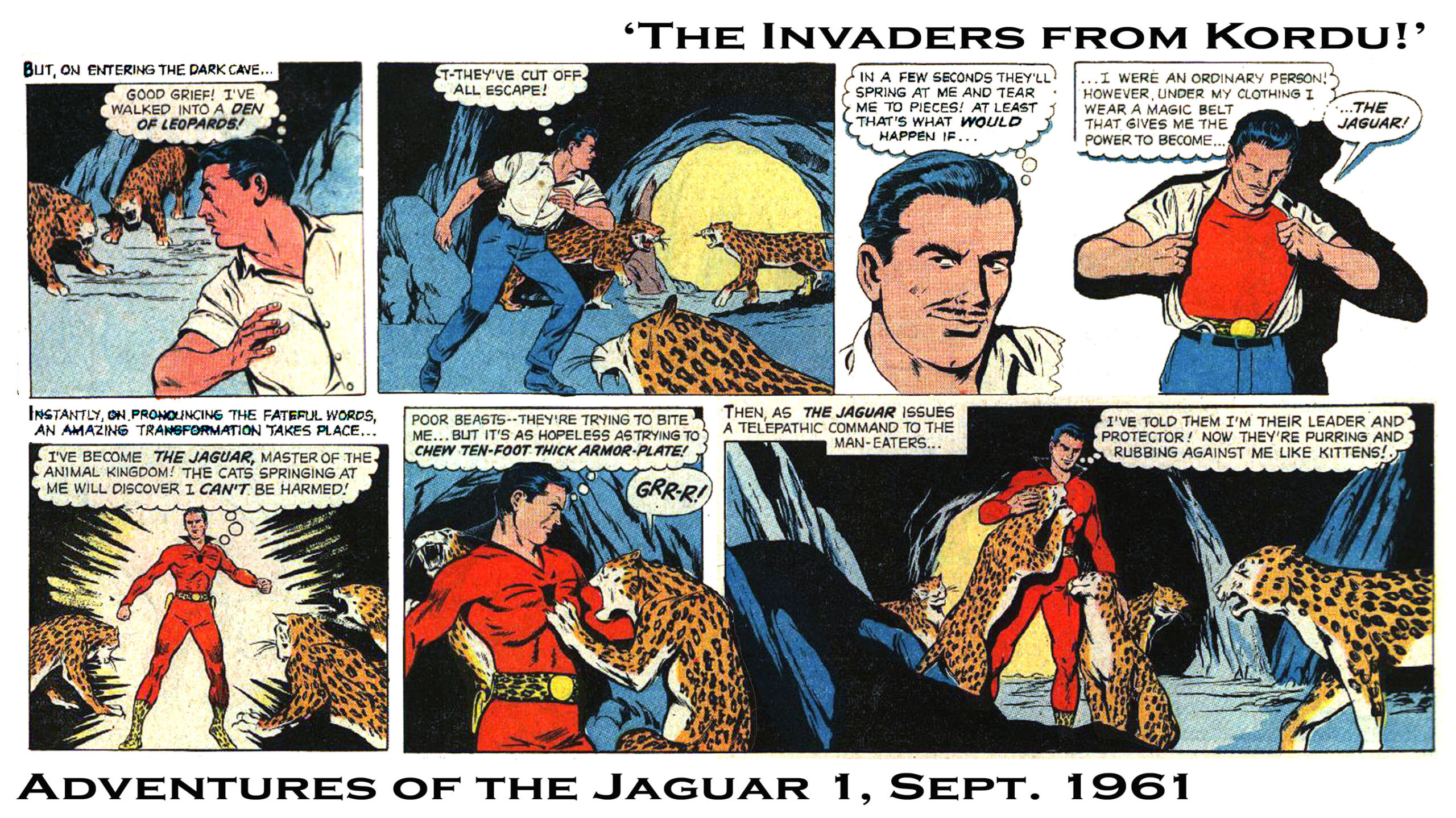
We had several creature-totemic superheroes knocking about then, not just the Fly and the Jaguar but also Aquaman, Hawkman and Ant-Man. All of them had not just costumes and powers inspired by their biological namesakes, but also an intimate connection with the creatures themselves, whom they could communicate with and command.
In this, they resembled a certain ape man — the ubiquitous afternoon-movie hero Tarzan, who was forever summoning elephants to his aid.
About Author
