
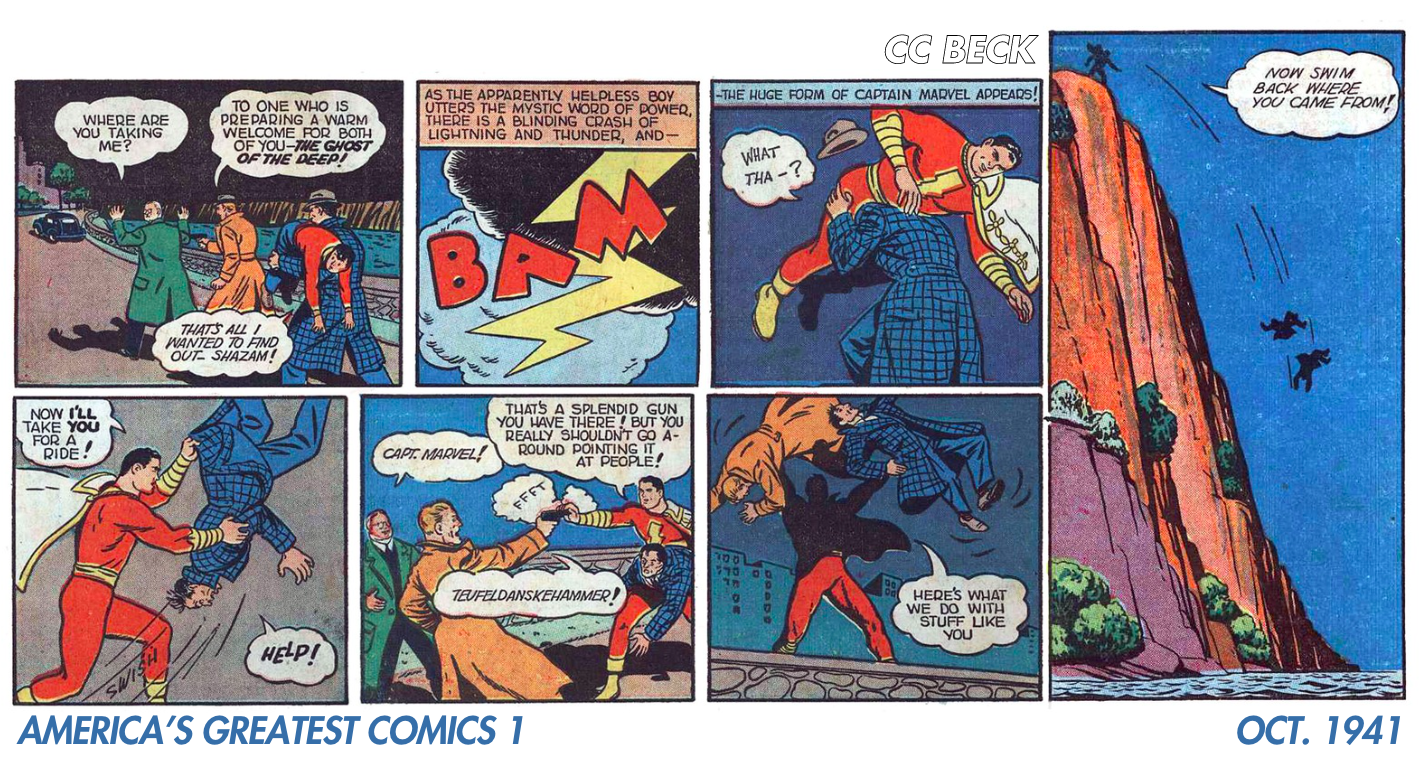
You didn’t want to mess around with Captain Marvel in 1940. You might just end up falling from a great height.
Far from the big, cheerful Boy Scout he would become, the original Captain Marvel was surprisingly offhanded about killing his enemies.
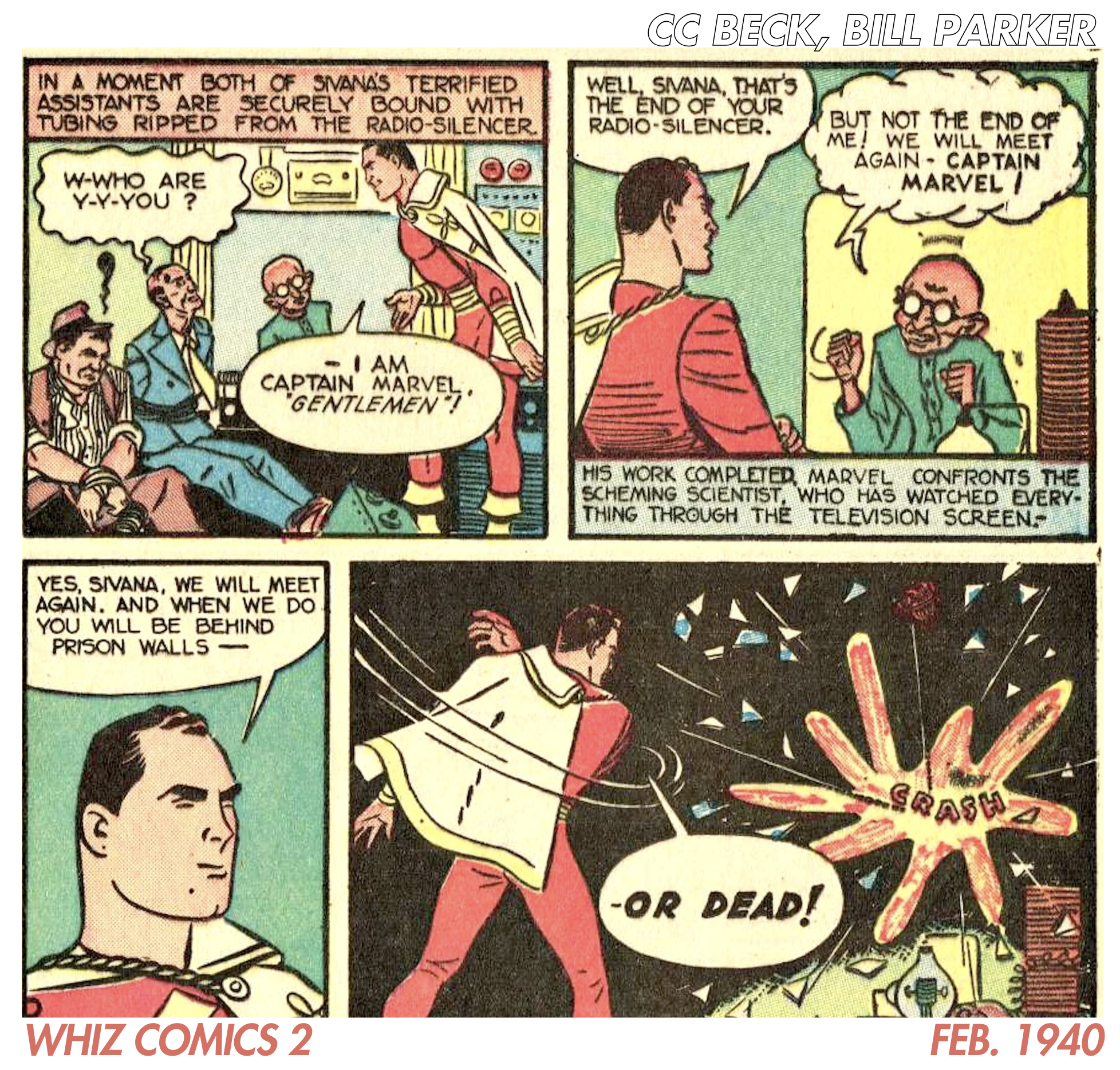
In his first appearance in Whiz Comics 2 (Feb. 1940), the good Captain warns the televised image of archfoe Dr. Sivana that their next encounter will conclude with the villain “…behind prison bars — or dead!”
In Whiz Comics 7 (Aug. 1940), Captain Marvel smashes the villain’s plane into burning wreckage that plunges into a crevice and explodes.
“Too bad — but you had it coming to you!” he remarks.
And in America’s Greatest Comics 1 (Oct. 1941), Captain Marvel grapples with the minions of the Ghost of the Deep. Telling them, “Here’s what we do with stuff like you,” he tosses them off a cliff hundreds of feet down into the sea.
They manage to survive, but the Ghost, disappointed in their performance, drowns them.
 So it’s no wonder that in 1941, in the Republic’s groundbreaking serial Adventures of Captain Marvel, the hero casually tossed enemies off buildings and mowed them down with a mounted machine gun.
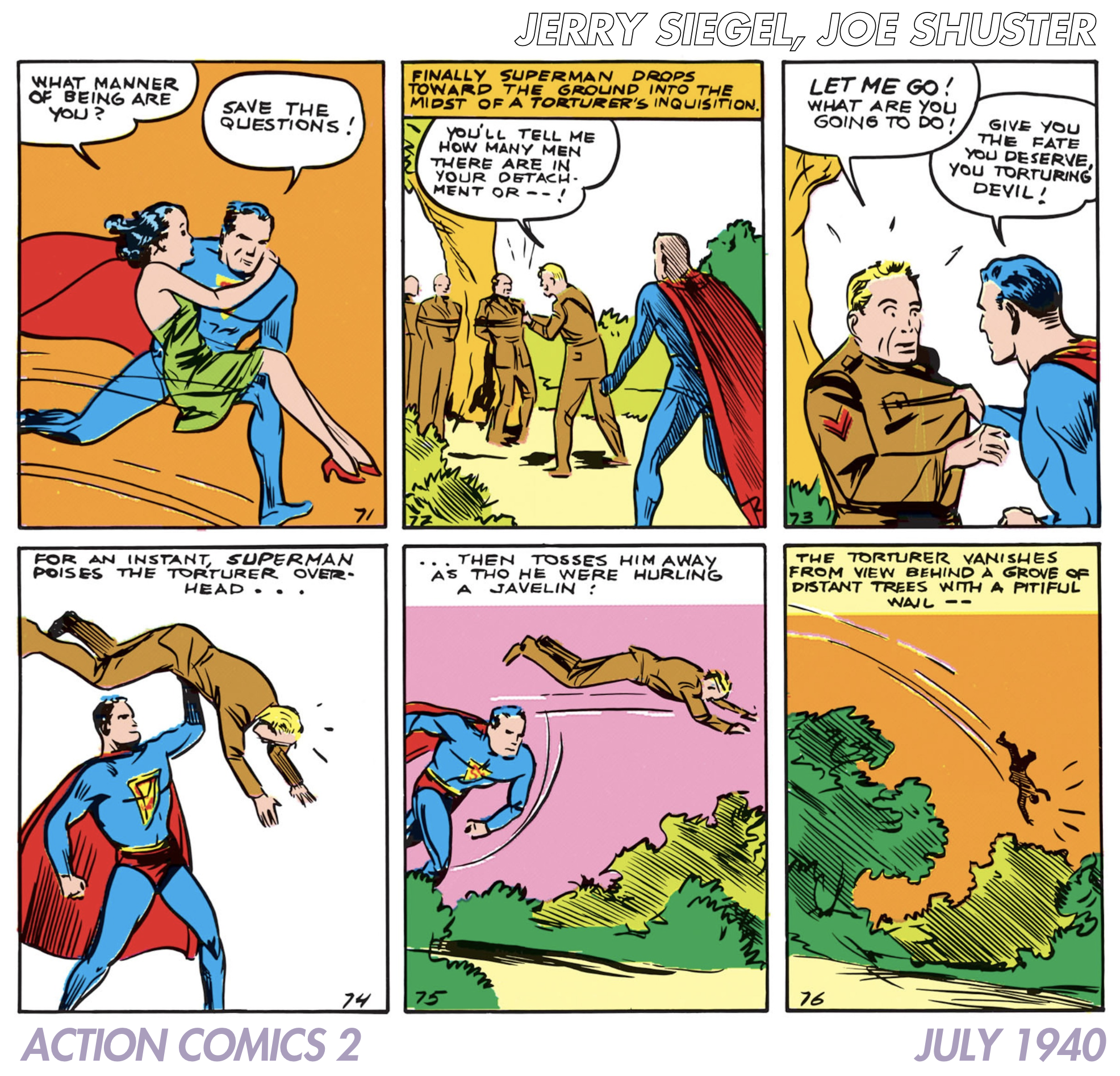
Captain Marvel wasn’t alone. Many early superheroes, including Superman and Batman, were ruthless in their pursuit of evildoers.
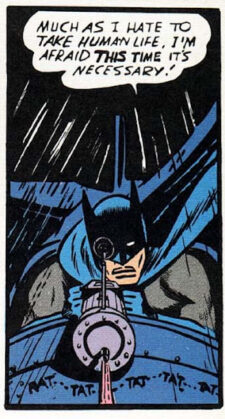
“Now the cover feature of the line’s namesake title, Detective Comics, the Batman had only eight episodes under his utility belt by the January 1940 issue,” noted Kurt F. Mitchell in American Comic Book Chronicles. “Much of his mythos had not taken shape. There were as yet no Gotham City, no Batmobile or Bat-Cave, no Alfred. Millionaire playboy Bruce Wayne’s cowled alter ego had not yet forsworn killing, and his opponents often met their demises through his actions, if not always at his hands.”
The comic book heroes inherited that trait from pulp superheroes like the Shadow and the Spider, whose blazing automatics disposed of many a criminal.
Doc Savage avoided killing criminals, but his behavior was shocking in another way. Without consent, he matter-of-factly operated on the brains of enemies to “eliminate their criminality.”
The superheroes’ behavior changed gradually as comic book companies came to realize that promoting homicide to children wasn’t responsible storytelling. And then, finally, the Comics Code effectively precluded it.
“The superheroes give us examples of good people who can use force when it’s necessary, even sometimes taking violent actions, within limits, to defeat and subdue otherwise unstoppable evil, but without letting that get out of hand or rebound in self-defeating ways on their characters,” wrote Jeph Loeb and Tom Morris in Superheroes and Philosophy: Truth, Justice and the Socratic Way.
“Batman, Spider-Man, and Daredevil, along with Superman and many others, exercise a great deal of self-restraint and are careful to draw a line they will not cross. They can fight evil without becoming evil. In doing so, they address our common fear that it can’t be done. They show us that we can do whatever we have to do, in the face of evil, if we stay firmly in touch with our noblest motivations and our most cherished values. But that doesn’t mean that this is not dangerous. It’s very dangerous. But good can still prevail.”
About Author
