
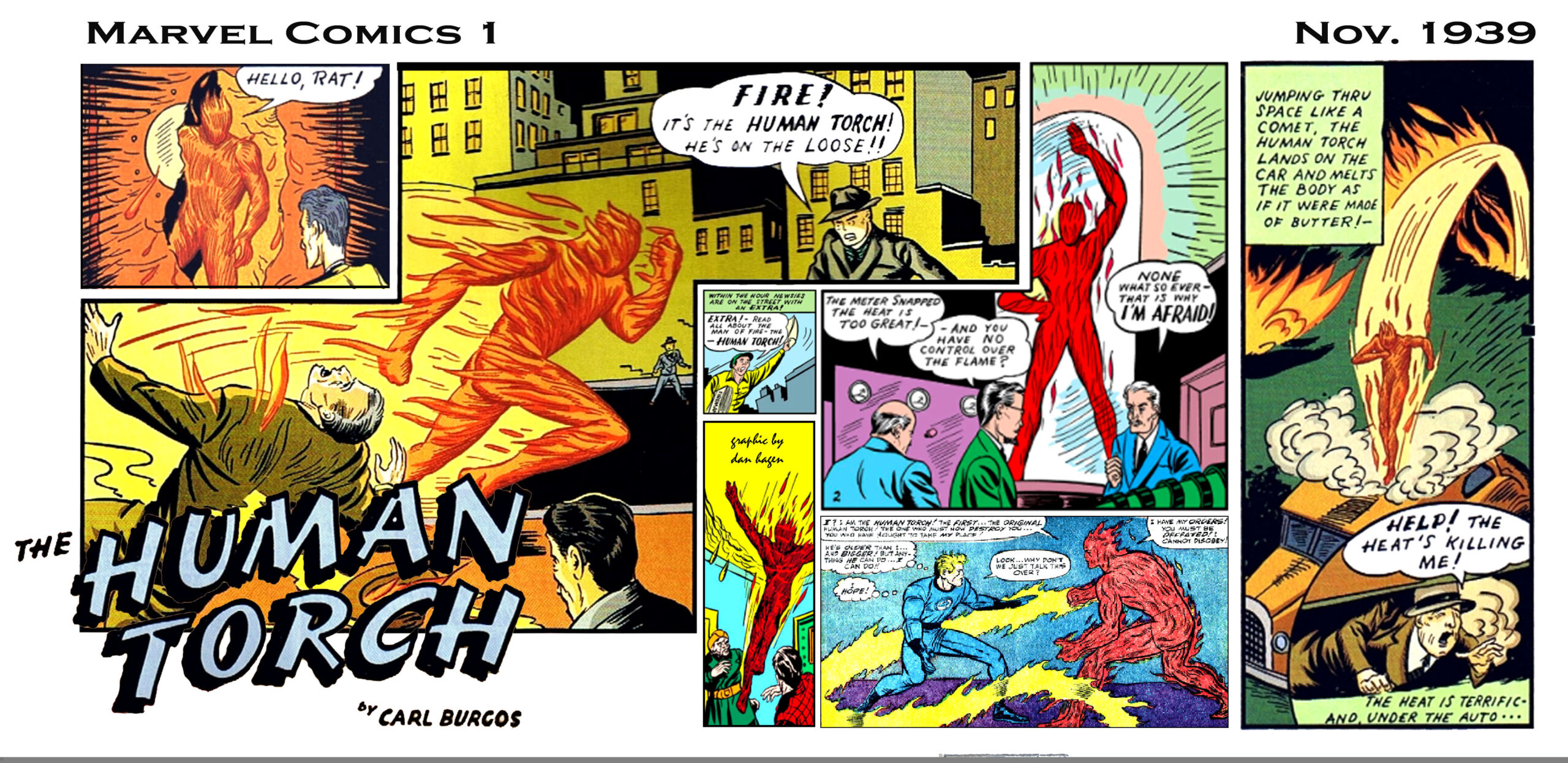
At first, he was the Frankenstein monster on fire, an inhuman torch. But that was before my day.
I first saw the Fantastic Four in the fall of 1961 on the cover of their second issue, mixing it up with some green-skinned aliens in a house. Because the cover featured people in civvies, dominated by an orange monster with lumpy, dinosaur-like skin, I wasn’t sure what kind of comic this was. Superhero? Science fiction? Horror? I left it on the newsstand rack.
But I know what would have sold me.
Johnny Storm was presented recoiling from a Skrull’s ray gun in his ordinary teen form, surrounded by a vague nimbus of flame. If he’d flamed on, I would probably have parted with my dime and bought the issue.
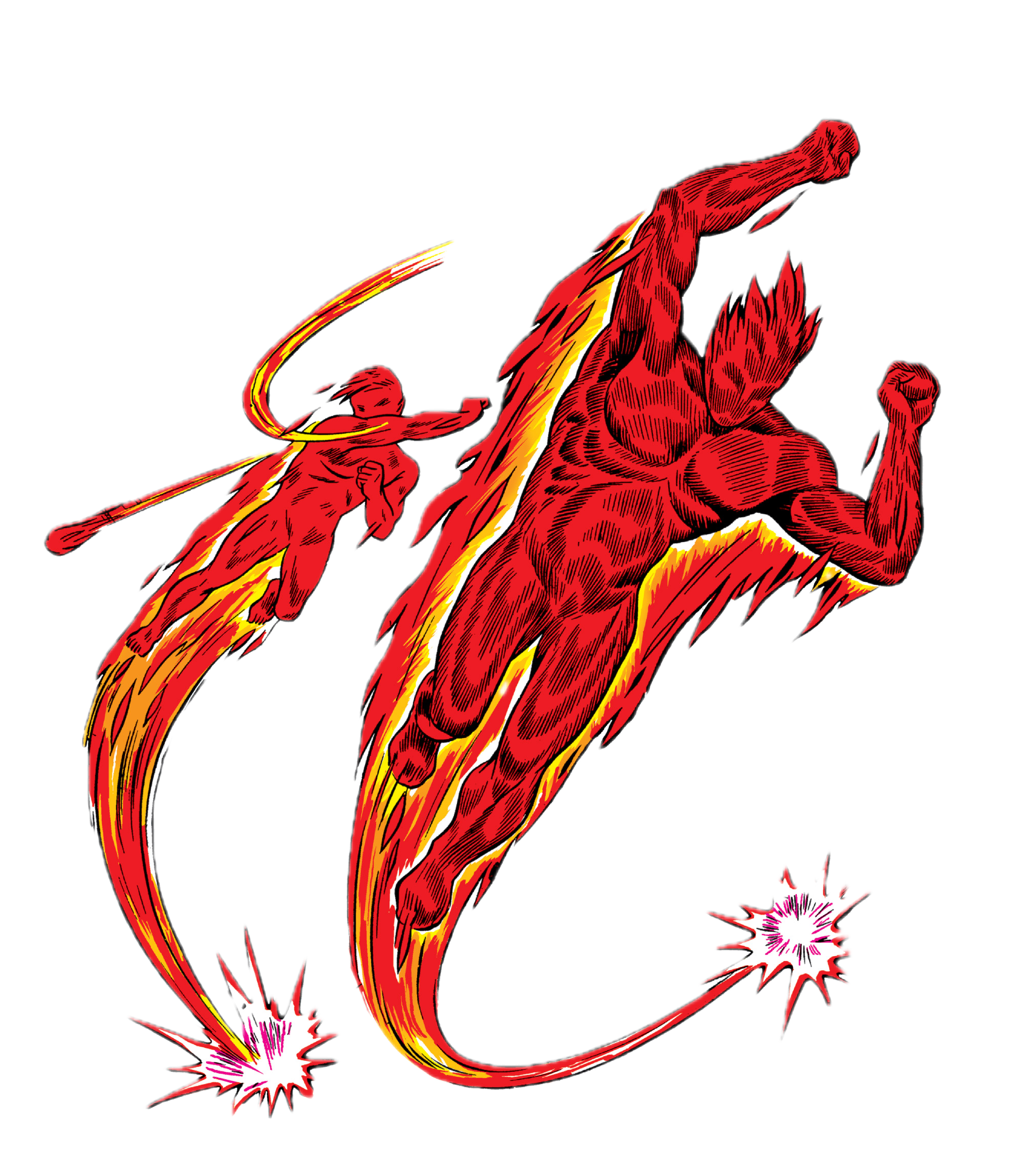
After all, that’s what I did the moment I saw the next issue, with the FF finally in costume, aloft in their intriguing flying bathtub, with the Human Torch fully aflame and exuberantly circling the Fantasticar. Something about this soaring being, blank-faced and ablaze, really grabbed me.
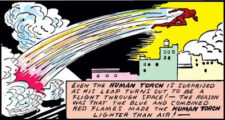 I had no idea that, unlike the other characters, the Human Torch had already had a long and successful run in comics. I only figured it out when I saw a tantalizing reference to an earlier Human Torch in a Mad Magazine parody about retired superheroes. He was said to have found a job lighting cigars for some millionaire.
Both the Human Torch and the Sub-Mariner debuted at the birth of Marvel Comics (Oct. 1939), which was both the title in which they initially appeared and eventually the brand name that would storm the world of popular culture. And both were monster men as much as supermen — the Torch, a confused android who burned whatever he touched, and Prince Namor, an angry loose cannon almost as likely to murder innocent people as to save them.
Comic book character concepts were less rigid in the experimental days of the 1930s. Initially amoral, unpredictable, and just plain weird, both the Torch and the Sub-Mariner reflected Universal’s popular monster movies as well as the new hit character, Superman.
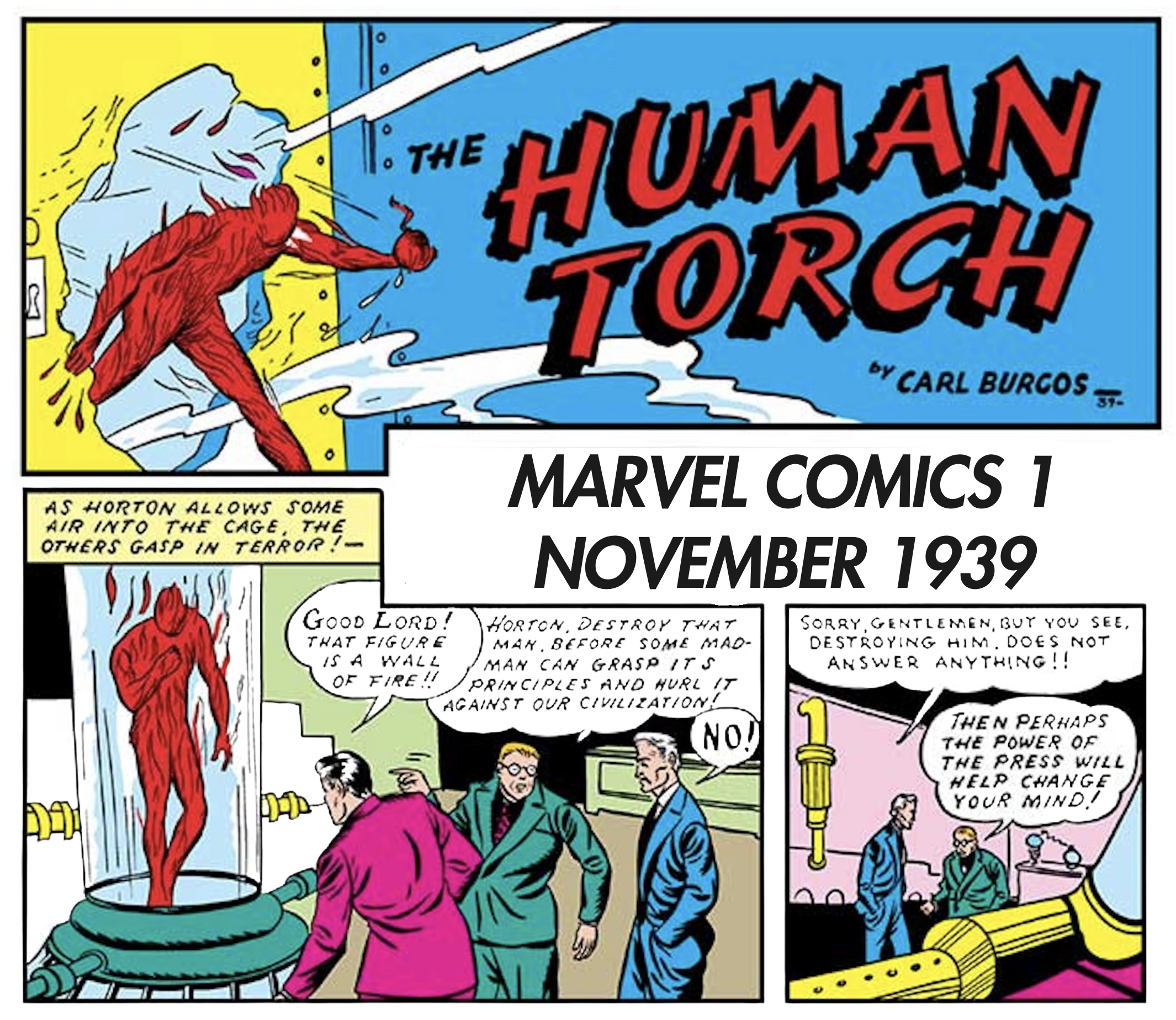
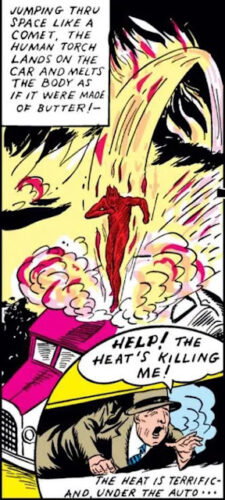 That first Human Torch story, crudely drawn but with a fascination of its own, opens with Prof. Horton’s press conference. He announces that he’s created a living synthetic man, but doesn’t know why it bursts into flame when exposed to the air. Horton tells reporters, “Something went wrong with my figurings somewhere.”
Yes, evidently so.
Encased in a concrete block for public safety, the android is freed by an explosion caused by an air leak, and runs through the streets setting things on fire.
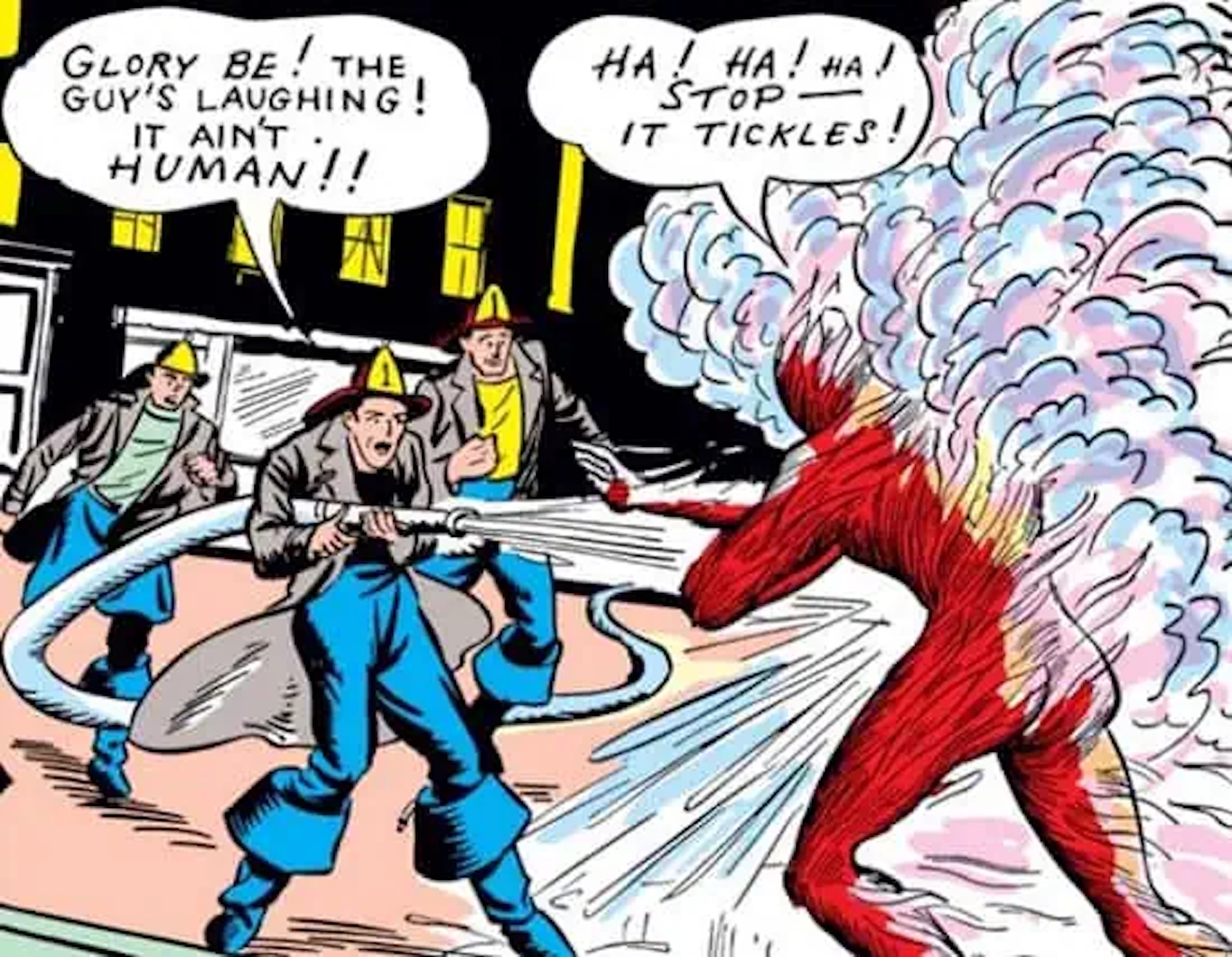
With the personality of a willful child, the Human Torch declares that the sound of fire alarms amuses him and that the blast of a fire hose tickles.
Recruited by criminals for an extortion racket, the naïve Torch eventually catches on and turns on the gang, burning some of them alive.
When the Torch learns to control his flame, Horton decides that the android’s powers will make him rich. But the Torch has suddenly somehow acquired a moral viewpoint.
“No, Horton, I’ll be free,” the Torch declares as he burns through the ceiling and springs into the sky. “And no one will ever use me for selfish gain — or crime.”
The Human Torch was one of the first of the shtik superheroes, a Superman with a gimmick. Children’s fascination with fire proved sufficient to sell 80,000 copies of Marvel Mystery Comics 1 in September 1939, sending publisher Martin Goodman back to the presses for a second run. Eventually, 800,000 copies were sold.
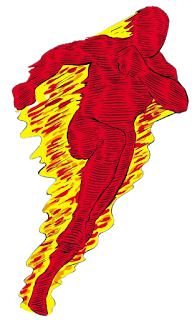 “While superheroes flourished, The Human Torch, one of the most spectacularly visual of the lot, blazed along, appearing in more individual comics than any other 1940s Marvel character except Captain America,” noted comics historian Don Markstein. “He outlasted most of the others, too. Still, by 1949, with the genre virtually a memory, even the addition of an attractive female sidekick, Sun Girl, couldn’t rekindle his ability to enflame the imaginations of readers. After Marvel Mystery 92 (June 1949) — a recap of his origin, ironically enough — he was seen no more. There was a brief revival of Marvel’s big three (Cap, Subbie, and The Torch) in 1953, but that lasted less than a year.”
The Torch’s android nature might have been explored in some interesting stories, but it was not to be. “The Human Torch started to act like every other costumed crime-fighter,” noted Sean Howe in his Marvel Comics: The Untold Story. “Whether the threat he defended against was a Martian or a trigger-happy racketeer, it could just as easily be a job for Superman — indeed, following in Superman’s footsteps, the Torch took on an alias (Jim Hammond) and upright-citizen day job (policeman).”
So the fact that the “Human Torch” wasn’t human was forgotten immediately. “From 1939-49, the Torch appeared in all 92 issues of Marvel Mystery, in all 35 issues of The Human Torch, and in dozens of other Timely mags — and to the best of my knowledge, after the first year or so at most, there was never another hint of the Torch’s being an android until his origin was retold in the final issue of Marvel Mystery,” Roy Thomas noted. “As a kid who started reading Torch stories circa 1945-46, I remember how shocked I was when I found out.”
When Stan Lee and Jack Kirby revamped the concept for the Fantastic Four in 1961, the Human Torch finally became human in fact as well as in name. But the Torch/Sub-Mariner “monster hero” theme would be echoed in one of his teammates, the Thing, and then again in the second Lee/Kirby title of the Marvel Age, The Incredible Hulk.
About Author
