
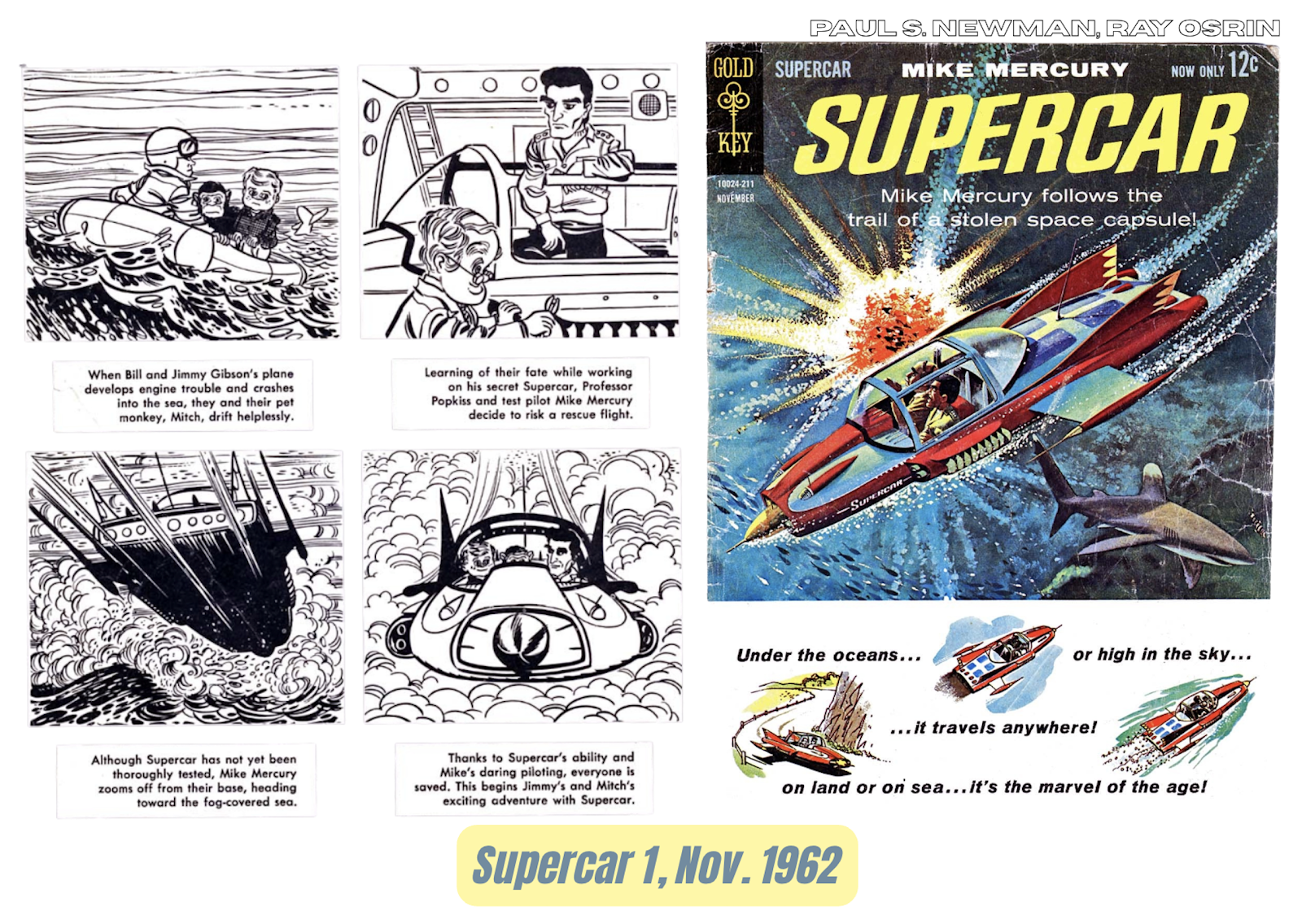
Supercar… Supercar…
With beauty and grace,
as swift as can be,
watch it flying through the air.
It travels in space,
or under the sea,
and it can journey anywhere.
Batman’s Batmobile, the Green Hornet’s Black Beauty, James Bond 007’s Aston Martin DB5 (with modifications) — the popular culture of the 1960s was certainly fond of its super vehicles.
Another Ian Fleming creation, Chitty-Chitty-Bang-Bang, was published as a children’s book in 1964 and became a film in 1968.
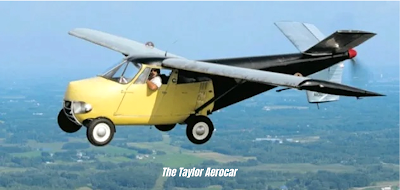 Even comedic actor Bob Cummings flew an actual Taylor Aerocar in his CBS sitcom The New Bob Cummings Show (1961-62). One of only six made, the detachable-wing car could be changed into a 110-mile-per-hour aircraft in roughly five minutes.
And let’s not forget the British import Supercar, a Gerry Anderson TV show that premiered in London on Jan. 28, 1961.
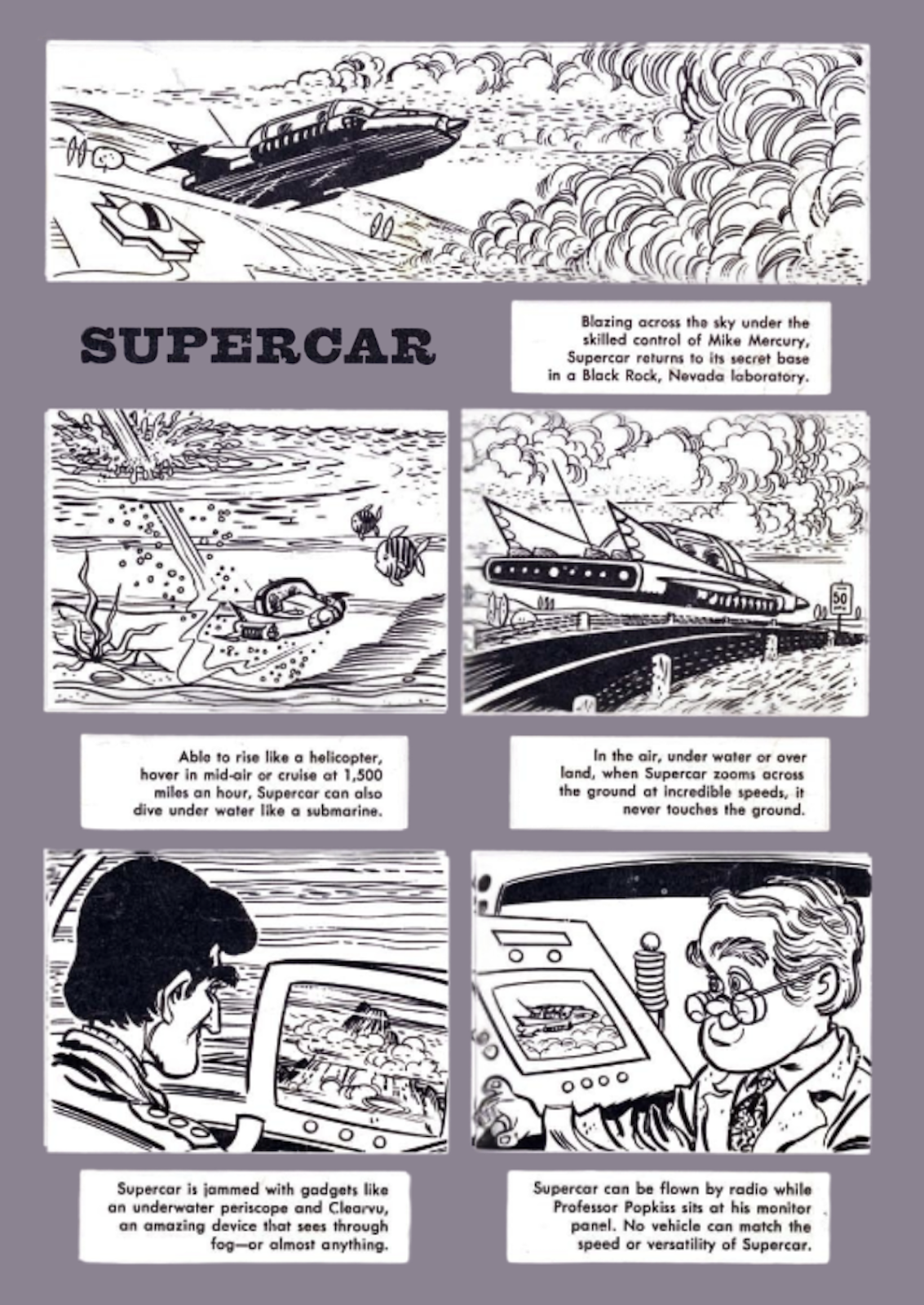
“Supercar can function like a hovercraft on land, can travel under the sea — it’s equipped with a periscope and sonar — can fly through the skies, aided by its Clearvu display screen, which allows the pilot to see through clouds and fog, and can journey through space,” wrote comics historian Jeff Rovin.
Based in a Nevada desert lab, daredevil pilot Mike Mercury takes Supercar on sorties to rescue trapped people and thwart global do-badders like Masterspy and Zarin.
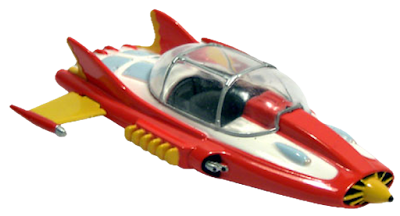 “Mike would check his systems, and engage each engine in turn — 9,000, 12,000, … to 15,000 rpm,” recalled a Supercar fan page. “When the external controller had engaged the ‘interlock,’ Mike would press the ‘fire’ button and each engine would ignite in turn. The roof doors would be opened, Mike would select vertical take-off, then the craft would rise vertically. Mike would extend the retractable wings and then be off into another adventure.
“Supercar had eight rockets which, like the retractable wings, were electronically operated and could be controlled from afar by using the special remote-control device. When on land, or travelling roadways, Supercar didn’t actually touch the ground, but instead hovered just off the surface.”
 As an instrument of scientific exploration, Supercar was unarmed, although its propulsive rockets could be used for destructive purposes in a pinch.
I loved the vehicle’s sleek design, which didn’t seem as ridiculous to me as Anderson’s purportedly human marionettes.
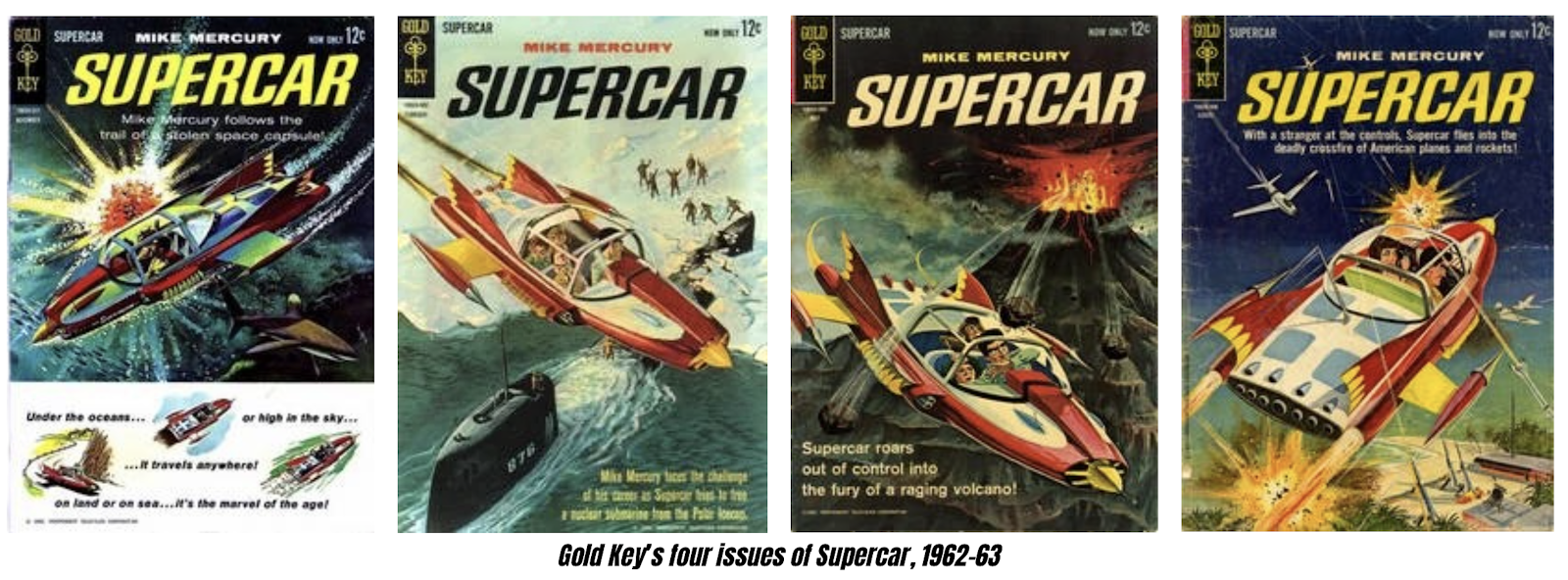
In Gold Key’s four issues of Supercar, the wonder-wagon recovers a stolen space capsule, serves as a “magic carpet” in a Middle Eastern exploit, overcomes jungle rebels, frees a submarine trapped in an ice floe, observes a volcanic eruption, soars into space to locate lost satellites, discovers a secret underwater city and battles pirates who raid by hydroplane.
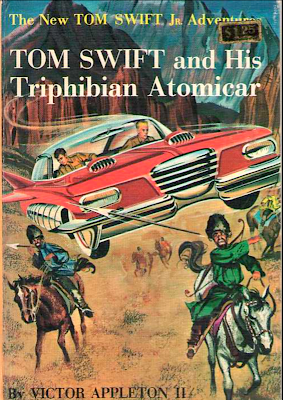
One wonders if Supercar caught the attention of the Stratemeyer Syndicate: 1962’s Tom Swift and His Triphibian Atomicar, a novel in the long-running series published by Grosset & Dunlap, features a highly similar concept. The Atomicar, which can travel on land, water and in the air, even looks like Supercar in Charles Brey’s cover illustration.
About Author
