
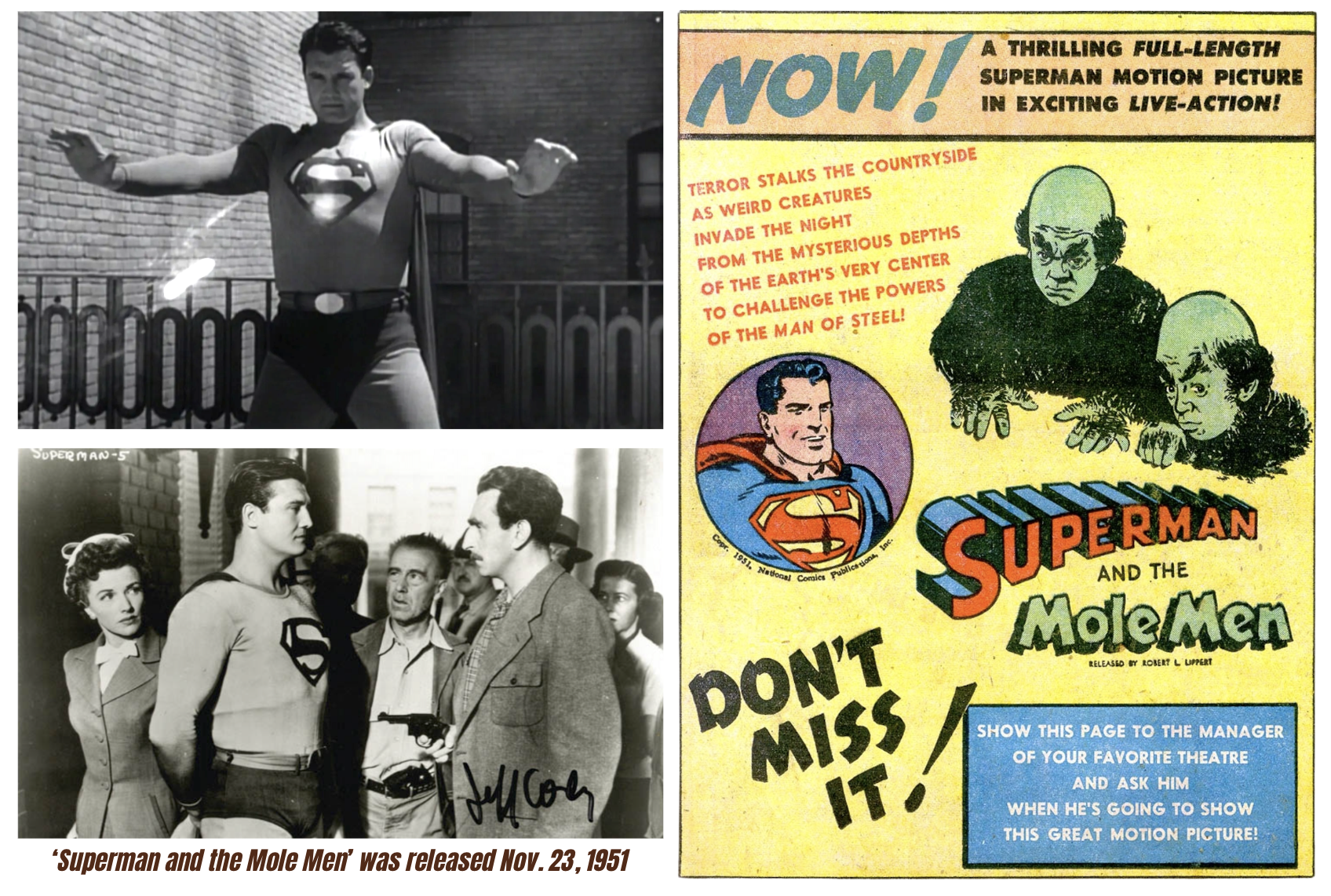
The man from the sky versus the men from the center of the Earth.
Well, not “versus,” exactly. Superman would end up protecting the small strangers from the violent, unreasoning prejudices of we surface dwellers.
Comics historian Bill Schelly noted that in 1951, “…near the year’s end, an event occurred that would soon have major ramifications for National. Superman and the Mole Men, a low-budget movie, was released on Nov. 23. The black-and-white film was the first feature film based on National characters… It was also the first time George Reeves played the Man of Steel. As much as George Reeves defined the role of Superman, the role of Superman defined George Reeves.”
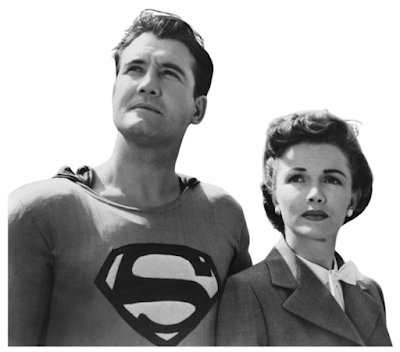 “Phyllis Coates first donned (Lois Lane’s) press hat in 1951’s Superman and the Mole Men, a delightfully oddball feature that introduced George Reeves’ earnest, square-jawed Superman to the world,” recalled Silver Screen Hub. “Mole Men aside — and yes, they were as wonderfully bizarre as you’d hope — what really jumped out was Coates’ take on Lois. She didn’t fawn. She didn’t swoon. She poked, prodded and challenged. She was a working woman first and foremost, and any starry-eyed glances toward Superman were tempered with journalistic suspicion. She wasn’t a romantic foil. She was a narrative counterweight. When the TV series launched in 1952, Coates brought that same no-bull energy to the small screen for its first season.”
Superman’s impressive Paramount movie cartoons had run their course, with the last, Secret Agent, having been released in 1943. Superman had last been seen on screen just a year earlier battling Lex Luthor in a serial (Atom Man vs. Superman, 1950, with Lyle Talbot and Kirk Alyn starring).
The fantastic elements in that serial — teleportation, a kind of “Phantom Zone,” and more — are matched in the feature film by the fantasy of an underground civilization uncovered by oil drilling.
In 1945, a different Atom Man had been the villain in one of the most popular storylines on the Superman radio show. The Mole Men feature also picked up a major theme from the radio show, the denunciation of prejudice. In 1946, the Clan of the Fiery Cross storyline had featured Superman fighting white supremacists.
When the luminous but harmless Mole Men emerge at night, they terrify townspeople. Superman must first protect the Mole Men from an ugly mob whipped up by the fanatical Luke Benson, and then Benson himself from a ray gun that the Mole Men wield in self-defense.
As in his first story in 1938’s Action Comics 1, Superman faces down a lynch mob.
“I’m going to give you one last chance to stop acting like Nazi stormtroopers!” he tells them. “Since you can’t be trusted with guns, I’ll have to take them away.”
“The sympathetic view of the aliens in this film, and the unreasoning fear on the part of the citizenry, has been compared by author Gary Grossman to the panicked public reaction to the peaceful alien Klaatu in the film The Day the Earth Stood Still, which was released the same year,” noted the Superman Wiki. “Both films have been seen retrospectively as a product of (and a reaction to) the ‘Red Scare’ of post-World War II.”
Jeff Corey played the heavy, and he got another lesson in prejudice when he was placed on Hollywood’s blacklist. “His portrayal of a xenophobic vigilante coincidentally reflected what was about to happen to him,” Wikipedia notes.
Blacklisted for 12 years after he refused to name names before the House Un-American Activities Committee, Corey eventually became known as one of the foremost acting teachers in the U.S. His students included Kirk Douglas, Jack Nicholson, Robin Williams, James Dean, Jane Fonda, Peter Fonda, James Coburn, Leonard Nimoy, Cher, Rob Reiner and Barbra Streisand.
After its theatrical release, the film became a two-part episode of The Adventures of Superman TV series, retitled The Unknown People.
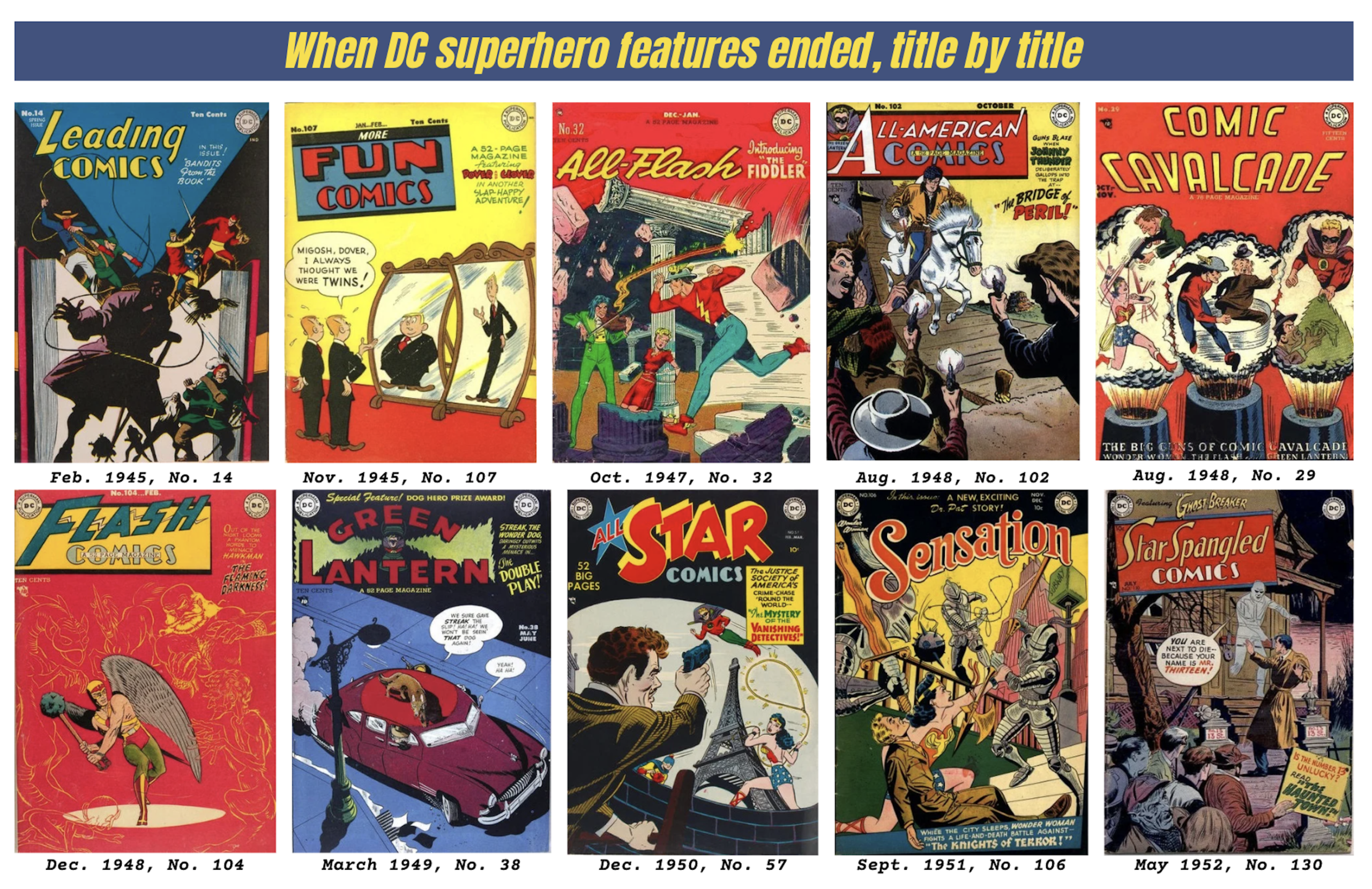
Superhero comic books were dying out in 1951, but the popularity of the Superman TV show rescued the genre for a whole new generation.
About Author
