
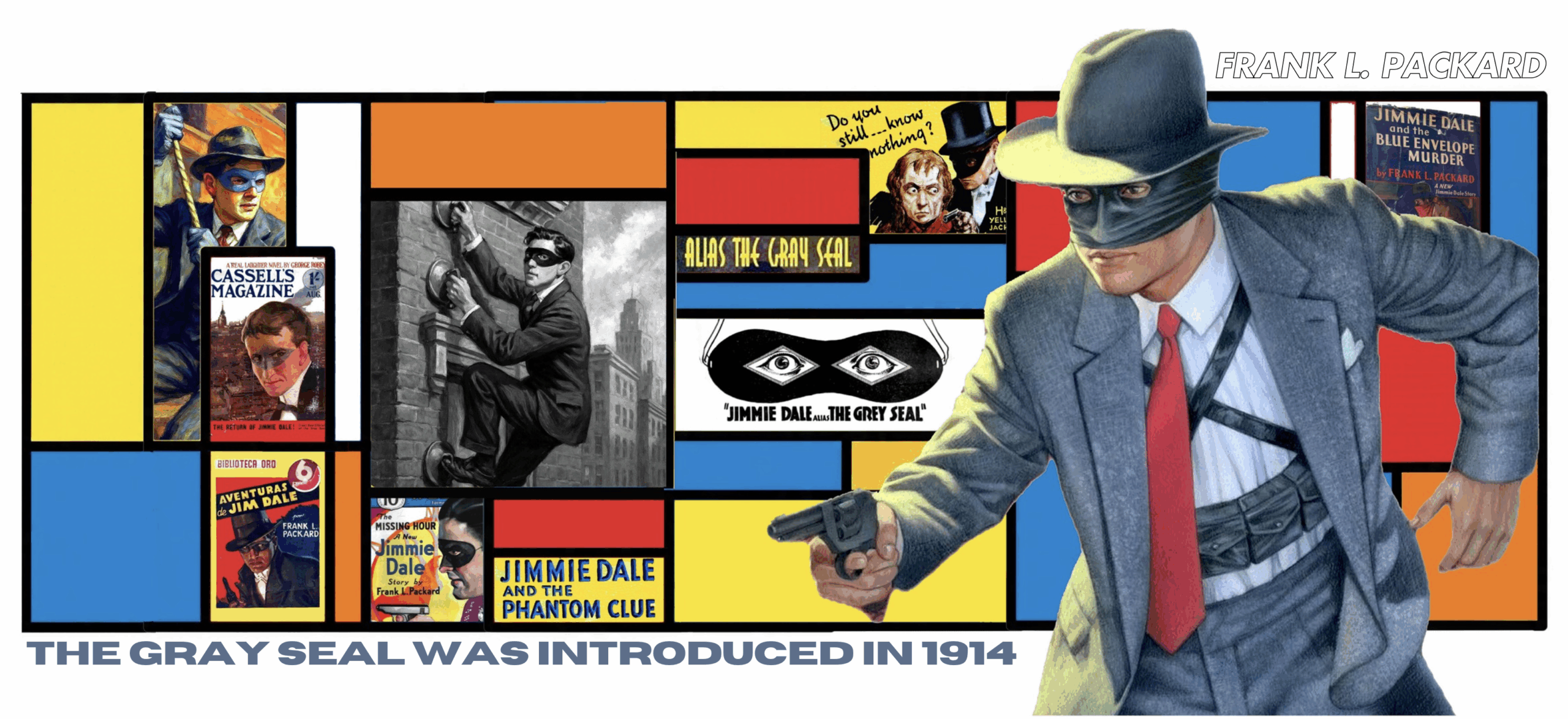
“There was a bull-like roar, the shrill CHEEP-CHEEP-CHEEP of the patrolman’s whistle, and a shattering crash as the officer flung his body against the partition — then the bark of a revolver shot, the tinkle of breaking glass, as the man fired through the office window — and past Jimmie Dale, speeding now for the front door, a bullet hummed viciously.
“Out on the street dashed Jimmie Dale, whipping the mask from his face, and glanced like a hawk around him. For all the racket, the neighborhood had not yet been aroused — no one was in sight. From just overhead came the rattle of a downtown elevated train. In a hundred-yard sprint, Jimmie Dale raced it a half block to the station, tore up the steps, and a moment later dropped nonchalantly into a seat and pulled an evening newspaper from his pocket.”
— The Adventures of Jimmie Dale by Frank L. Packard
The Gray Seal was a popular mystery man who’d be a mystery to most people today.
A proto-superhero, he fought for justice from behind a masked persona in a series of stories that began before World War I.
“Few characters as obscure as Canadian novelist Frank L. Packard’s gentleman cracksman, Jimmie Dale the Gray Seal, have had the impact and long-term import of this one,” observed David L. Vineyard. “From his secret lair, the Sanctuary, his multiple identities and his calling card — a gray diamond paper seal — Jimmie Dale set the pattern for the mystery men and superheroes who will follow.”
“Jimmie Dale was a wealthy young man-about-town — part of, and perhaps inspiring, a long tradition of wealthy crimefighters that includes the Scarlet Pimpernel, Zorro, the Spider, Batman, and non-masked crimefighters like Peter Wimsey and Paul Temple,” noted D.K. Latta.
When radio writer Fran Striker was first assigned to launch the crime series that was to become The Green Hornet, (radio station owner) George W. Trendle presented him with a copy of a Jimmie Dale novel and asked him to create something like it,” Will Murray noted.
Introduced by Packard in 1914, the Harvard-educated hero fought evildoers in the guise of the Gray Seal, always leaving a gray diamond-shaped stamp at the scene of his crimes. Dale’s family wealth came from a safe-manufacturing firm, so he had easy access to their secrets.
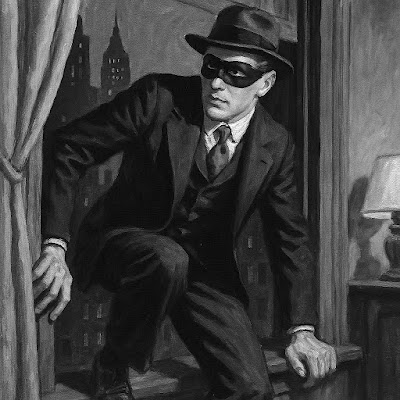 “His gimmick was that he was an expert lock-pick and safecracker (who carried his pick-locks, along with his box of seals, in a special girdle he wore under his clothes — shades of Batman’s utility belt),” Latta noted.
The point of leaving behind his insignia was so that others wouldn’t be blamed for the burglaries in which, initially, Dale didn’t steal anything.
“The Gray Seal’s only signature visual accoutrement was a black silk mask (with a lot of early pulp and radio ‘mystery men’ the details of any costume were often vague, their signature look — Zorro’s all-black ensemble, the Green Hornet and Kato’s green trench coat and black chauffeur’s uniform — only being entrenched once they started appearing in films and comics),” Latta wrote.
Although he carried a gun, the Gray Seal was reluctant to kill his enemies, who included members of the Crime Club and a master of disguise called the Phantom.
“His greatest fear is being caught — not because he’ll go to prison, but because he’ll besmirch his good name in New York society,” noted William L. DeAndrea.
For intelligence-gathering purposes, Dale operated not only as the Gray Seal, but also as the lowlife criminal Larry the Bat and the drug-addicted artist Smarlinghue, retreating when necessary to the Sanctuary, an apartment he used as a secret base.
Initially just a thrill-seeker, Dale began receiving letters from a mystery woman known only as the Tocsin (her nom de guerre being French for “alarm bell”). She threatened to expose him if he didn’t undertake her covert missions. At first, Dale had to be blackmailed into becoming a crimefighter.
In the 1920s, the same mystery-lady gimmick was employed by Bruce Graham for his stories about the dashing masked burglar Blackshirt.
The first Jimmie Dale short story, The Gray Seal, was published in the May 1914 issue of People’s Ideal Fiction Magazine. Between 1917 and 1935, Packard published five books about the Gray Seal, as well as various other novels focusing on upper-class New Yorkers being involved with criminals.
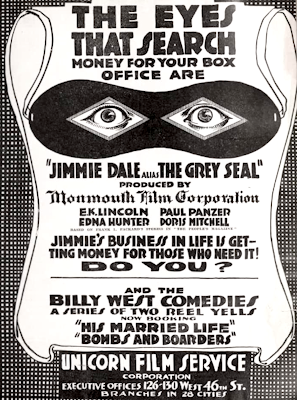 In 1917, the character was featured in a 16-chapter silent movie serial called Jimmie Dale, Alias The Grey Seal.
“Perhaps the oddest mystery about the Jimmie Dale stories is that they have fallen into such obscurity … because they’re pretty good,” Latta observed. “In some ways, the Jimmie Dale stories are more literary versions of pulp stories. Later pulp hero adventure writers often affected a deliberately stripped-down, just-the-essentials style, whereas Packard’s prose can seem more descriptive, more full of palpable atmosphere and imbued with deeper emotional gravitas.”
Among the character’s fans was a young Kenneth Millar, who was later to adopt his own dual identity as Ross Macdonald, the creator of the celebrated private detective Lew Archer.
“After dorm bedtime, he’d rig a mirror to reflect hall light on his pillow so he could read into the night,” wrote biographer Tim Nolan. “Ken Millar liked stories of heroes who worked outside the law, righting wrongs and making the rich pay, (particularly those of) gentleman thief Jimmie Dale.”
About Author
