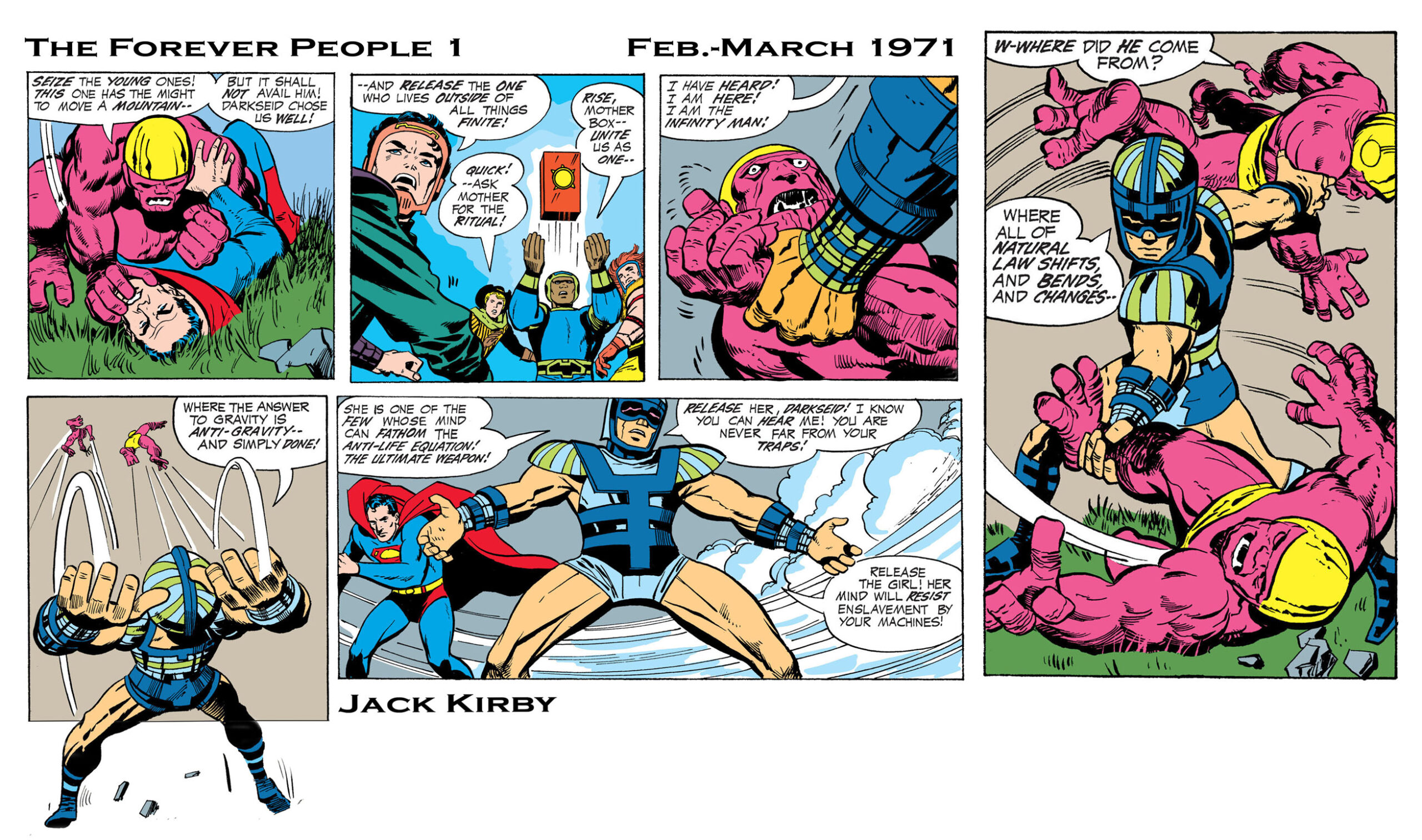
Heeding the late-1960s zeitgeist, writer-artist Jack Kirby cleverly turned his venerable kid gang concept into a team of super-hippies.
 Beautiful Dreamer, Big Bear, Serifan, Vykin the Black and Mark Moonrider (a name that somehow suggests “Luke Skywalker” to me) were the title characters in Forever People 1 (Feb.-March 1971), one of Kirby’s Fourth World titles freshly minted for DC. The issue hit newsstands in December 1970, simultaneous with Kirby’s New Gods 1.
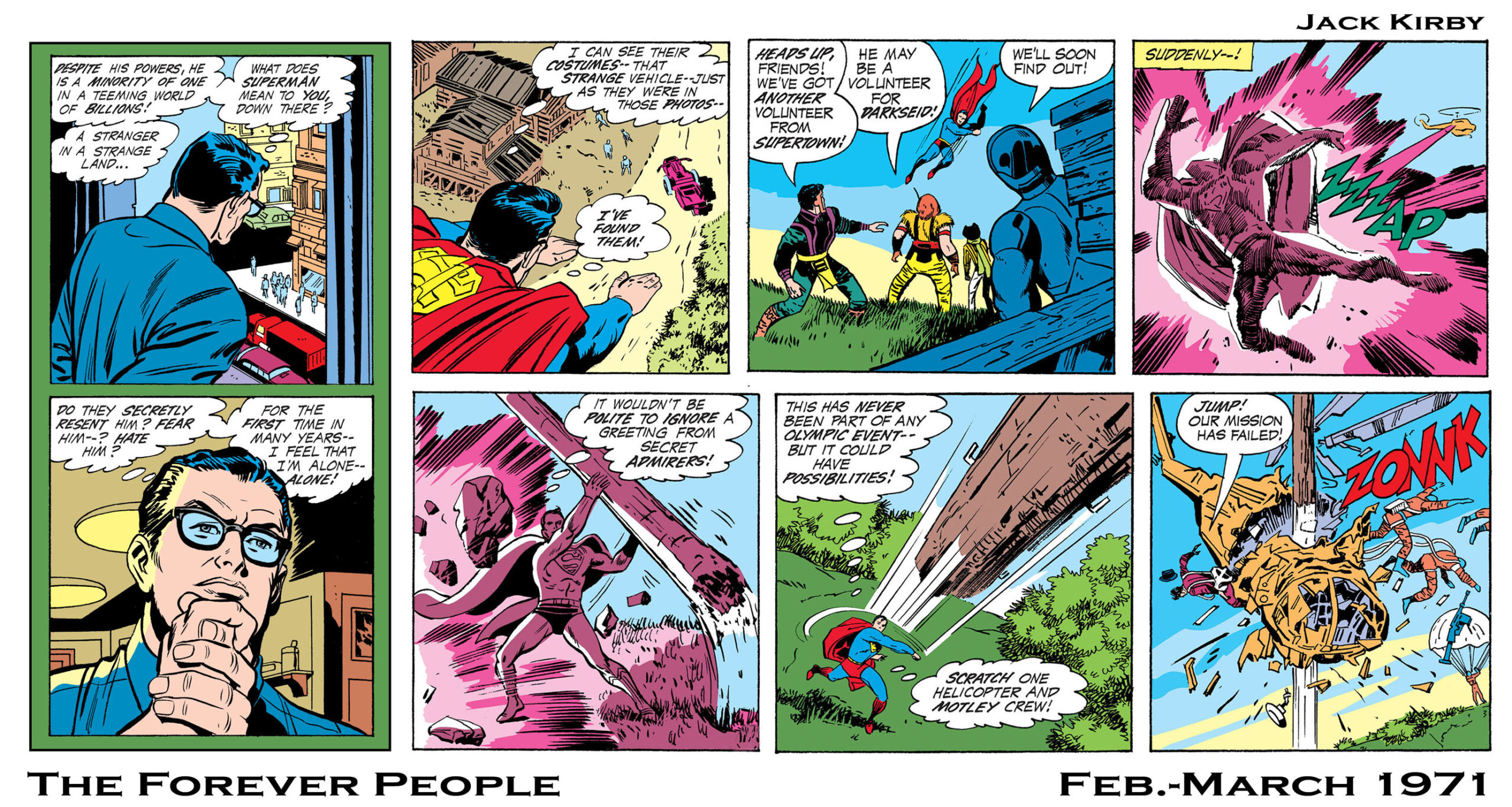
One of the things that fascinated me about that first issue was seeing comics’ most celebrated action artist take on comics’ central superhero.
I ignored Superman’s unnecessarily redrawn face, and focused on the dynamism Kirby imparted to the character. Superman had grown stately and sedate in the Silver Age, and Kirby brought back the raw energy that had originally propelled the feature 30 years before.
We see the Man of Tomorrow uproot a telephone pole and hurl it into the sky to spear an Intergang helicopter — just the kind of thing the Thing, Thor or the Hulk might have done in their earliest, most exciting days. This straining Superman leaped from panel to panel with a newfound vigor.
 Superman’s characterization seemed off-model, however. Kirby presented the Man of Steel as desperately lonely and eager to meet these newly arrived “super-people,” the Forever People. But that seemed inconsistent because A) Superman already knew lots of super-people and B) Superman, as Clark Kent, was long established as identifying with ordinary humanity, the people he made it his mission to rescue.
I understood Kirby’s angle, though. He was exploring the interesting idea that some people would certainly fear and resent their super-savior, no matter how many times he’d rescued them. This was a central theme at Marvel Comics, the company he’d just left.
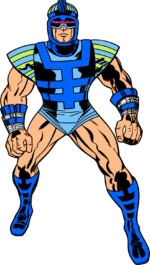
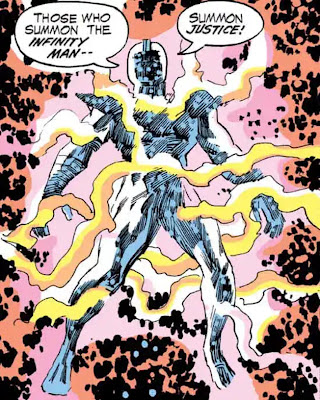
As the Forever People story progressed, I was less interested in the super-hippies, and more interested in what they could become, or channel — a being called Infinity Man who was powerful enough to rescue Superman himself from Darkseid’s magenta-skinned Gravi-Guards. They had Superman pinned with their ability to “…transmit gravity waves from heavy mass galaxies.”
The Forever People were essentially multiple Billy Batsons who could, by shouting “Taaru,” summon up a Captain Marvel whose powers included super-strength, flight, invulnerability, telepathy, super-healing, magnetism, phasing through matter, energy and matter manipulation, and the ability to “bend” natural law, among others.
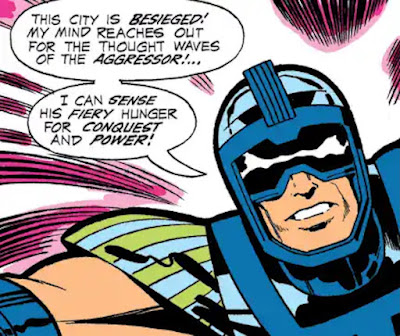 Back at Marvel, another character symbolic of contemporary youth, Rick Jones, had also gained the power to “trade atoms” with a latter-day Captain Marvel (Captain Marvel 17, Oct. 1969).
Just shows you the popular persistence of the concept of one magic word, Shazam. Within a couple of years, DC would finally revive the original Captain Marvel in a title called Shazam!
Infinity Man had golden skin, a shade paler than that of Him, another omnipotent being Kirby had created for Marvel who was later renamed “Adam Warlock.”
Forever turned out to mean only 11 issues, but Kirby’s concepts live on. The issue also introduced the Mother Box, a kind of omnipotent, benevolent computer no bigger than the proverbial breadbox.
I have been reminded of this story ever since people started carrying the sum total of civilized knowledge in the palms of their hands.
After all, what are cell phones but proto-Mother Boxes?
About Author
