
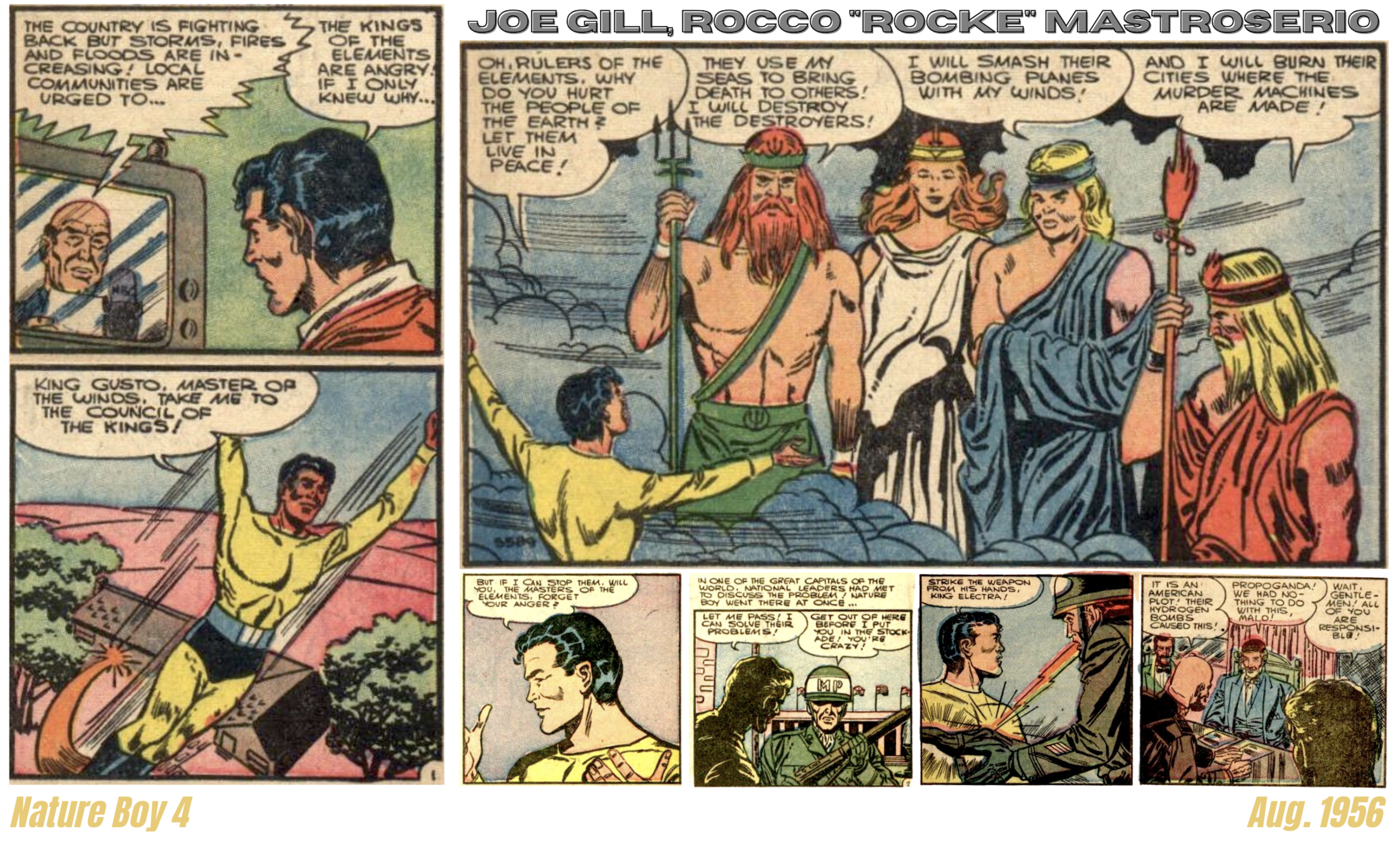
Writer Jerry Siegel had already co-created a Superman who came from outer space, and a super-ghost powered by the heavens.
Okay then, how about a superhuman who hails from the opposite direction — a superman from the Earth and its seas?
“Siegel bounced around from publisher to publisher trying to find traction after his lawsuit against DC Comics failed to recover the rights to Superman,” recalled comics historian Craig Yoe. “Siegel’s endeavors gave us Funnyman, The Invisible Boy, Jon Juan The World’s Greatest Lover, and here, Nature Boy.”
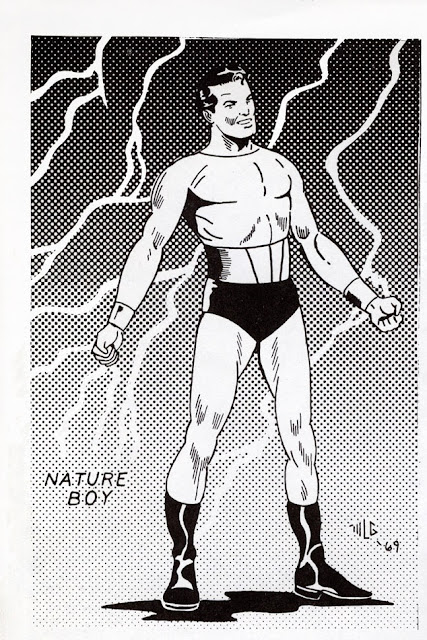 Taking his cue from a popular song and working with artist John Buscema, Siegel created “a strange, enchanted boy” for Charlton Comics in 1956.
Lost at sea, young David Crandall was rescued by eight elemental gods who granted him power over natural forces. Among them were mastery over water and the ocean; command of the winds; control of fire; power over the earth; control over lightning and electricity; power over ice and cold; command of the skies and — well ahead of Huey Lewis and the News — the power of love. His “psychic mind” can sense suffering.
He debuted in Charlton Comics’ Nature Boy 3 and lasted only another two issues.
“Siegel would go on to create many of the members of the Legion of Super-Heroes,” noted comics historian Michael E. Grost. “Like them, Nature Boy is an idealistic, mature, capable teenager, with a series of specialized powers. He is a responsible person who plays a leadership role in the world of grown-ups.
“The phrase ‘Nature Boy’ had a long history before this comic book, but it is hard to express exactly what it meant. Partly, it indicated a nature lover and outdoors type, such as our hero here, who loves being outside. Partly also, it perhaps suggests an earthy, direct, romantic type. It is an oddly romantic and suggestive title for a superhero.
“Nature Boy does not control the elements in the detached way Superman, say, controls his powers. Instead, the elements are his friends, and carry out his wishes. This is a bit like Aquaman, and his underwater sea animal ‘friends.’”
Like Wonder Woman, Nature Boy was concerned about bringing peace and harmony to humanity.
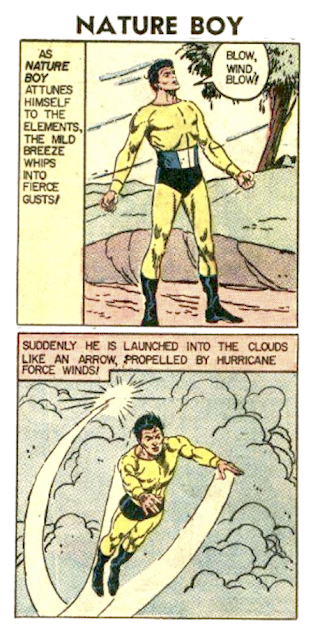 Despite its short run, the feature offered something of a “Nature Boy Family” (Fawcett’s popular The Marvel Family title having ceased publication only two years before).
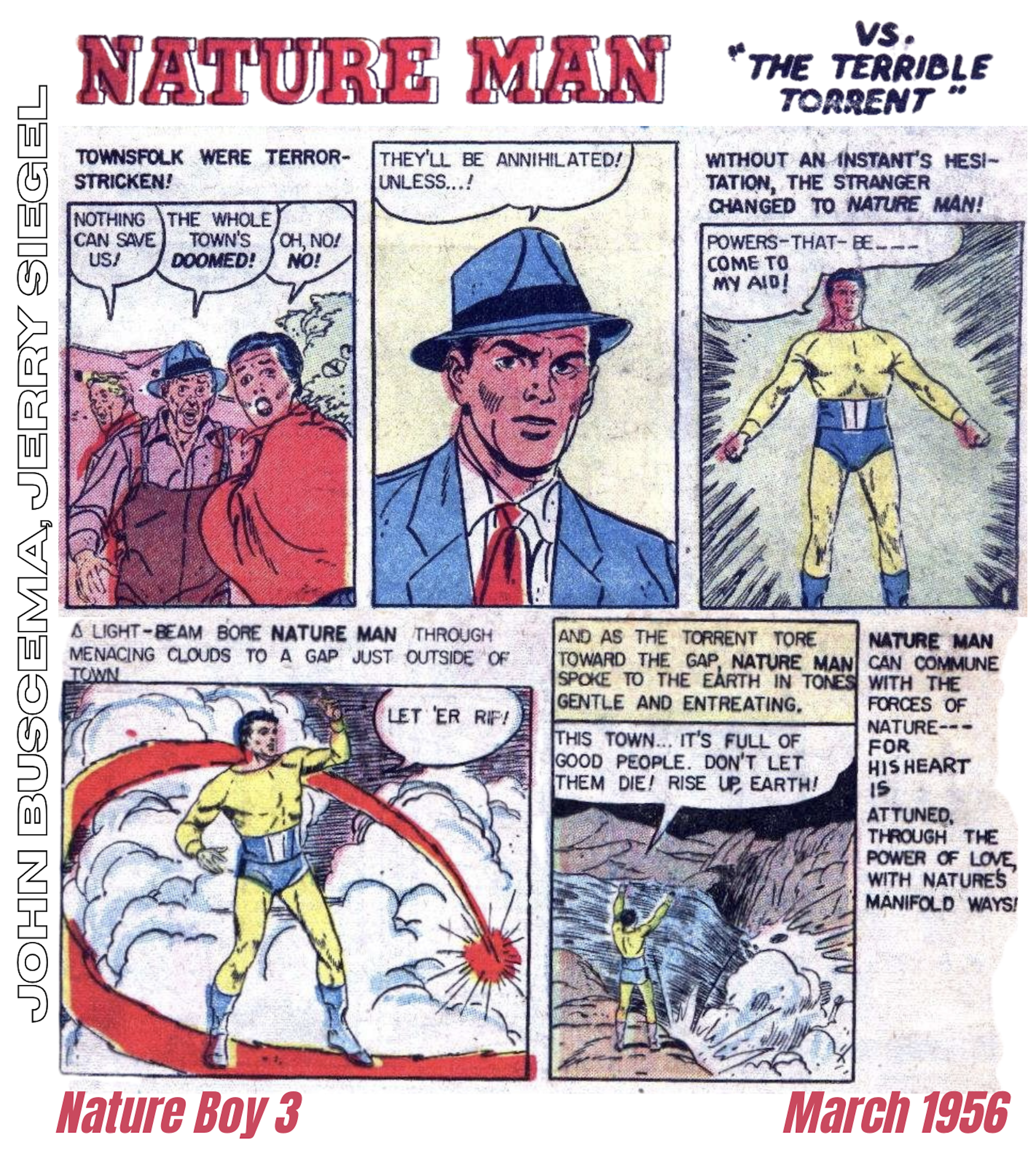
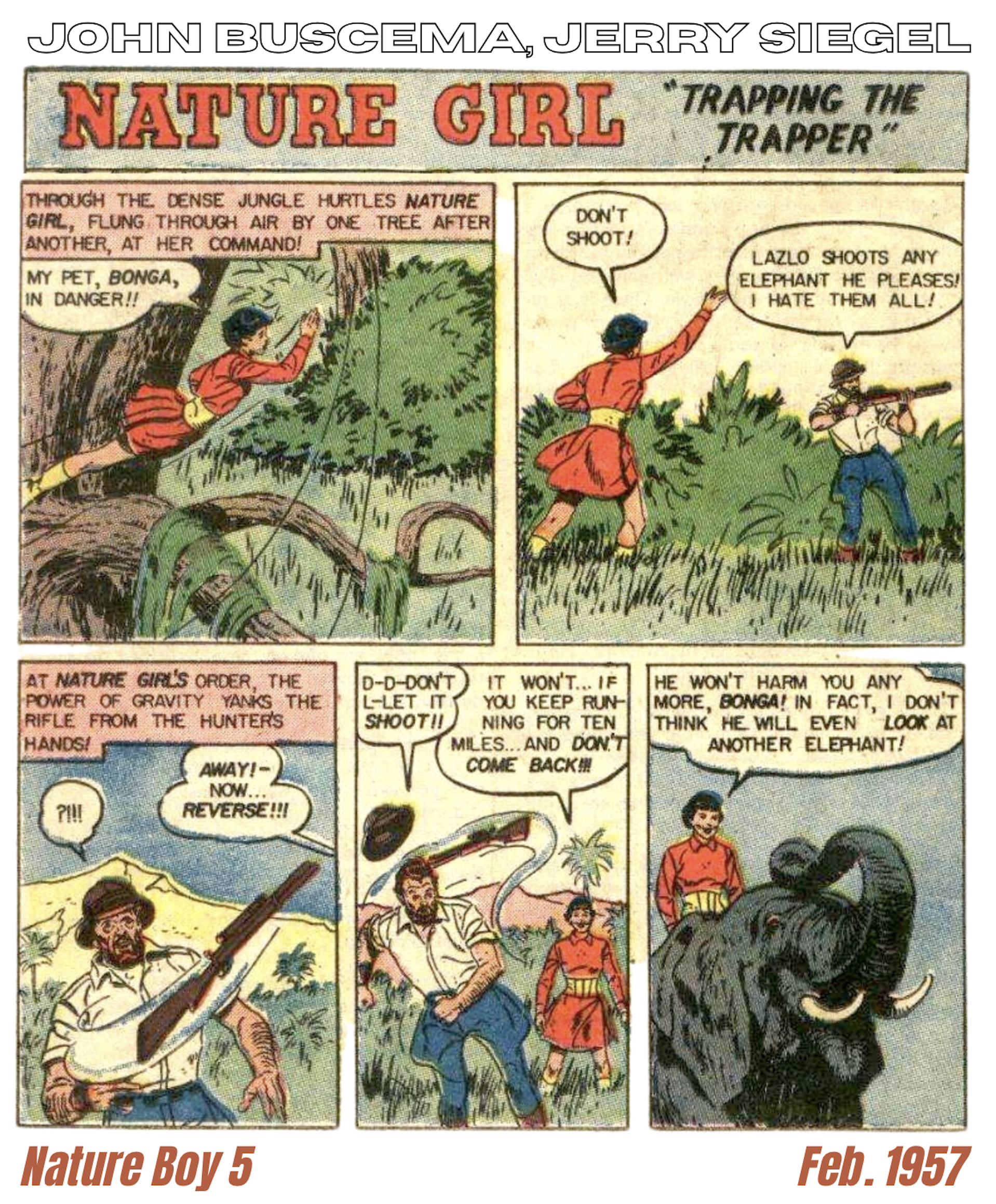
Nature Man — possibly an adult version of the character, or a separate character entirely — appeared in the first issue, and Nature Girl had a one-page story in the last.
“While not written or drawn anywhere near the level of the new Flash, the adventures of David Crandall were imaginative and more than competently done —that is, before Buscema was replaced by lesser artists such as Rocke Mastroserio,” wrote comics historian Bill Schelly. “Siegel even had grand expansion plans, briefly introducing Nature Girl and Nature Man in the book. It all came to naught, but not for lack of trying.”
“Nature Boy 3 had a story in its back pages about the Blue Beetle, reprinted from an old Fox comic book,” observed comics historian Don Markstein. “He’d eventually wound up at Charlton after Victor Fox’s properties were scattered following his bankruptcy and disappearance years earlier. This was the last of several stories Charlton published about that character before launching a new Blue Beetle in 1964.”
“Superhero fans… tend to think of the 1950s as a vast wasteland in comics history, the time between the superhero efflorescence of the early ’40s and its resurgence in the ’60s, which only a few hardy survivors — Superman, Batman, Wonder Woman and their hangers-on, Aquaman and Green Arrow, all DC Comics characters, successfully spanned,” Markstein said. “But quite a few, including Plastic Man and Johnny Quick, very nearly made it from one period to the next; several, such as Sub-Mariner and the Flame, were revived during that time; and even a few new ones, like Captain Flash and the Avenger, popped up between the demise of the Justice Society of America and the rise of its ’60s counterpart, the Justice League. Nature Boy was part of that last group.”
About Author
