
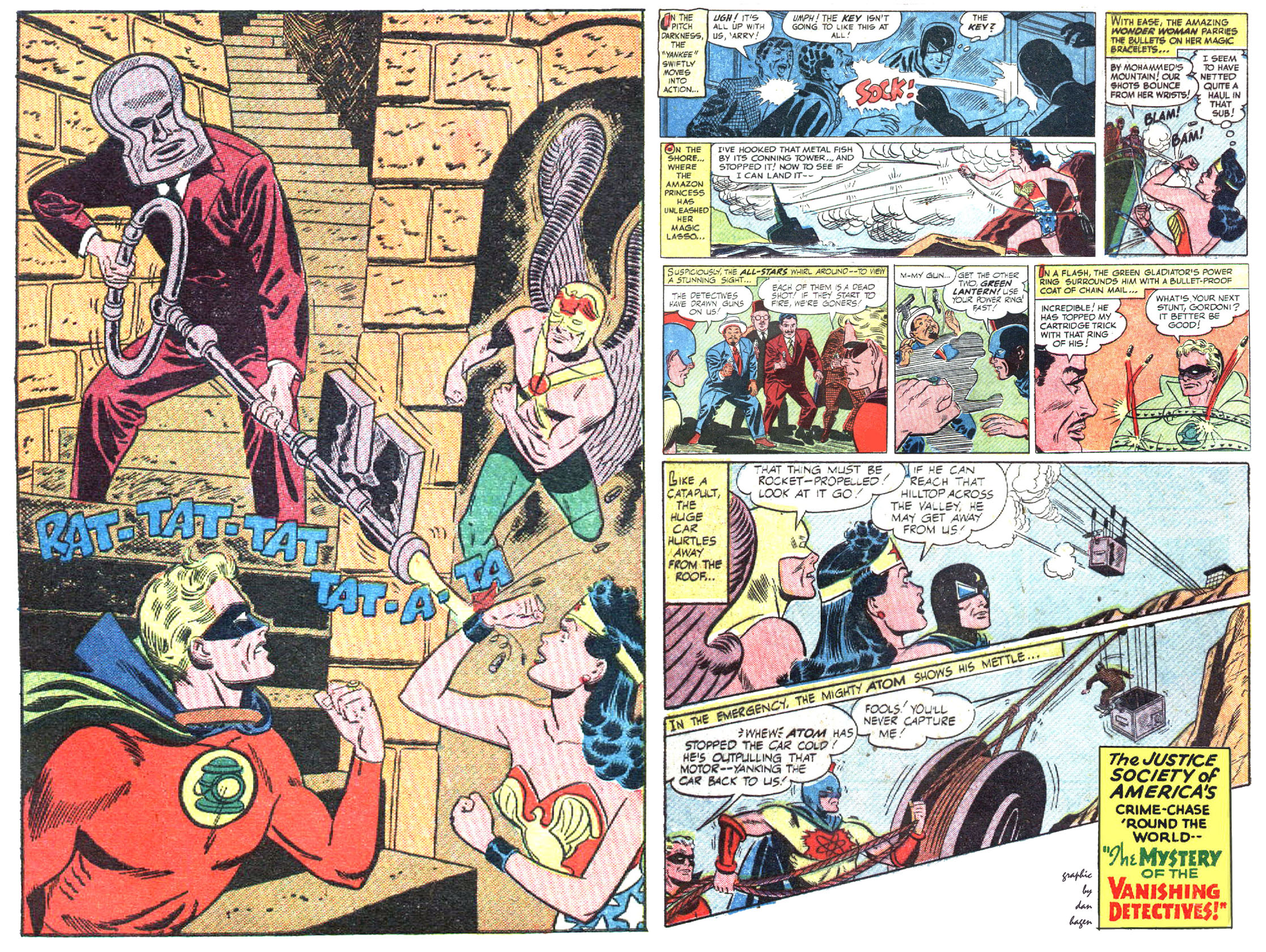
In the early 1960s, DC Comics tantalized us with allusions to the forgotten mystery men in this “Justice Society.”
“It has to be unbelievable to comic book readers today that, back in 1960/1961 and only 10 years after the JSA’s final appearance in All-Star Comics, such characters could be so forgotten,” wrote Fred Marra.
During the 1950s, comic books took a hard turn away from such colorful and fanciful fare as the Justice Society.
“The witch hunts against comics also added to their demise and gave us a decade of watered-down family-oriented silly books,” wrote somebody who styles himself A.M. Gman. “To be fair regarding the crime-related titles, they were only returning to the roots of pulp in an effort to salvage the medium. I’m glad I was a kid in the ’70s when the characters were coming back into their own.”
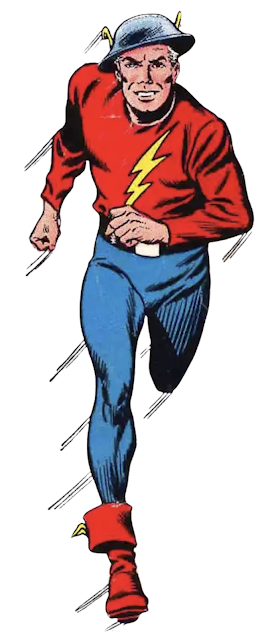 “(DC editor) Julie Schwartz had actually teased readers of the Justice League of America with the JSA in the letter columns as old-time readers like Roy Thomas would write in and mention the team, until someone asked who was on the team and Julie listed ALL of the members!” recalled comics historian Paul Zuckerman. “And then, within weeks apart, Flash 123 and the first Showcase Atom appeared with that reproduction of the JSA’s first meeting! Boy, was I excited to see them! There was something about the fact that the characters were old — and characters 12 years from their last appearance seemed virtually ancient to someone who was not even 10 yet.
“Julie built the JSA slowly with a real tease in the second Flash team-up — a flashback to the last adventure of the team. And then, a year later in the third team-up, the team actually appeared, although only the Flash took part in the action.”
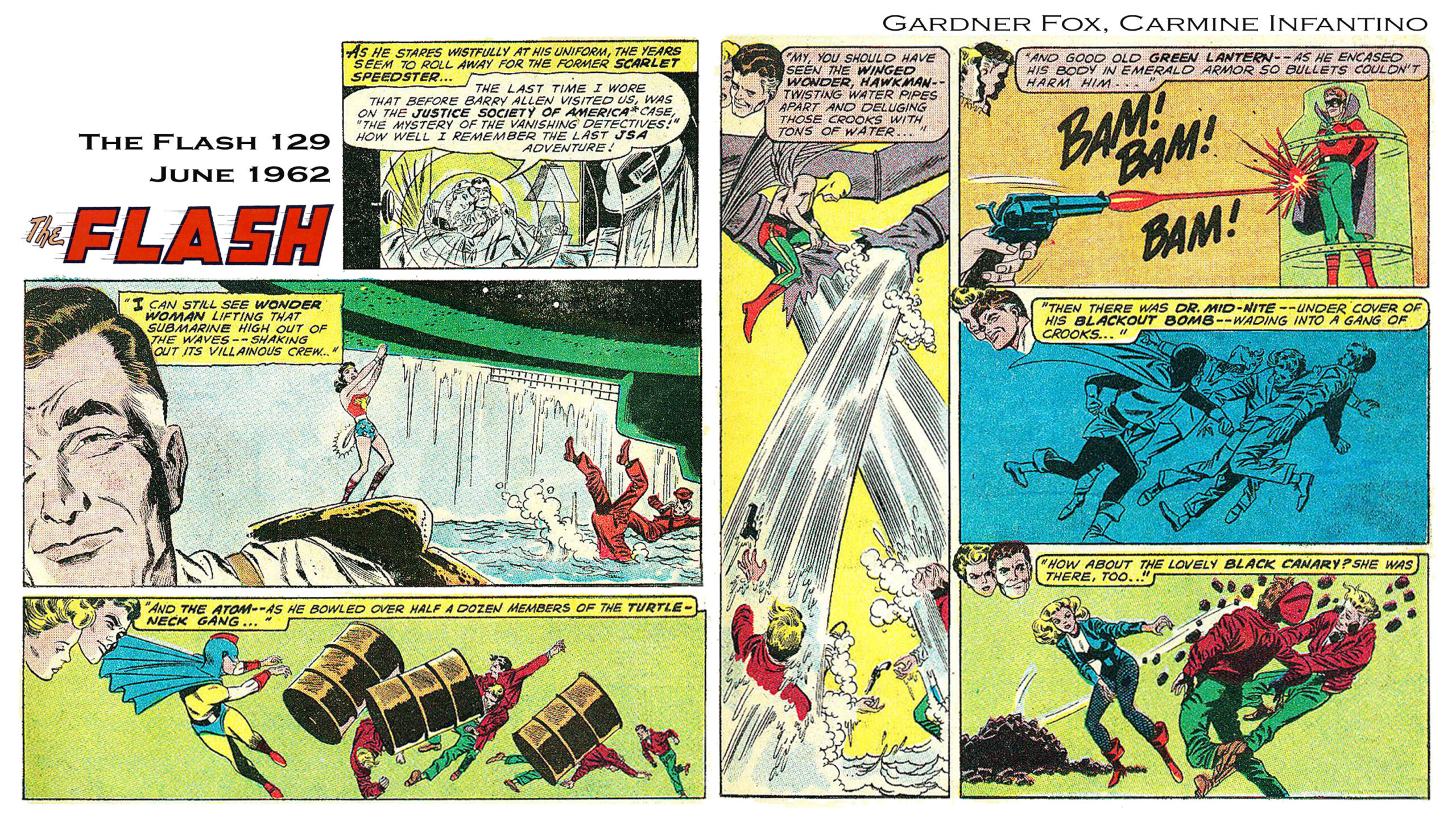
In The Flash 129 (June 1962), Jay Garrick reminisces with his wife Joan about his former teammates in the JSA, specifically recalling their last published adventure, The Mystery of the Vanishing Detectives in All-Star Comics 57 (Feb.-March 1951). The Flash’s fond recollections ranged from the sublime (Wonder Woman lifting a submarine out of the sea) to the near-mundane (the Black Canary clunking crooks with lumps of coal).
I was particularly intrigued to see the earlier incarnation of Green Lantern with his red and green costume and purple cape (my tastes ran to the garish when I was 8).
“All of which led a month or two later to the full-blown revival of the team in JLA 21!” Zuckerman said. “Oh man, was that just so exciting to read. What interested me about the team was that in each of its early appearances, there was a different membership. How many members did the dang thing have after all, I wondered!!!”
“Hard to believe that the forgotten JSA had been out of the picture for only a decade at that time,” observed comics historian Vincent Mariani. “The Golden Age and Silver Age were separated by the 1950s which had the extremes of EC and its imitators’ horror and DC and Dell’s wholesomeness.”
“What is interesting is that it was only five years between the disappearance of the JSA and the first appearance of the Silver Age Flash; and for us young readers in 1961, the 10 years since the JSA had folded shop to then was like forever, man,” Zuckerman noted “It seemed so very long ago! It’s hard to imagine nowadays that one could just start over with a blank slate as they did.”
“It was a special time to be a little kid,” Bob Bailey said.
About Author
