
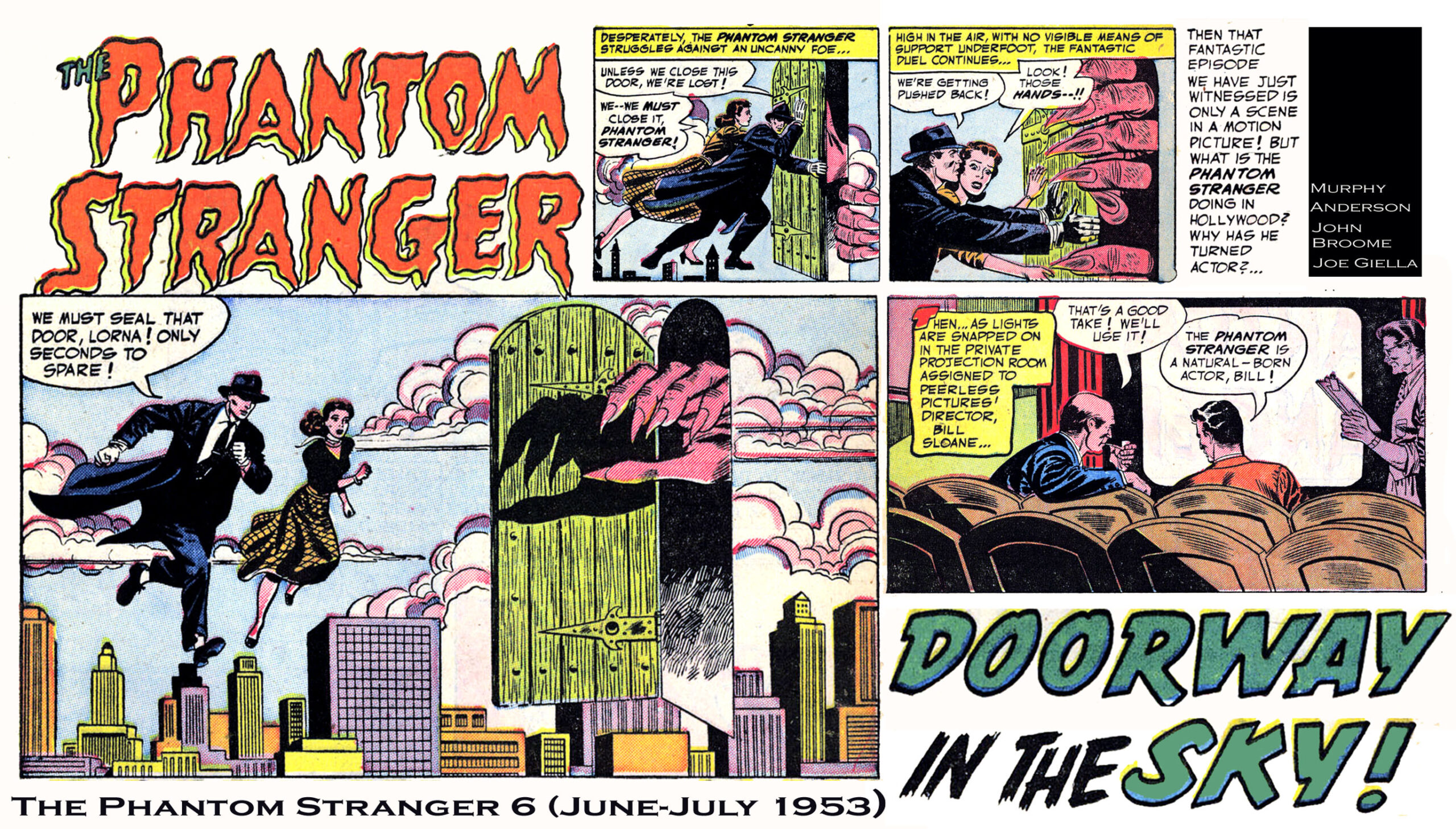
The Phantom Stranger was sort of a Spectre for the conformist 1950s — less extravagant, less obviously a superhero, dressed in an ordinary suit and fedora, but the possessor of ill-defined powers.
He was so mysterious that it wasn’t even clear whether there was anything supernatural or superhuman about him.
“In the early 1950s, most American comic book publishers used stories of horror and the supernatural, often quite grisly and tasteless, as a means of selling their wares,” observed comics historian Don Markstein. “DC Comics, which wasn’t known for hopping on trends toward grisliness and against good taste, responded with a few tepid (but long-lived) fantasy titles without continuing characters, like House of Mystery and Tales of the Unexpected — and with one rather short-lived title based on a continuing character.”
“The Stranger was an ambiguously supernatural character, one who regularly dealt with supernatural menaces and helped people get through crises involving the supernatural, but it wasn’t clear whether he, himself, was anything but a mortal man. He wore an ordinary coat and tie, a trench coat and a hat that cast a deep shadow over much of his face;d the whole ensemble was black. In this, he had a couple of look-alikes in ’50s comics, Charlton’s Mysterious Traveler and Harvey’s succinctly named Man in Black.”
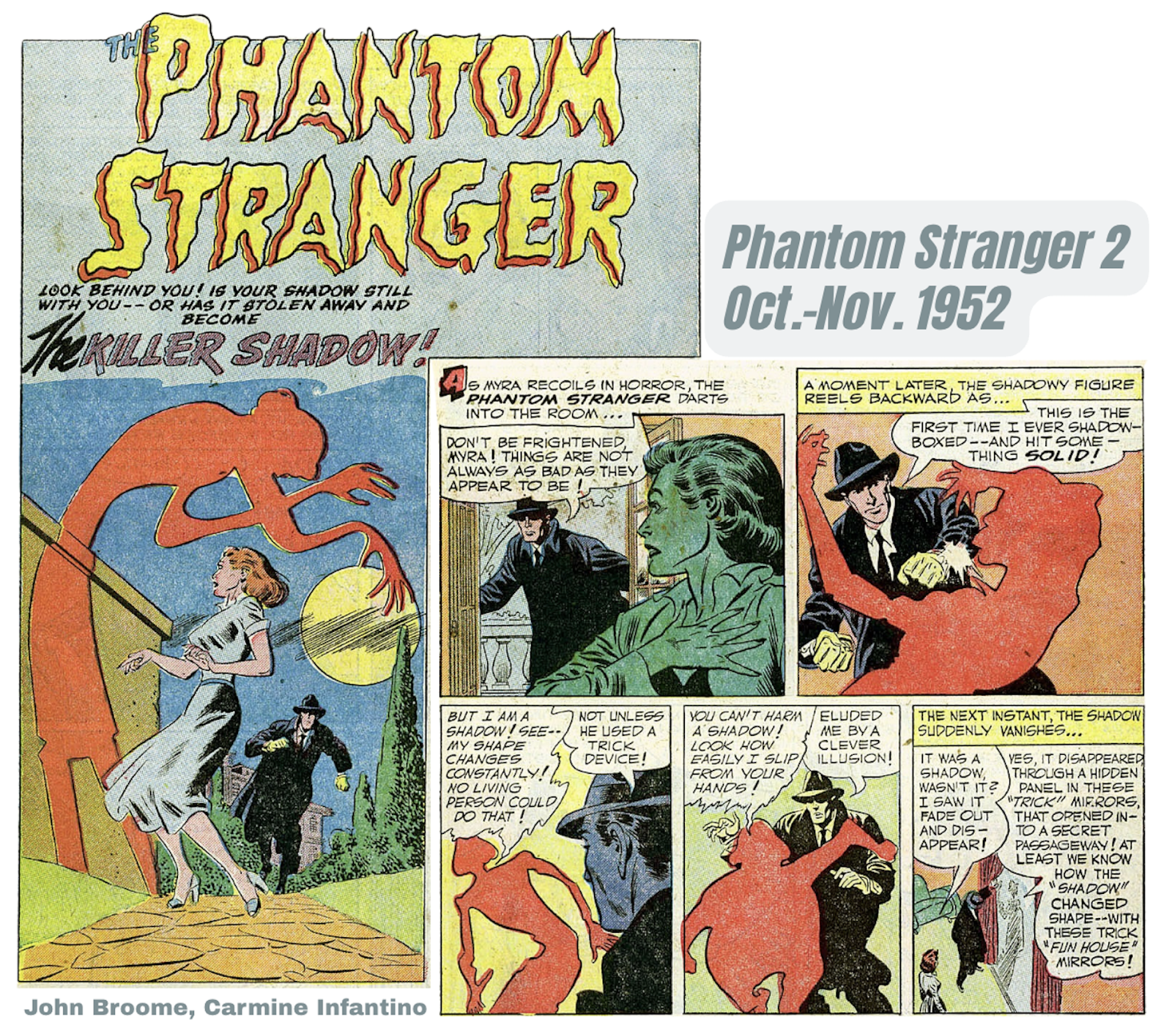
 In the first issue of The Phantom Stranger (Aug.-Sept. 1952), the spooky sleuth solves a phony haunting. “In fact, he solves two phony hauntings and stops a mad magician from his crazy scheme of achieving immortality,” observed Tom Stewart in Back Issue. “The Stranger would appear out of the swirling fog, solve the ghost problem by exposing the greedy relatives or smugglers, evil businessmen and assorted crazy magicians and sorcerers, then vanish back into the ether from whence he came (you just have to use a word like ‘whence’ when talking about the Stranger), all in six-page stories written mostly by John Broome and penciled by Carmine Infantino, over the span of six issues.”
“In the ’50s, the Phantom Stranger was ‘maybe supernatural,’” Stewart wrote. “He was mysterious, sure, but did he have any powers beyond being able to make himself scarce at the wrap-up?”
The cover for the title’s last issue was particularly arresting — the Stranger and a woman desperately attempting to prevent some menacing giant from invading Earth through a doorway in the sky. But the situation turned out to be just a tease, a scene from a motion picture that was being shot.
The Phantom Stranger is, in fact, on hand to protect Lorna, the superstitious star of the picture, from mysterious “accidents.” Actually, they’ve been arranged by Lorna’s stand-in so she can take over the starring role.
After the Stranger pulls his usual Lone Ranger routine, director Bill Sloane says, “He’s gone! So that’s what he meant by telling me to send his salary to the Society for Occult Investigations! That’s why he agreed to appear in the picture!”
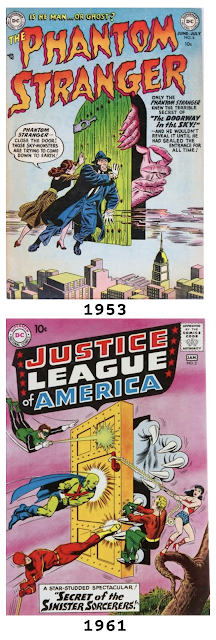
DC would recycle that cover idea in two ways.
Broome himself used the idea of explaining away a striking cover image by revealing it to be a Hollywood film sequence in 1961’s The Flash 118 (where the Scarlet Speedster is racing to intercept a bullet fired at a scarecrow from a helicopter).
And Julius Schwartz and Gardner Fox used the threatening “doorway in the sky” as the cover of Justice League of America 2 (Dec. 1960-Jan. 1961). The Flash, Green Lantern, the Martian Manhunter, Wonder Woman, and Aquaman are shown desperately trying to close the doorway on a giant blue, clawed hand in a scene that actually does appear in the story.
But it’s still a bait and switch, after all. The giant is no monster, but the JLA’s goofily transformed mascot, Snapper Carr.
About Author
