
You might apply many adjectives to Marvel’s early giant monster stories, but “subtle” would rarely be one of them.
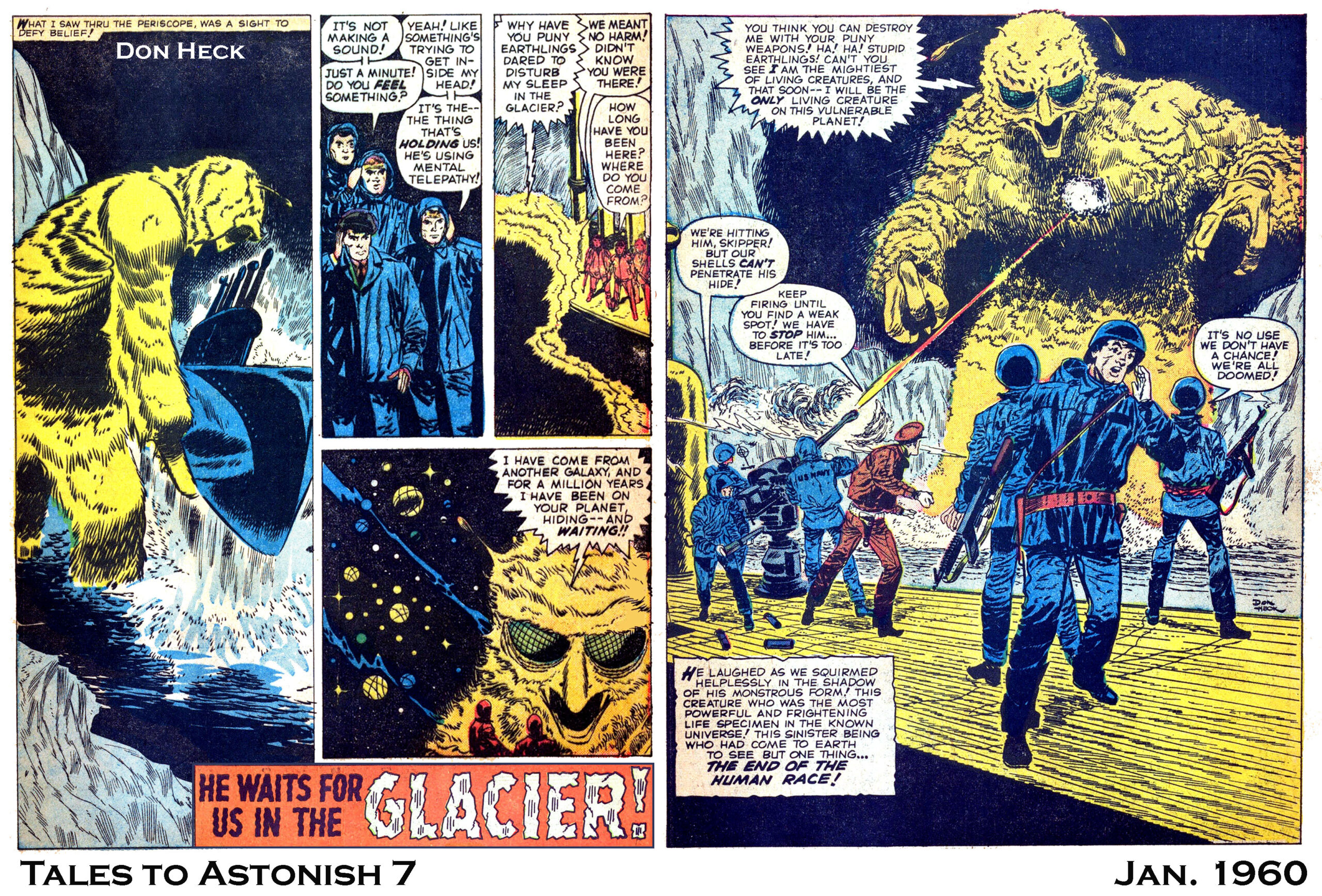
In He Waits for Us in the Glacier! (Tales to Astonish 7, Jan. 1960), artist Don Heck shows us a U.S. nuclear submarine using its “new gamma electrization gun” to melt through a glacier. The successful experiment has an unintended consequence of awakening a gigantic hibernating alien invader.
Yellow-furred, with insectoid eyes and antenna, the hundred-foot-tall being lifts the sub from the ocean. Via telepathy, the monster explains that he belongs to “…a race that sends scouts out to different planets of the universe where we hide and wait … until the life forms of those planets die out. Then we claim those worlds and make them colonies of our mother planet.”
The creature arrived during the dinosaur era and has waited out Neanderthals, human civilization and World War II, which gave it hope.
“Always, more of you humans survived than were destroyed! But then you discovered the secret of atomic energy, and that made me happier than I’ve been for ages… Unless you humans somehow learn to live in peace, I won’t have much longer to wait. You will soon be extinct and I shall claim all of Earth in the name of my planet!”
Thinking back on the encounter, the sub’s pipe-smoking captain says, “And with those fateful words, he put our ship back in the sea … And he faded from sight among the all-concealing glaciers.”
Despite the fact that it was intended for children, the story shares something of the understatedly apocalyptic vibe of Nevil Shute’s 1957 novel On the Beach (which became a quietly chilling 1959 film starring Gregory Peck, Ava Gardner, and Fred Astaire).
In Shute’s story, Australians await the radioactive aftermath of a nuclear war that has already wiped out the Northern Hemisphere. In both these tales, which avoid hysterical melodrama, humanity’s doom is patient but inexorable.
We don’t know who wrote the story, but given the use of the telltale term “gamma,” I’m going to assume it’s Stan Lee.
In a nod to the comic book story’s relative sobriety, Lee refers only once, in passing, to the monster’s name (which is Anuxa). And he thought enough of the low-key tale to include it in the first Strange Tales Annual in 1962.
About Author
