
Early on, Marvel Comics had a Thing and a Hulk. So why not an It?
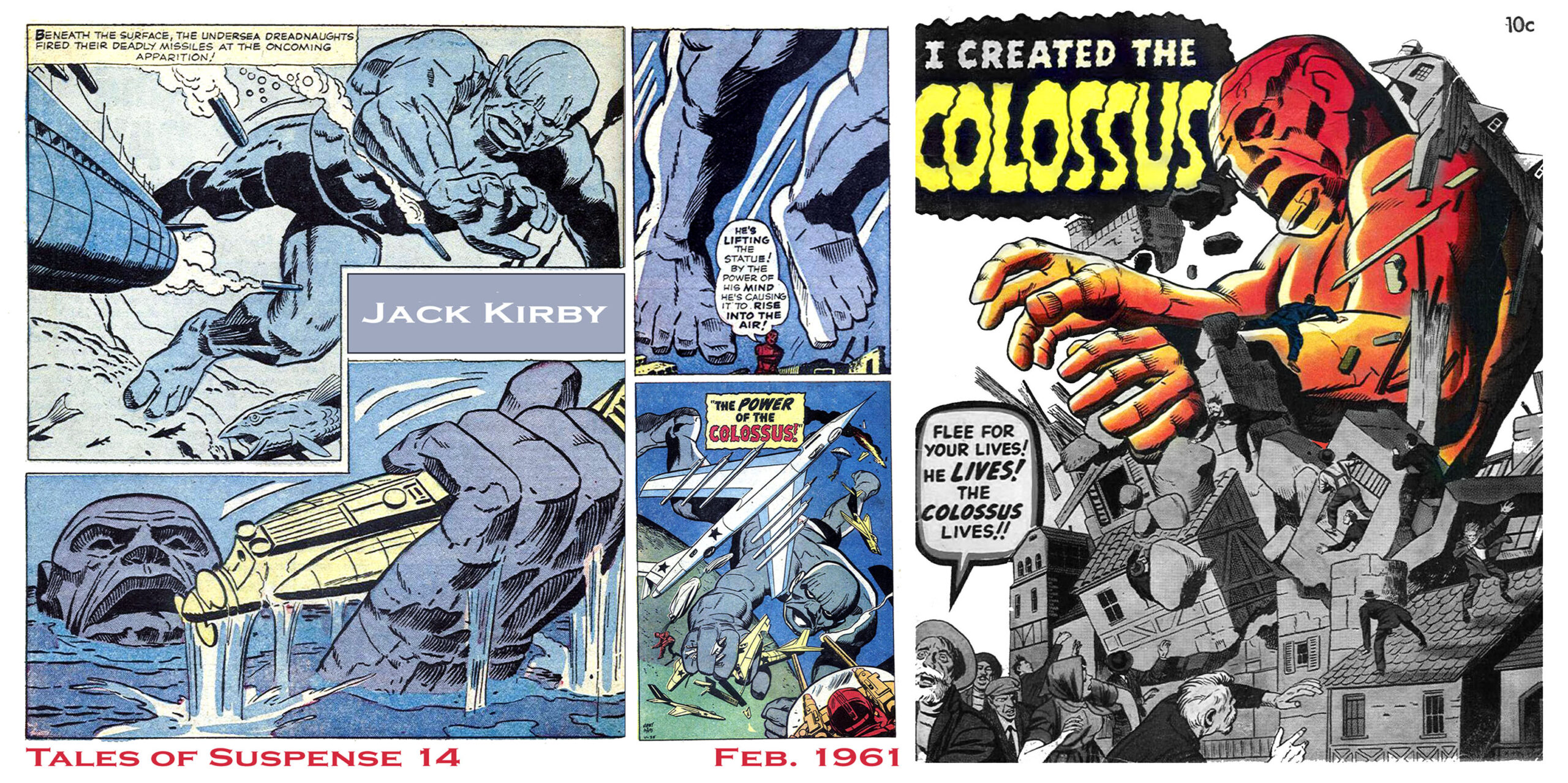
Actually, Marvel had the makings of an It even before the other two man-monsters arrived. In I Created the Colossus (Tales of Suspense 14, Feb. 1961), a dissident Russian artist is compelled to build a statue to glorify the Soviet Union.
Even though he is “suspected of democratic tendencies,” Boris Petrovski is told to create “…the largest, strongest, most impressive statue in the world! A gigantic figure, to be a symbol of the power and invincibility of our government!”
“How cruel fate is!” muses the sculptor. “For years I have loathed the ruthless tyranny of our dictator … and now I, of all sculptors, must glorify his government with a statue!”
But fate is less cruel — and far more weird — than Petrovski imagines.
 After Petrovski finishes the 100-foot granite statue, a “fantastic crab creature” from the planet Cancrius III (where else?) crash-lands nearby, then becomes incorporeal and melds into the statue for safety. When the Russian military attacks the moving monstrosity, the alien fights back effectively, even lifting the statue in flight to attack fighter jets.
The statue becomes immobile again when a rescue ship arrives for the telepathic space crustacean, but Petrovski uses the incident as a propaganda opportunity to denounce totalitarian government.
“A power beyond our understanding gave life to the colossus … to punish those responsible for injustice, tyranny, and oppression,” he tells Soviet leaders. “If you change your ways, if you start behaving like civilized men rather than despotic brutes, the Colossus shall not again come to life.”
But it did, six months later.
 In Colossus Lives Again!! (Tales of Suspense 20, Aug. 1961),The crab creatures of Cancrius III return to reanimate the Colossus in an attempt to take over Earth, but they’re thwarted by Hollywood special effects man Bob O’Bryan. He tricks them into inhabiting a plaster of Paris figure, then explodes it.
“The first two stories were powerfully drawn by Jack Kirby and reprinted in Monsters on the Prowl 17 and 25 in 1973,” noted comics historian Jeff Rovin.
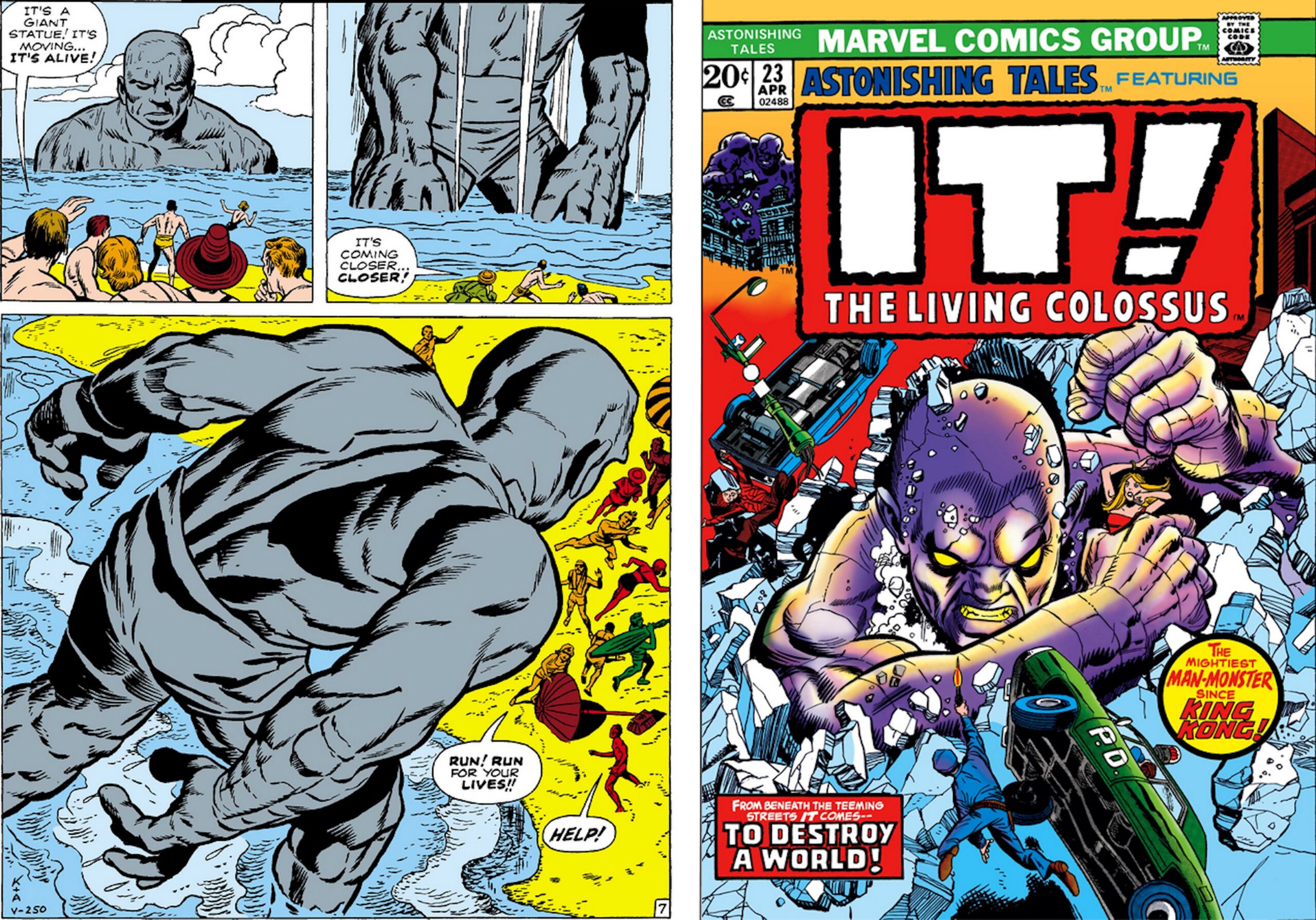
Perhaps those reprint issues sold well, because the statue began to move again three months later in Astonishing Tales 21 (Dec. 1973).
“Writer Tony Isabella (Black Lightning, The Champions) and artist Dick Ayers (who had inked Kirby’s work on the original stories) put together an origin story in which O’Bryan, now confined to a wheelchair because of an accident on the job, somehow learned to project his own consciousness into the statue,” noted comics historian Don Markstein.
“He then embarked on a career of protecting the world from deadly menaces — including a couple of returnees from those old monster comics of the late 1950s and early ’60s, specifically Gorgolla the Living Gargoyle (from Strange Tales 74, April 1960) and Fin Fang Foom (from Strange Tales 89, October 1961).”
Now called “It, the Living Colossus,” the statue’s giant steps were cut short when Deathlok the Demolisher took over Astonishing Tales with issue 25.
“The usual procedure for Marvel characters who lose their series is to guest star all over the place, but it wasn’t seen again until the Hulk turned up in L.A. for a slugfest with It, six years later,” Markstein wrote. “Since then, guest appearances have been few and far between.”
Still, it’s interesting to speculate what might have happened if Stan Lee and Jack Kirby had tried to turn the Living Colossus into a hero before the Fantastic Four arrived at the end of 1961.
Instead of a Hulk being hounded by the U.S. Army, we might have ended up with a Russian dissident in a running battle with the Soviet military.
Interesting to observe, too, that another Russian superhero named Colossus would arrive in 1975.
About Author
