
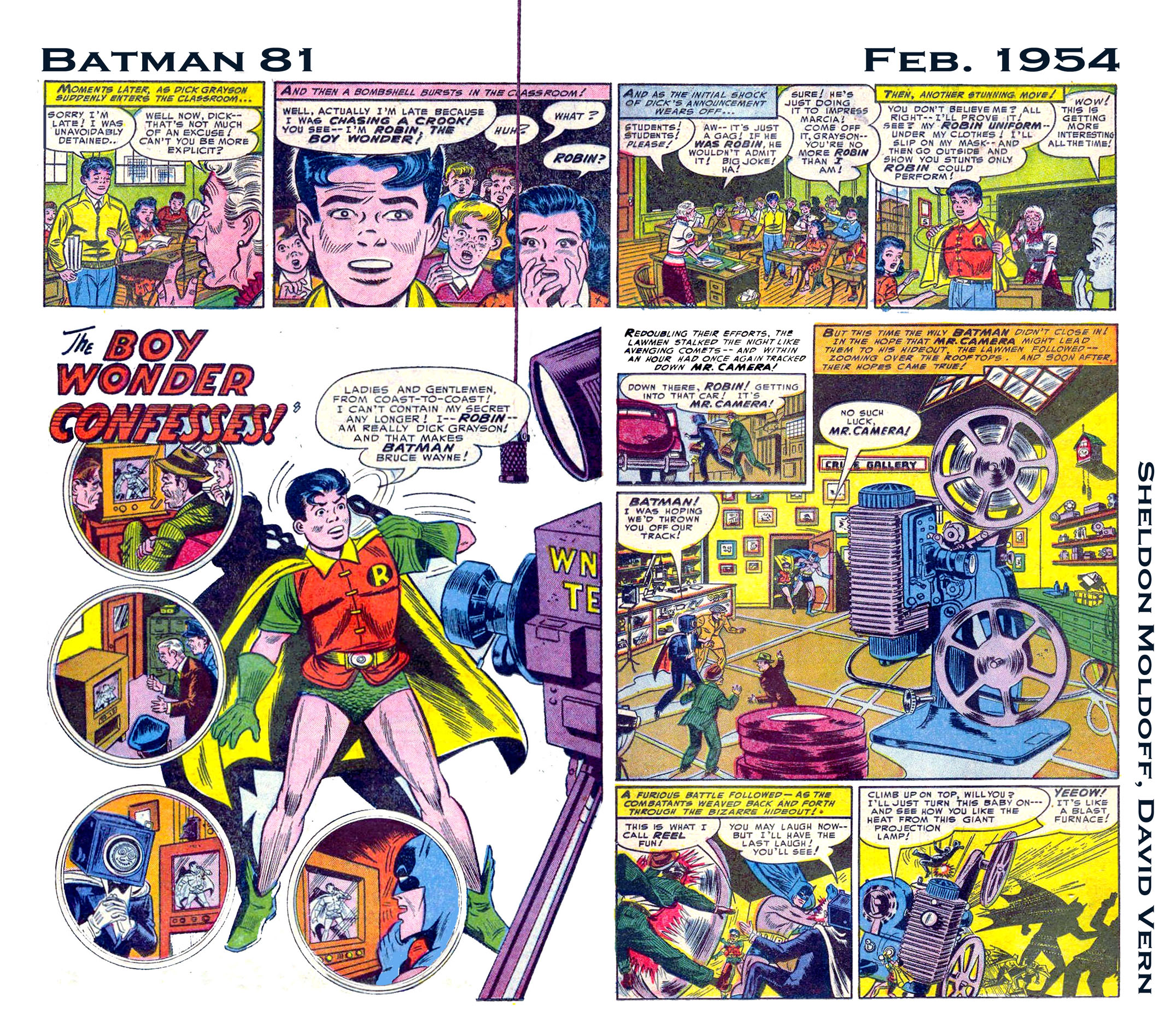
I do like a story with a slam-bang beginning.
In The Boy Wonder Confesses (Batman 81, Feb. 1954), Dick Grayson arrives late at Gotham City High School one morning, explaining to the teacher that he was unavoidably detained.
When she tells him that excuse isn’t good enough, he replies, “Well, actually, I’m late because I was chasing a crook! You see — I’m Robin, the Boy Wonder!”
 Classmates accuse him of pulling a gag, but Dick opens his shirt to reveal Robin’s red tunic, then goes outside to perform acrobatic feats with his silken cord.
As word gets out, news reporters confront Bruce Wayne and demand to know if he, then, is Batman, but Wayne has no comment.
Then the story flashes back a year before, when Batman and Robin were on the trail of “…the strange criminal who called himself Mr. Camera.”
When they finally capture him, the masked criminal reveals that a secret alley camera he’d set up caught Batman in the act of changing into his costume. Although he’ll go to jail, Mr. Camera has hidden the undeveloped film.
“Yes — I’ll go to prison, Batman — but you won’t sleep one night!” Mr. Camera tells the Caped Crusader. “Hanging over you will be the realization that one day I’ll explode your secret — and end your career!”
Of course, Dick Grayson’s “confession” turns out to be part of an elaborate hoax designed to discredit Mr. Camera, and the story even includes an ironic twist ending.
Writer David Vern and artist Sheldon Moldoff crafted a tale that proved good stories could be written spotlighting the Boy Wonder.
 Vern, who wrote for DC Comics throughout the 1950s, also co-created the villain Deadshot and revamped the Batplane in 1950. He wrote the 1952 story The Joker’s Utility Belt, which was adapted as the first TV episode starring Cesar Romero as the Joker 14 years later.
Vern recognized Robin’s potential. Despite some fans’ objections to the character, Robin’s early presence contributed greatly to Batman’s longevity and fame.
“It was like flipping a light switch,” observed comics historian Don Markstein. “Batman without Robin, a grim midnight avenger who seldom spoke except to issue dire warnings to evildoers, was capable of making a pretty good splash in the comics world. But the addition of a bright, cheerful kid to provide counterpoint to his dark presence (as well as a sounding board for dialogue) made him a classic.”
“Robin not only lit up Batman’s series — he even had one of his own. In Star Spangled Comics 65 (February 1947), he ousted the Newsboy Legion, which had formerly been the stars of that title, not only from the cover but from the magazine itself. He later lost his lead status to Tomahawk, but remained part of the line-up until 1952, when Star Spangled switched to war stories.”
About Author
