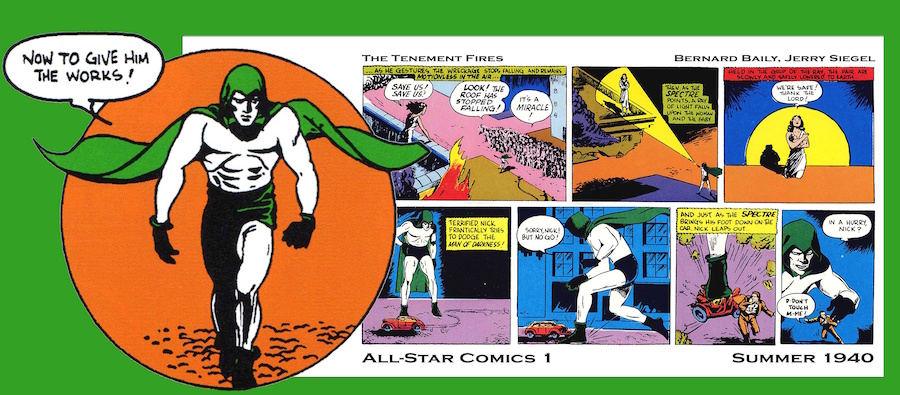
Once you’ve created Superman, how do you top that? Why, with super-Superman, of course. So that’s just what Jerry Siegel did in 1940.
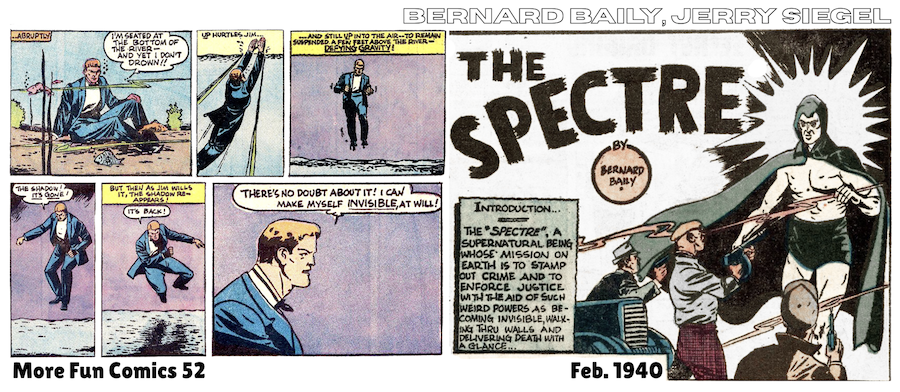
Instead of merely leaping tall buildings, this character could fly to the ends of the universe with the speed of thought. He could read evildoers’ minds and kill them with a glance. He could rescue the victims of burning buildings by bathing them in a beam of light projected from his finger. He could swell to the size of a ten-story building to crush an escaping criminal’s automobile with his green-booted foot.
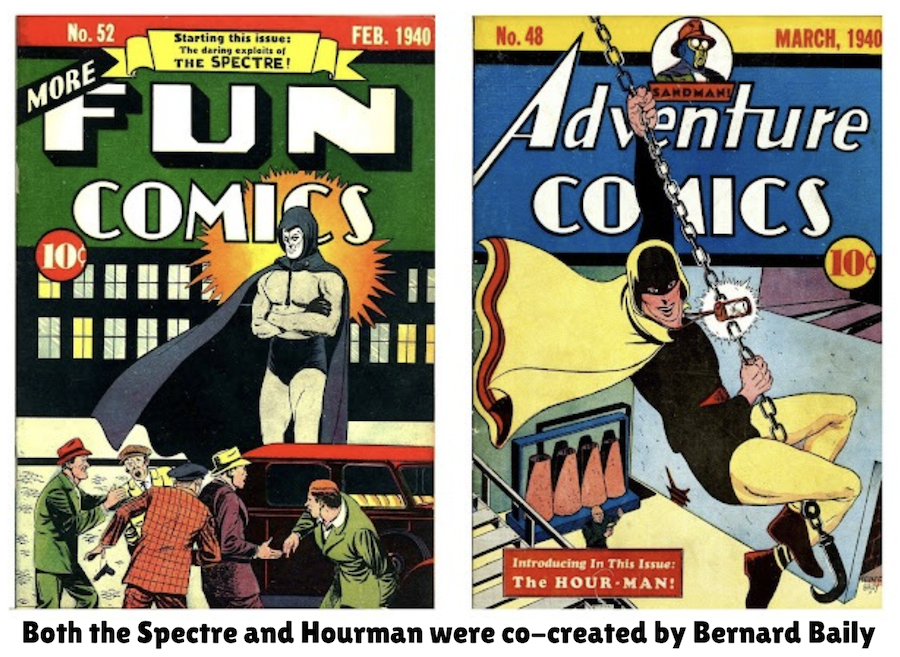
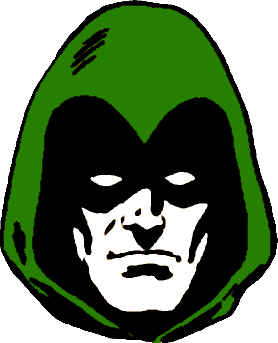 He was the Spectre, the brainchild of Siegel and artist Bernard Baily who debuted in More Fun Comics 52 (Feb. 1940). Cartoonist Jules Feiffer noted that the Spectre had the grimmest origin of all: he was a murdered cop, Jim Corrigan. He returned to fight for justice as an omnipotent ghost and, despite his attractions, the Spectre was proof that more isn’t necessarily better. Infinite powers turn out to offer limited plot lines.
“Apparently nobody involved gave much thought to the incongruity of publishing the Spectre, Spirit of Vengeance, in a comic entitled More Fun Comics,” noted comics historian Ken Quattro. “Baily accomplished the remarkable task of modernizing the traditional depiction of Death. His was a brawny Grim Reaper, sans scythe. Along with the hooded cloak, life-stealing eyes and blanched complexion expected of his ghastly position, the Spectre also unnecessarily sported boots, gloves and tighty whities (albeit green) in keeping with the already de rigueur superhero fashion of the era.”
So how do you handle an omnipotent hero? Eventually, in desperation, you saddle him with a stooge.
“At some point after Robin caught on, someone at DC decided that all of their heroes would have to have sidekicks — some serious, some comic relief,” comics historian Steven Thompson wrote. “One of the most bizarre was the great, terrible Percival Popp, the Super Cop! Percy was the sidekick to the grim dark ghostly avenger, the Spectre!”
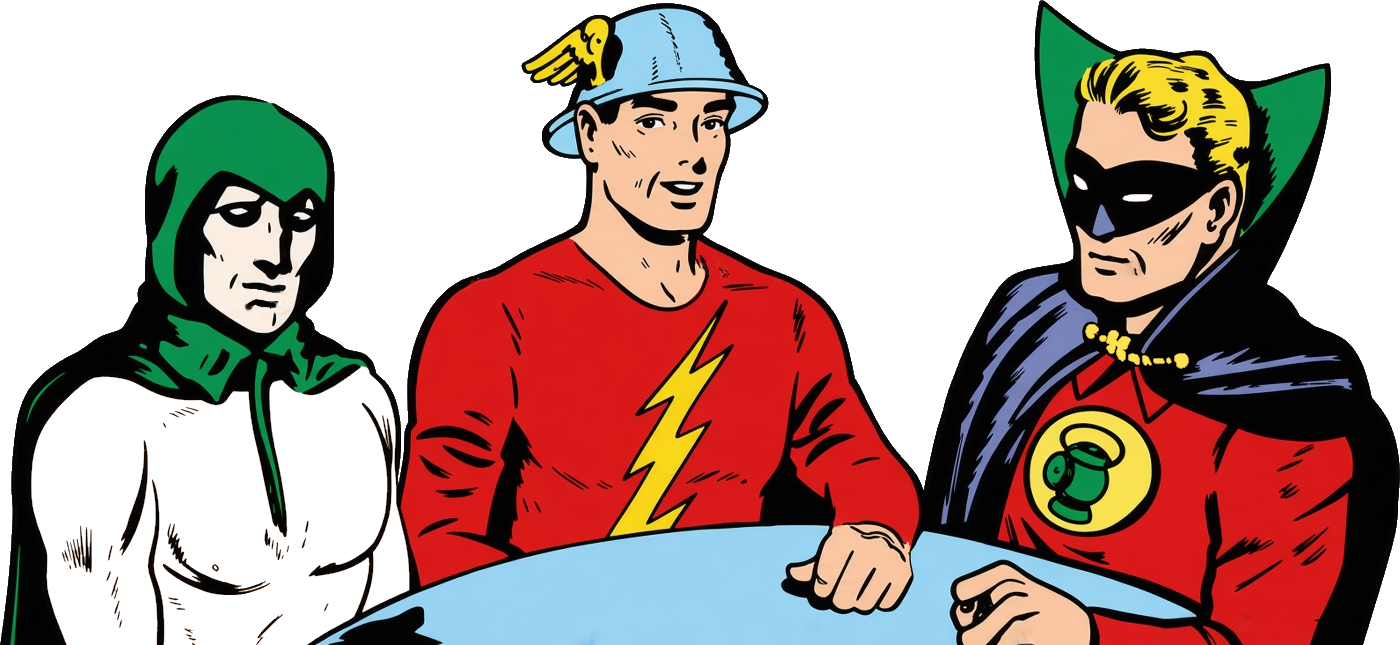 Having defeated the Psycho-Pirate in All-Star Comics 23 (Winter 1944), the Spectre faded from sight until his mid-1960s revival. Instead of providing the customary updated revamp of the character, DC editor Julius Schwartz decided to bring back the original. His absence was explained away. He’d been trapped in his host body for 20 years by occult forces.
“Superheroes often come in distinct sub-genres, many of which are epitomized by a single character,” comics historian Don Markstein noted. “For example, the Flash is the exemplar of the super-speedster, Batman of the mysterious creature of the night, and Captain America of the patriotic-style hero (even though the Shield beat Cap to the stands by more than a year). The Spectre is the template upon which the ‘avenging spirit as superhero’ is based. Others of that type include Mr. Justice and the Vision.”
About Author
