

One was turned into a monster by a weapon he created. The other was himself a weapon he created.
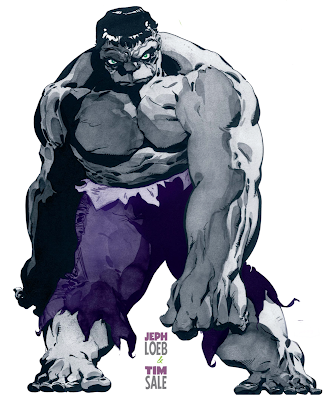
A high point of Jeph Loeb and Tim Sale’s Hulk: Gray miniseries was the battle between the Hulk and Iron Man. I was struck by what an appropriate confrontation that was, the characters being two of the superheroes most closely tied to American military-industrial complex.
One represented American confidence; the other, American guilt.
In a 1961 speech, President Dwight Eisenhower warned, “(W)e must guard against the acquisition of unwarranted influence, whether sought or unsought, by the military–industrial complex. The potential for the disastrous rise of misplaced power exists, and will persist. We must never let the weight of this combination endanger our liberties or democratic processes.”
A little more than a year later, in March 1962, the Incredible Hulk showed up on the newsstands. And in December 1962, Iron Man appeared there.
In fact, the United States has rarely lacked for symbolic representatives of its superpower status. Other characters spawned by the American military included the earlier Captain Atom and the later Six Million Dollar Man and Dr. Manhattan. Much earlier, Captain America foreshadowed the trend, a super soldier born in a Pentagon experiment 20 years before anyone ever heard the term “military-industrial complex.”
In Tony Stark’s case, at least, the connection was conscious. “I liked Iron Man because I liked the idea of taking a guy who nobody’s ever made a hero of before — a guy who’s a member of the military-industrial complex — and making a hero out of him,” Stan Lee recalled in 1983.
At times, the connections between these characters and the military-industrial complex were too close for comfort.
 Comics historian Mark Seifert observed, “In my opinion, the inspiration (for) the Captain Atom origin moment, the Dr. Manhattan origin moment and the Hulk’s origin moment is an incident that took place on a Nevada test range during which physicist Dr. Stanley Kronenberg drove out to the test tower, climbed it by himself and fixed the nuclear trigger on the bomb — with full knowledge that the nuclear device might go off at any moment before he could diagnose the problem.”
In the actual comics of the 1960s, Iron Man and the Hulk didn’t meet until the formation of the Avengers in September 1963. This story explains that away by saying that Stark covered up accounts of this first encounter to save himself embarrassment. And Loeb and Sale’s tale shows that Stan Lee missed a bet here — Iron Man and the Hulk should have met earlier.
In Hulk: Gray, two frightening, lumbering products of the military-industrial complex trade blows and blasts in the darkness of an southwestern nightmare-scape. The overconfident Iron Man, still in his original bulky armor, has underestimated the gray brute he faces, and ends up largely dismantled and motionless on the ground.
The official representative of the military-industrial complex, Gen. Thaddeus E. “Thunderbolt” Ross, doesn’t come off well in this retelling. The Hulk’s Captain Ahab of a nemesis drugs his daughter with his late wife’s Thorazine to keep her quiet and slaps around a minor, Rick Jones.
“He’s a punk,” Ross says. “They’re all punks until they grow up and go into the Army.”
“I never went into the Army,” says Tony Stark, helping himself to a drink.
“My point exactly,” replies Ross.
And after having called in Iron Man to save his daughter, Ross orders his troops to leave the helpless superhero where they find him, battered and bleeding.
“Stark got that tin can into this mess,” the general says. “Stark can get him out of it.”
Iron Man’s life is saved only because the Hulk has accidentally struck Betty Ross, and abandons his grudge match to leap away with her and “fix Betty.”
Hulk: Gray was published in 2003, the year the real American military-industrial complex got busy in Iraq.
About Author
