
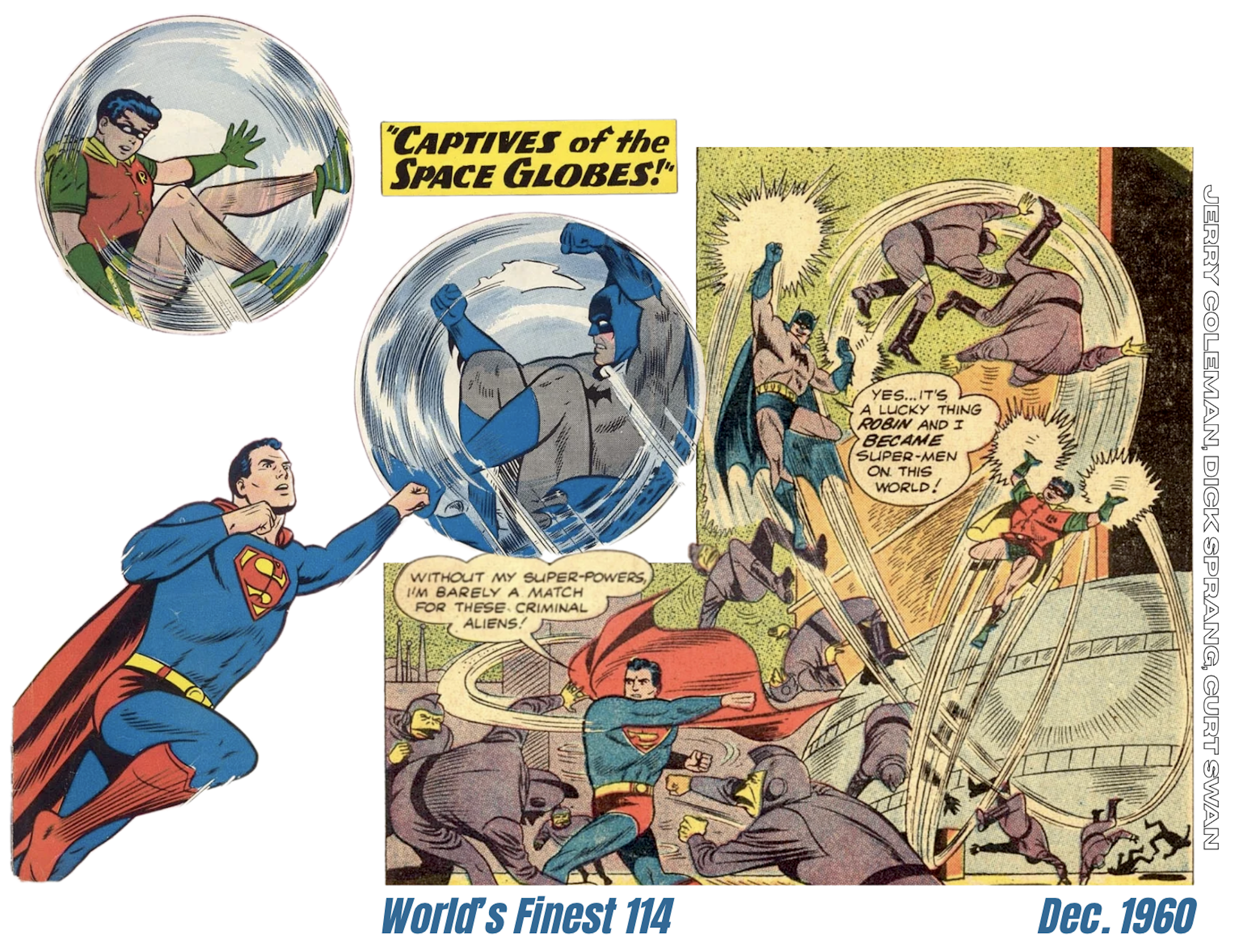
I enjoyed it whenever Batman and Robin got Superman’s powers, in part because they were so free to delight in them.
Such powers were old hat to Superman, but the Dynamic Duo were understandably exuberant when they got them (always temporarily, of course). When that happened, Batman and Robin could serve as stand-ins for the readers’ fantasies about acquiring superpowers.
Because they were the stars of the two most popular DC Comics features, it was probably inevitable that Superman, Batman, and Robin would team up in a title. But that created a logistical problem for writers.
With a guy like Superman around, what exactly was left for the Dynamic Duo to do?
One solution was role reversal, having Batman and/or Robin sport the powers while a powerless Superman muddled along as best he could.
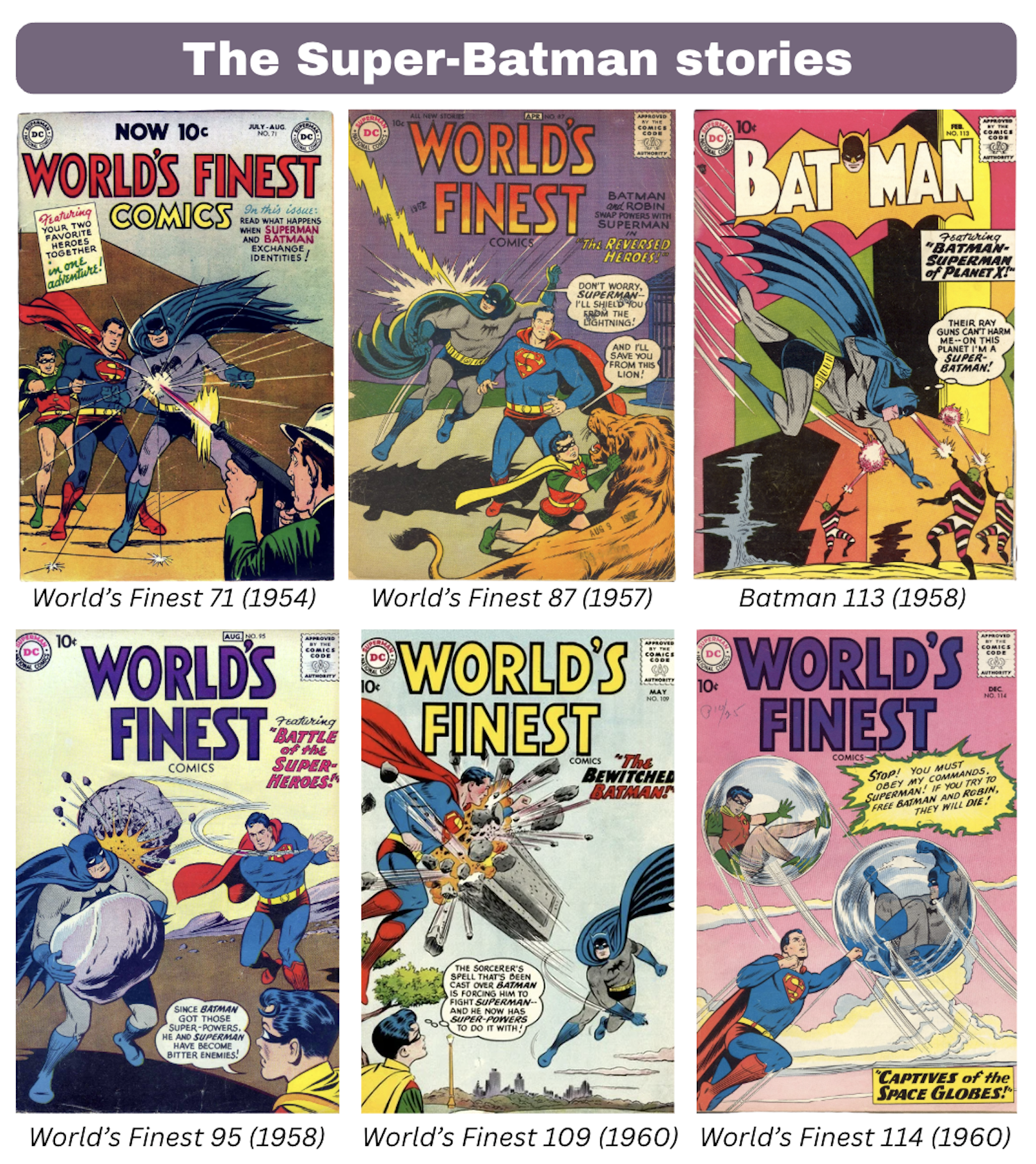
That seemingly happened in their first team-up in the World’s Finest title (issue 77, July-Aug. 1954).
On the cover, a super-Batman is seen protecting Superman from gunfire. But in fact, Superman and Batman had merely switched costumes to protect Superman’s identity.
And it actually happened in The Reversed Heroes (World’s Finest 87, March-April 1957). The cover shows Batman shielding Superman from a lightning bolt while Robin protects him from a tiger, thanks to super-capsules from Krypton.
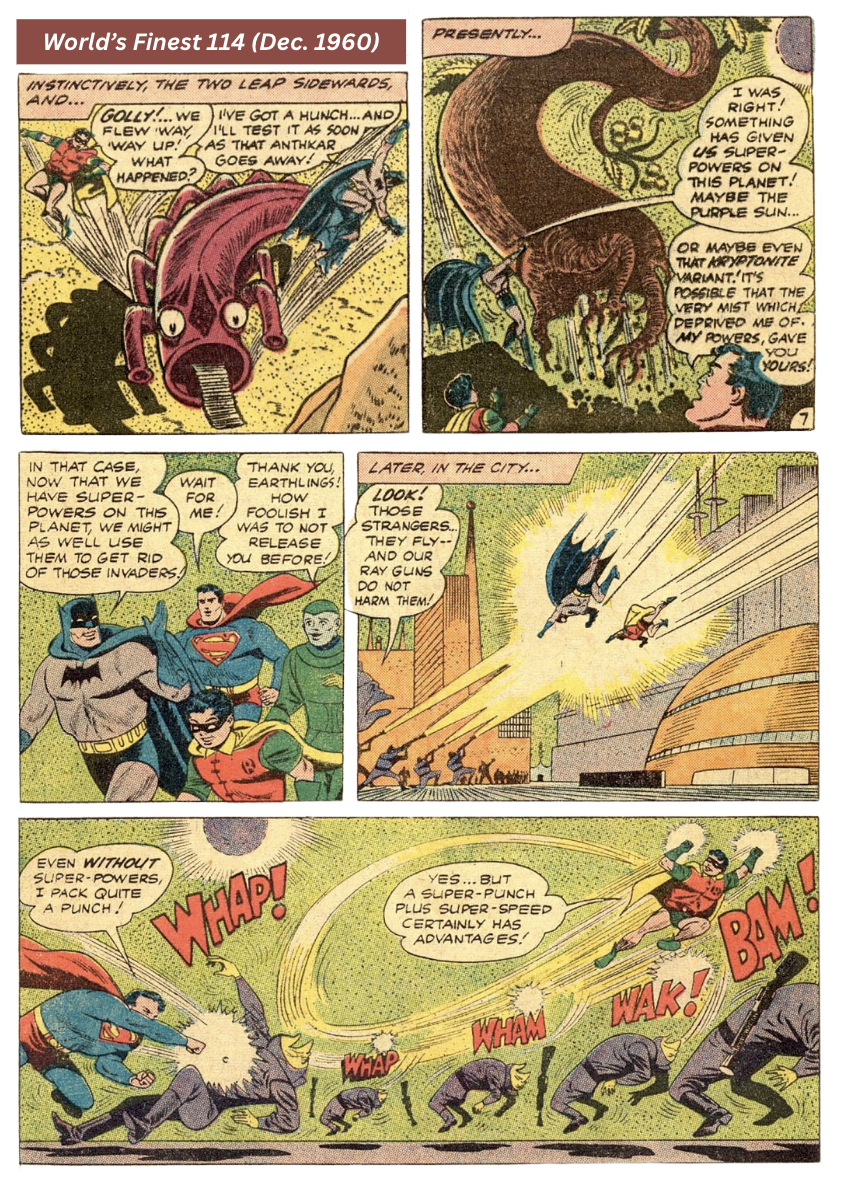
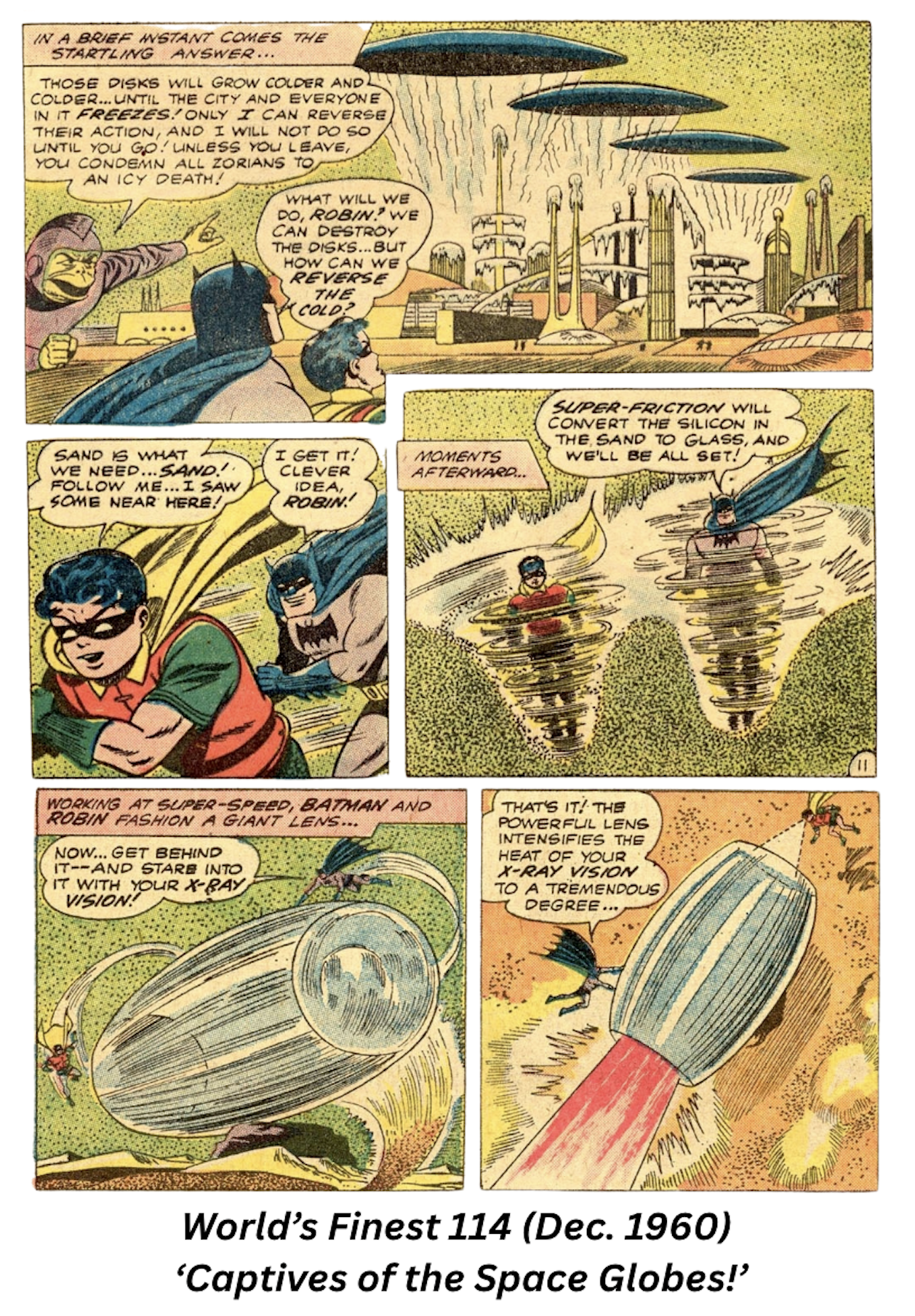
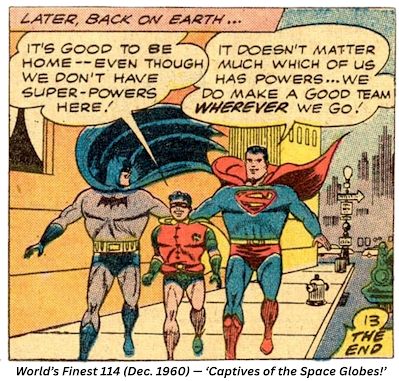 It happened again in World’s Finest 114 (Dec. 1960), when Batman and Robin were kidnapped into space as a means of forcing Superman to intervene in an alien invasion. Conditions on the planet Zoron render Superman powerless, but empower Batman and Robin.
Which means that Zoron is remarkably similar to the planet Zur-En-Arrh, where Batman was transported in Batman — The Superman of Planet X! (Batman 113, Feb. 1958). There, he gained Superman-like powers to help that planet’s Batman thwart another alien enemy invasion.
World’s Finest 114 was written by Jerry Coleman, and Batman 113 by Ed Herron, but both tales were drawn by the redoubtable Dick Sprang, who once admitted — sacrilegiously, for some fans — that he enjoyed drawing Superman stories more than Batman stories, because the former offered more latitude for extravagant science-fiction action.
Critics have praised Sprang’s “expressive, high-adventure aesthetic” and noted that he “…heavily experimented with pacing, frequently using dizzying perspective shots and cinematic angles. He often studied how children read to craft visual flow that kept pages turning.”
Rereading World’s Finest 114 now, I find it interesting how uncertain and defensive Superman’s dialogue is — lines like “Without my super-powers, I’m barely a match for these criminal aliens!” and “Even without super-powers, I pack quite a punch!”
Coleman was keeping in mind just how unsettling sudden “normalization” might be to a superhuman.
And what do all these “super-Batman” stories tell us? In the 1950s, the Man of Tomorrow was indisputably DC’s dominant property ( the company logo even proclaimed “Superman DC Comics”).
Since then, Superman and Batman have had yet another of their role reversals.
About Author
