
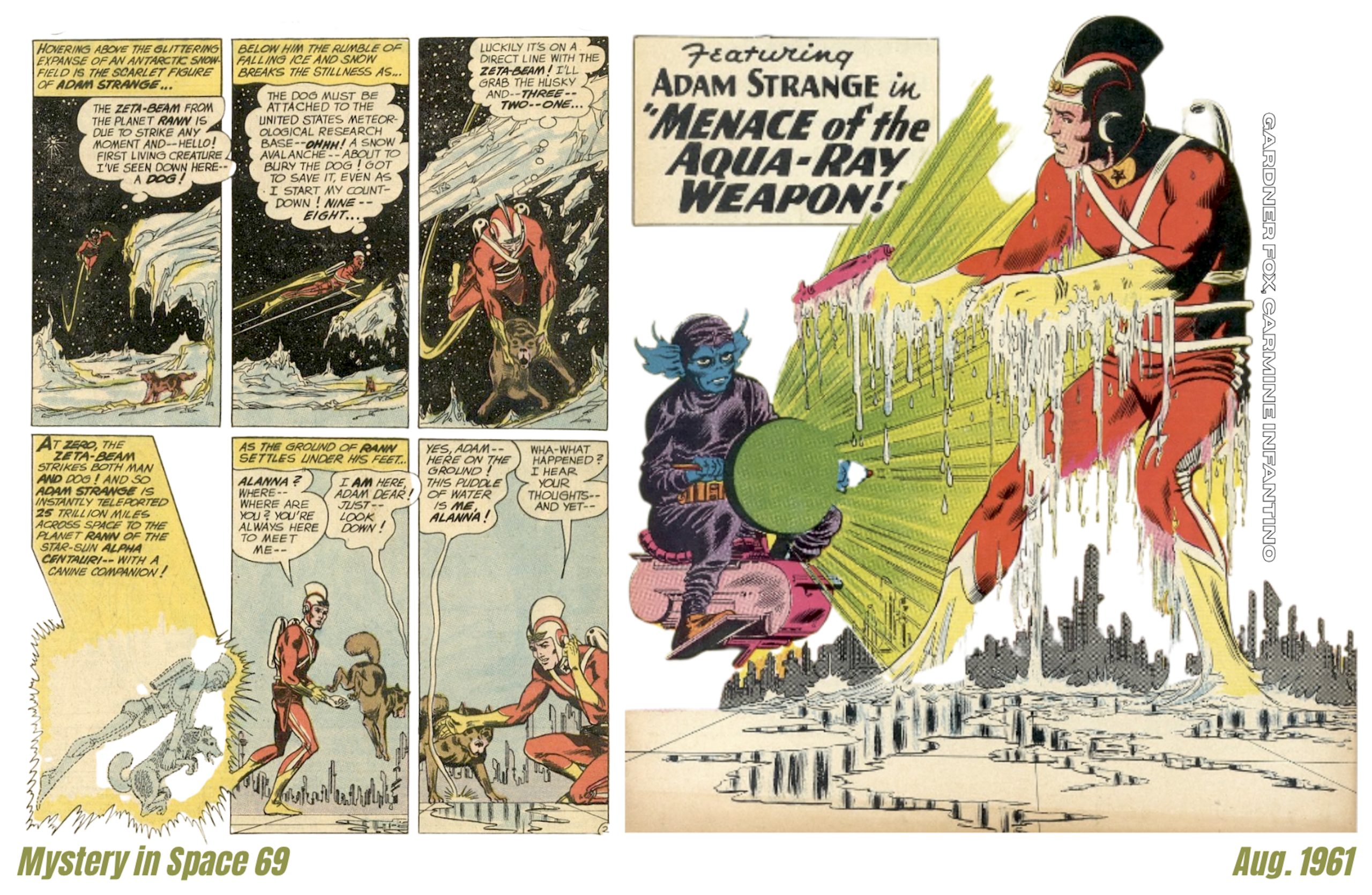
Flying above an Antarctic snowfield, mere moments before being teleported to the planet Rann, Adam Strange spots a dog that’s about to be crushed in an icy avalanche.
Rocketing to the rescue, our hero grabs the husky, and both are instantly transported 4.5 light-years away.
On Rann, the menace of the moment is the Kirri, an ancient blue-skinned humanoid race that has reappeared armed with irresistible ray-weapons that transform living beings into sentient water.
This time, it isn’t just Strange’s cool head that saves him, but also his kindness.
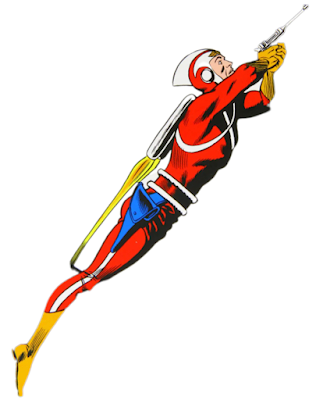 When the Kirri encases him in ice, the archeologist-adventurer can encourage the friendly husky to free him, enabling him to turn the tables on the blue meanies.
When both Strange and the dog are drawn back to Earth, the scientist returns the husky to the meteorological research base where he lives. The researchers there wonder where he’s been, and would be particularly surprised to find out.
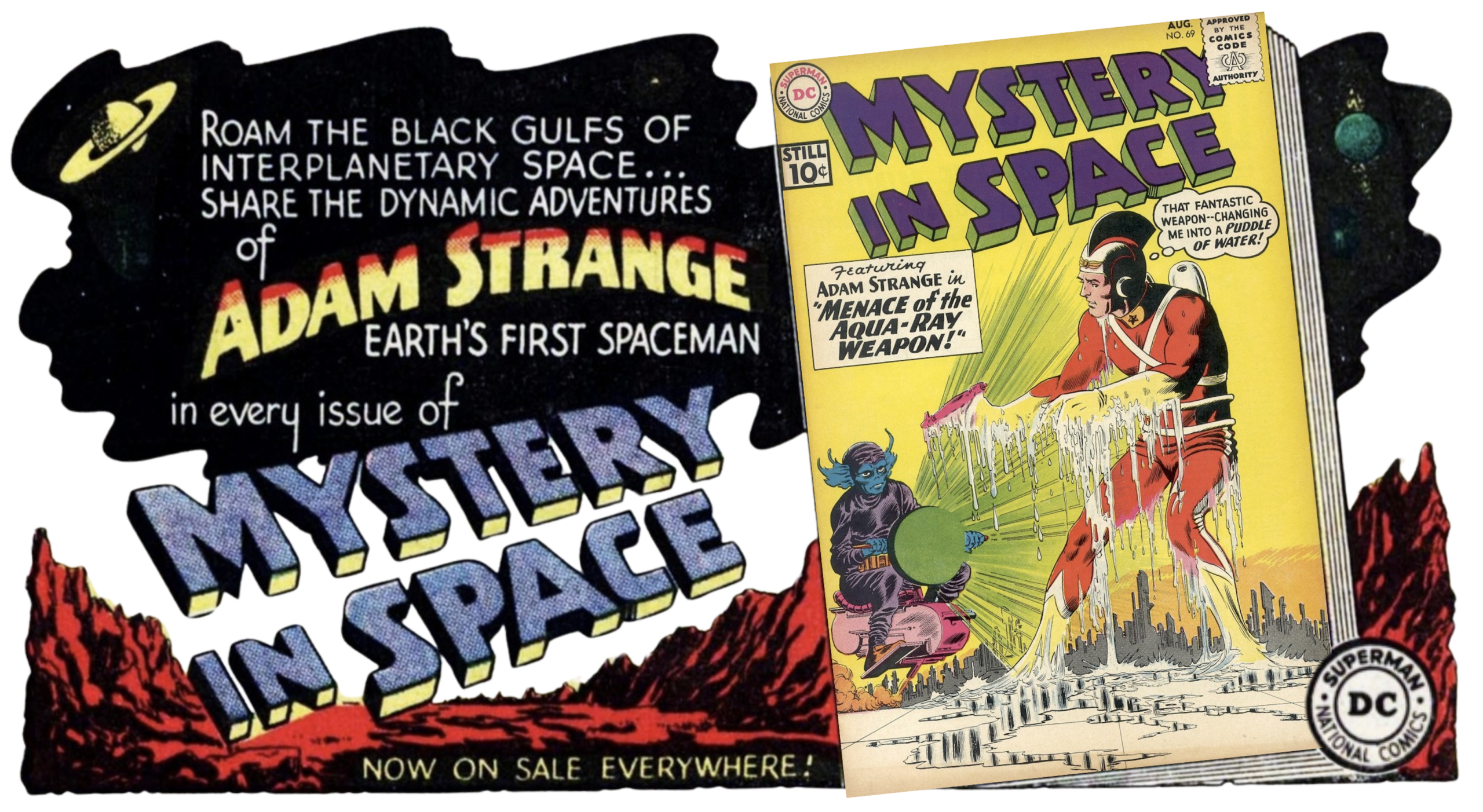
The Menace of the Aqua-Ray Weapon! (Mystery in Space 69, Aug. 1961) was written by Gardner Fox. The elongated, aerodynamic figures set against elegant, delicate cityscapes were drawn by Carmine Infantino and inked by Murphy Anderson.
“Ranagar is often seen in the background, its skyline in silhouette, like other Infantino cities,” observed comics historian Michael E. Grost. “It is full of spiral ramps and sloping ramps that tilt upwards from building to building. It also has trapezoidal doorways and numerous towers.”
“Despite the setting of an advanced alien civilization, the thing I always loved about Adam Strange stories was their evocation of the celebrated ‘plucky problem solvers’ of ages past,” Mark Engblom said. “Wonderfully integrating aspects of Gulliver’s Travels, Robinson Crusoe and A Connecticut Yankee in King Arthur’s Court, Adam Strange was an archetypal warrior/ thinker/ mensch for the Space Age!”
Vincent Mariani wrote, “Adam Strange was a product of his time; the clean-cut comic book version of JFK’s ‘Best and Brightest’ analytical types. He reflected the era’s reverence for science, bringing inevitable progress and prosperity via Gardner Fox’s insertions of scientific tidbits in the service of otherwise strange concepts.
“He was also typical of the period in Julius Schwartz’s series. Adam Strange, Hal Jordan, Barry Allen, and Ray Palmer were all sturdy, young, white, handsome technophiles. By the end of the sixties, diversity among superheroes exploded the stereotype.”
However, I see no reason why characters of any race or gender shouldn’t be rational ‘plucky problem solvers.’ I’m afraid the baby went out with the bathwater. Even Mr. Spock has to have emotional outbursts now.
About Author
