
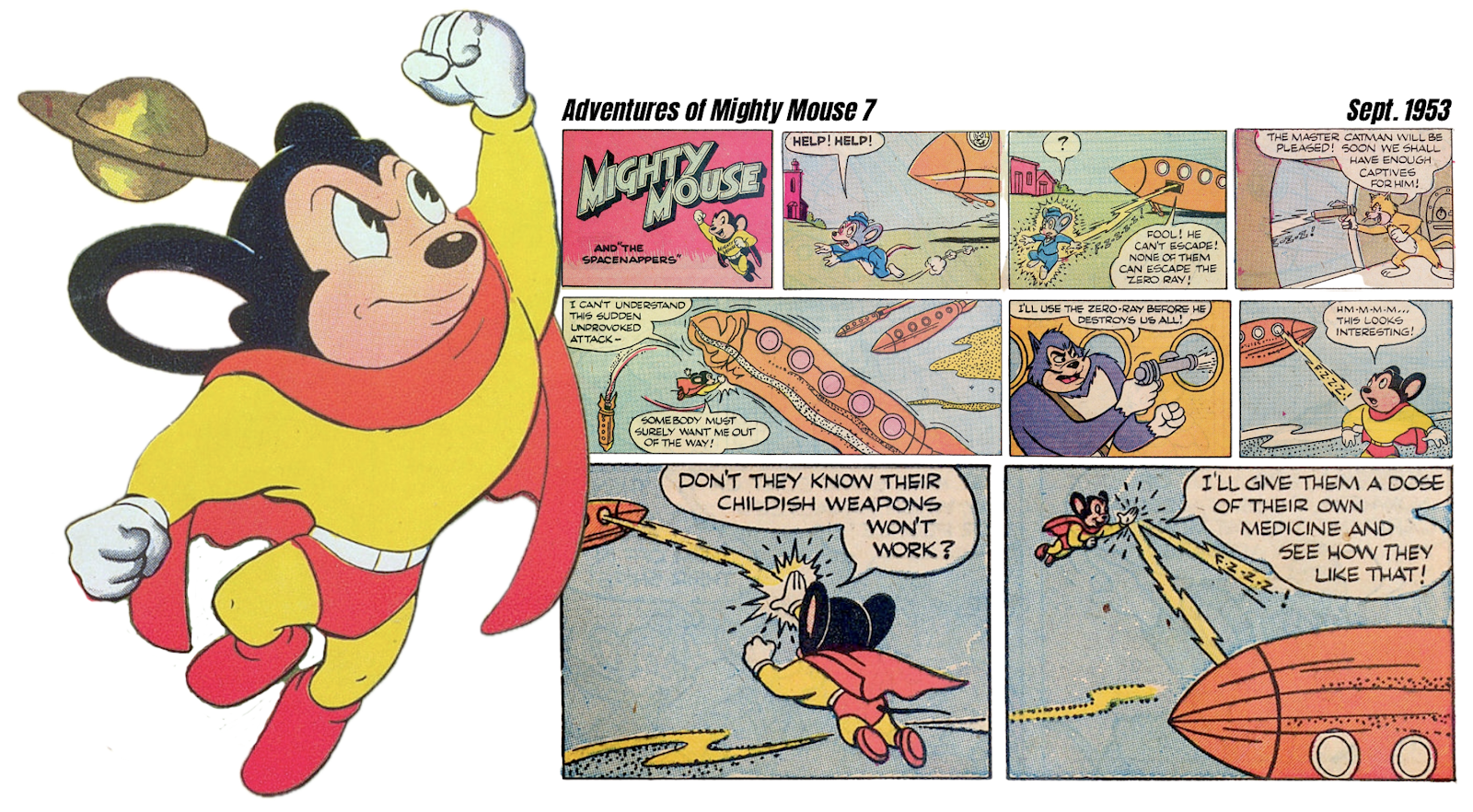
As a small boy, I was besotted by capes. I really couldn’t understand why people didn’t wear them all the time.
While watching The Adventures of Superman on TV, I somehow got the vague idea that it must be Superman’s cape, whipping so dramatically in the wind, that somehow enabled him to fly. And I must not have been alone, because 1950s parents tended to be nervous about kids getting the idea that Superman’s costume enabled him to fly.
So I was surprised to learn recently that, in at least one twice-reprinted comic book story, it was Mighty Mouse’s cape that enabled him to soar into battle against cats. His super strength and super speed were his own, but he required that red cloak to take to the air.
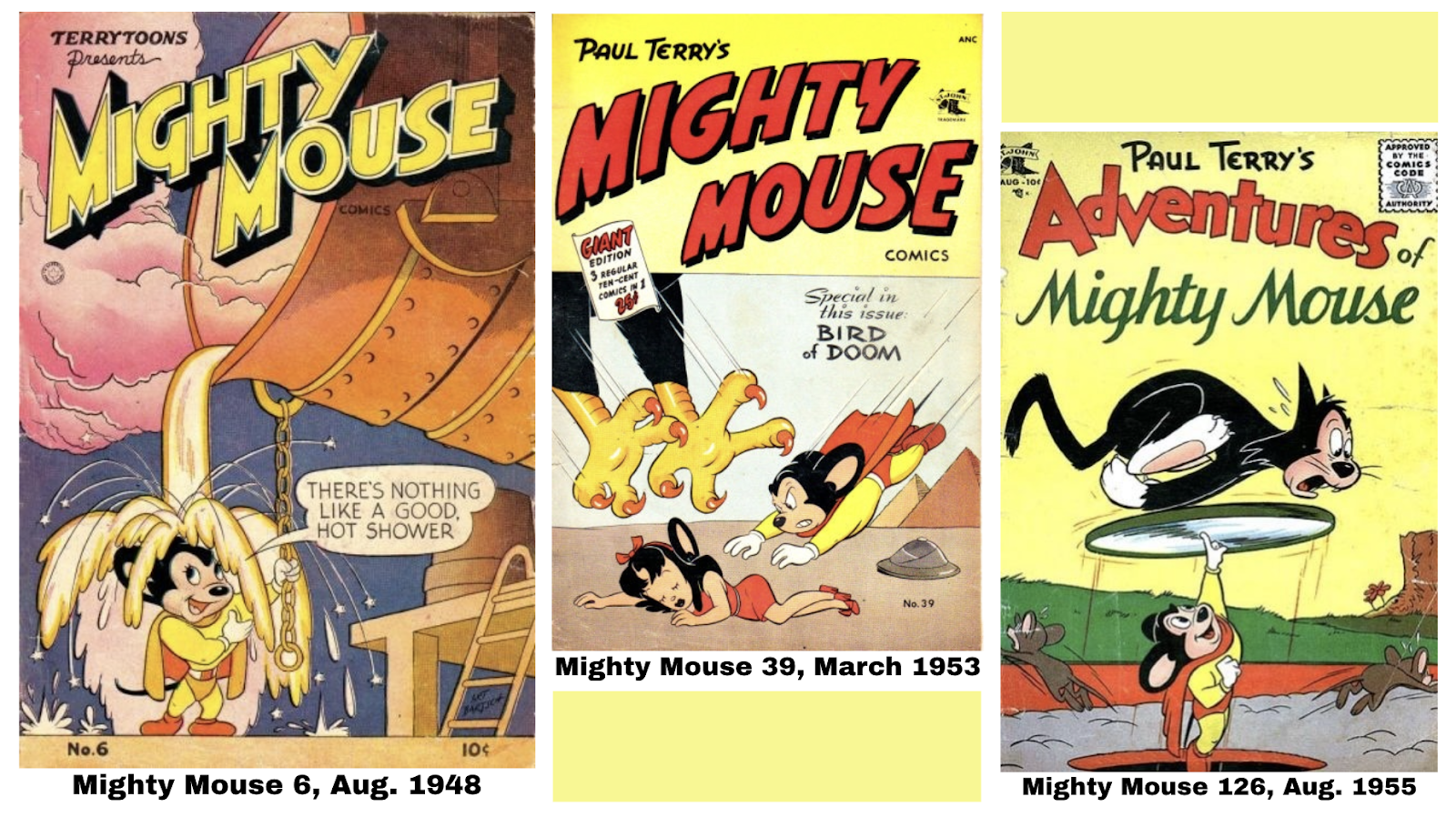
In Stolen Power (Mighty Mouse Comics 6, Aug. 1948), our hero is having a nap between takes while working on a movie, and two young mice seeking autographs sneak into his trailer to get an autograph. When one of them tries on the superhero’s cape, he finds himself flying!
Mighty Mouse’s flying cape ends up in the paws of “that no-good Fisheye Fox,” who inaugurates a reign of terror. Running and swimming at super speed, Mighty Mouse chases the fox around the world until he falls, exhausted. The story was reprinted in Paul Terry’s Mighty Mouse Comics 39 (March 1953) and Paul Terry’s Adventures of Mighty Mouse 126 (Aug. 1955).
Actually, the source of the redoubtable rodent’s powers was all over the map, according to the movie cartoons in which he originated.
“Late in 1942, Terrytoons released the classic The Mouse of Tomorrow,” recalled Jim Korkis in Amazing Heroes. “Cruel cats are subjugating innocent mice. One of these poor little mice, chased by a hungry cat, dashes into a supermarket for safety. In the supermarket, the mouse bathes in Super Soap, swallows Super Soup, munches Super Celery and plunges headfirst into Super Cheese. When the mouse reappears, he is now a Super Mouse attired in blue tights with red shorts and a red cape. This Mouse of Tomorrow can beat up all the cats and send them to the moon.”
Subsequent cartoons contradict the story, however. In one, he becomes a superhero by swallowing vitamins A through Z, and in another by imbibing liquid atomic energy. Another comic book story reported that he was a super baby mouse abandoned on the doorstep of a kindly, elderly mouse couple.
Mighty Mouse’s true origin, of course, was as a conceptual combination of the commercially successful characters Mickey Mouse and Superman, complete with the latter’s red cape.
“One knew, of course, that it was not the red cape, blazoned with a small golden version of the shield on his chest, that gave Superman the ability to fly,” recalled author Michael Chabon. “That ability derived from the effects of the rays of our yellow sun on Superman’s alien anatomy, evolved under the red sun of Krypton. And yet you had only to tie a towel around your shoulders to feel the strange vibratory pulse of flight stirring in the red sun of your heart.”
Superheroes who actually do get the ability to fly from capes include the Fighting Yank and Dr. Strange.
American actors playing superheroes sometimes seem to be a little embarrassed about wearing capes — but not so the British actors. Playing Shakespeare has accustomed them to the dramatic advantages of capes. Just watch Ian McKellen whip that cape about when he’s playing Magneto.
I’m still not sure why we don’t wear capes. Yes, they are practically useless, but they are no more useless than ties, after all — and they’re a lot more impressive.
About Author
