
Prof. Quatermass: “If we found that our Earth was doomed, say by climatic changes, what would we do?”
Dr. Roney: “Nothing. Just go on squabbling as usual.”
— Five Million Years to Earth, 1967
—
After observing the various self-induced disasters in which 21st century humanity finds itself, it occurs to me that the person we really need is Prof. Bernard Quatermass.
Intellectual, analytical, ethical, humane, open-minded but dismissive of superstitious bunk and irrational twaddle, cool even in a global crisis, the 1950s BBC hero is the polar opposite of the assorted assassins and prostitutes that contemporary popular culture offers us as role models.
Our culture has lost its way in part because we no longer celebrate the kind of people who can explain the principles upon which a compass, moral or otherwise, operates.
The cool, clever, catastrophe-thwarting scientist Quatermass was created by writer Nigel Kneale for BBC Television in 1953. He fended off alien menaces in three 1950s BBC serials (The Quatermass Experiment, Quatermass II and Quatermass and the Pit) which were remade into increasingly excellent Hammer films, as well as a 1979 Thames TV series and a 2005 live remake. Actors who played Quatermass include Brian Donlevy, Reginald Tate, André Morell, Andrew Keir, John Mills and Jason Flemyng.
And it all began because of a panic at the BBC drama department in the early days of television. They had a half-hour gap in the lineup of six Saturday evenings between July 18 and Aug. 22, 1953.
 “Kneale’s solution was rather neat,” wrote Andy Murray in his book Into the Unknown: The Fantastic Life of Nigel Kneale. “He could easily have suggested a book that might have made a workable television serial, but after endlessly adapting the work of others, he was longing to write something of his own.
“He dreamed up a contemporary thriller serial, entitled Bring Something Back, about a disastrous launch undertaken by the fictional British Experimental Rocket Group. Three men would go up in the rocket, which would disappear from the scanners, and reappear only to crash-land. Inexplicably, of the three-man crew, only one would remain — although it was impossible that the rocket had been opened during the journey. It would transpire that some basic alien life-form, floating in space, had penetrated the rocket and fused the three men into one.
“In addition, the survivor was infected with the alien creature, and was slowly transmuting into a monstrous hybrid. The tale would focus on the unfortunate victim, rocket scientist Victor Carroon, and the gifted man in charge of the whole experiment, one Prof. Charlton.”
Kneale later reworked the name, calling his protagonist “Bernard” to honor physicist and radio astronomer Bernard Lovell. He picked the mysterious-sounding “Quatermass” from the London phone book
Unexpectedly, the serial attracted a huge audience. “Westminster Abbey undoubtedly dominated television during the summer of 1953 but it was not just the Coronation of the Queen that sticks in my mind now,” recalled Geoffrey Wansell in The Times in 1981. “It is also the memory of Prof. Bernard Quatermass grappling with the pulsating giant plant that threatened to destroy the world from its rooting place in the Abbey’s nave… The Quatermass Experiment frightened the life out of a vast new generation of television viewers whose sets had been acquired in order to watch the Coronation.”
BBC Four controller Janice Hadlow later described the serial as “one of the first ‘must-watch’ TV experiences that inspired the water cooler chat of its day.”
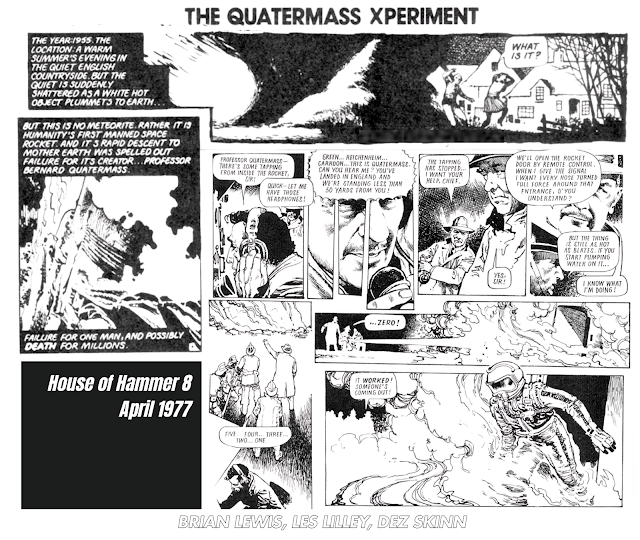
The first BBC Quatermass serial became a Hammer film, and even a comic book story in House of Hammer 8 (April 1977).
“It didn’t matter in the slightest if you hadn’t sat through The Quatermass Xperiment, for in these five pages the narrative that flowed between the panels, coupled with Brian Lewis’ sumptuous artwork, held the reader firmly transfixed,” recalled Peter Normanton in TwoMorrows’ Cryptology magazine. “The film may have dated back to 1955, but the page layouts appeared so very modern, a reflection of the mood of the day.”
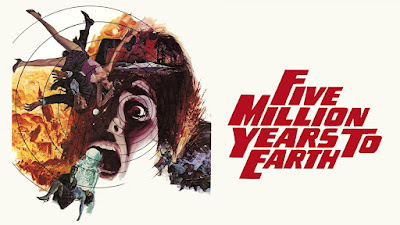
I regard 1967’s Quatermass and the Pit, also released as Five Million Years to Earth, as the pinnacle of this excellent film series. It’s the kind of intelligent science fiction that ranks right up there with Robert Wise’s 1951 film The Day the Earth Stood Still, the 1966 Francois Truffaut film Fahrenheit 451 and the 1980 film Altered States, Paddy Chayefsky’s philosophical monster movie.
The time-hopping rationalistic scientist-hero of the BBC’s Doctor Who is clearly a direct descendent of Prof. Quatermass. But Quatermass himself is an heir to Arthur Conan Doyle’s 19th century sage Prof. Edward Challenger, that loud and egotistical genius whose adventures included the discovery of living dinosaurs in South America and the rescue of mankind from a seemingly fatal “poison belt” in space.

About Author
