
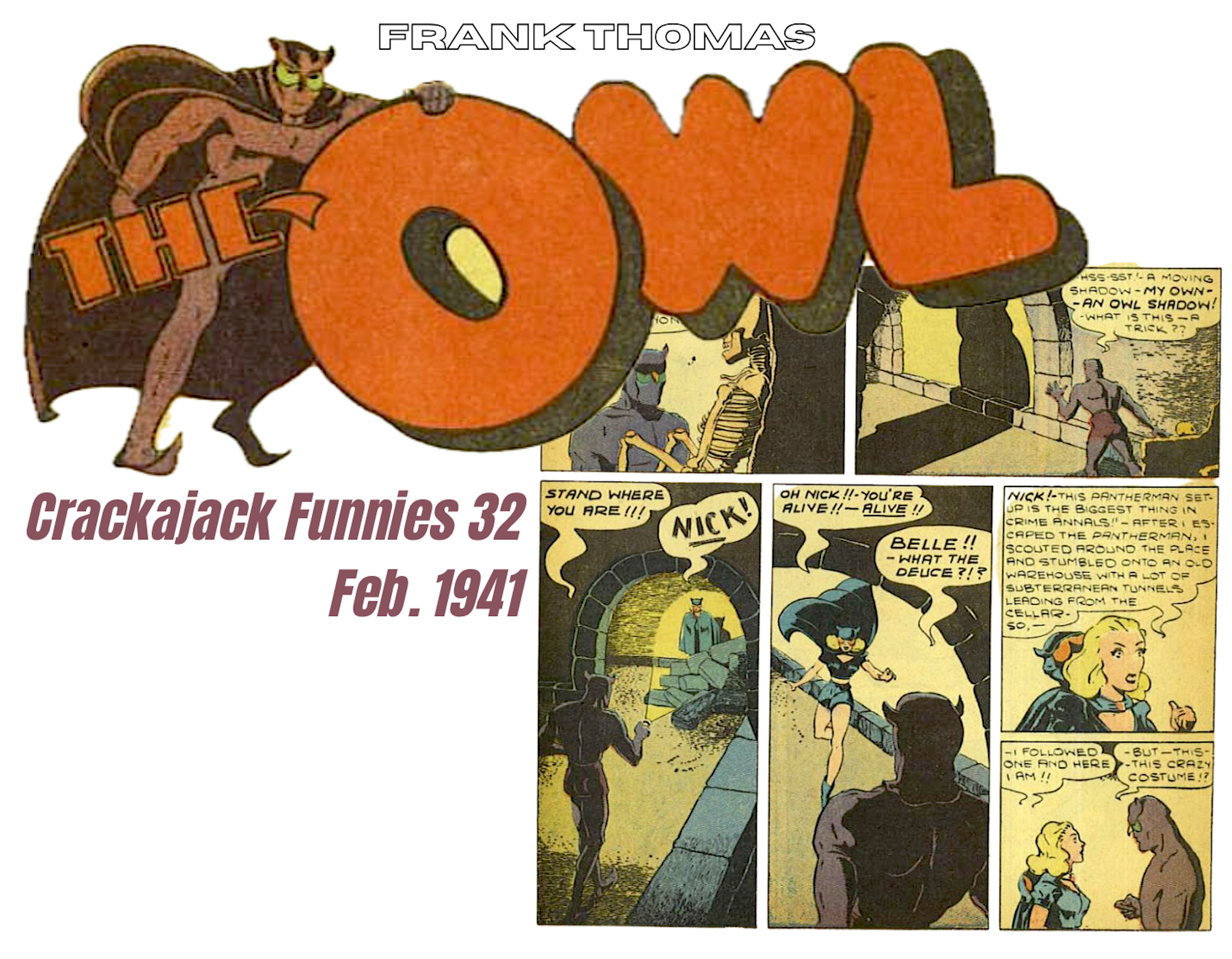
Named after a night flyer, this mystery man had a costumed partner and a super-vehicle to aid in his crusade against crime.
Batman?
No.
One of the few original Dell superheroes, the Owl’s inspirations were fairly obvious from his debut in Crackajack Funnies 25 (July 1940).
“The Owl, like Batman, was a creature of the night,” noted comics historian Jeff Rovin. “To (Nick) Terry, keeping the Midwestern city of Yorktown safe means that he must sometimes operate outside the law. Thus, when his police tactics fail, Terry heads for his Owl hideout on the top of a mountain and becomes the Owl. Apart from his judo and unique crime-fighting hardware, the Owl has no extraordinary ability.”
“The Owl is actually quite similar to Batman in several ways, only not as deadly serious as the Dark Knight has become in recent years,” Stuart Fischer noted. “The Owl is aided by his friend and sidekick, Owl Girl, who is secretly Belle Wayne (no relationship to Bruce Wayne), a newspaper reporter who formally becomes his partner after she discovers his secret.”
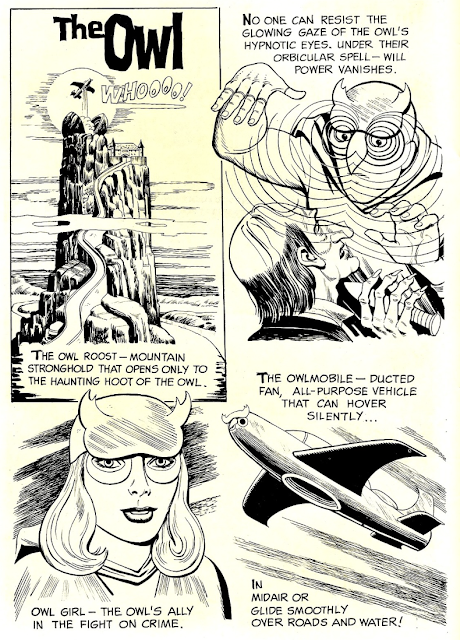 “The Owl has no superpowers, another similarity he shares with Batman; instead, he has superior fighting skills and a very good understanding of sophisticated gadgets that enable him to fight crime effectively.
“He has his Owlmobile, which he uses to get around in style and in haste, and which also has the power to fly like the bird after which it’s named. He also possesses a cape that gives him the ability to glide gracefully through the air; when in flight, he does look like a human owl.”
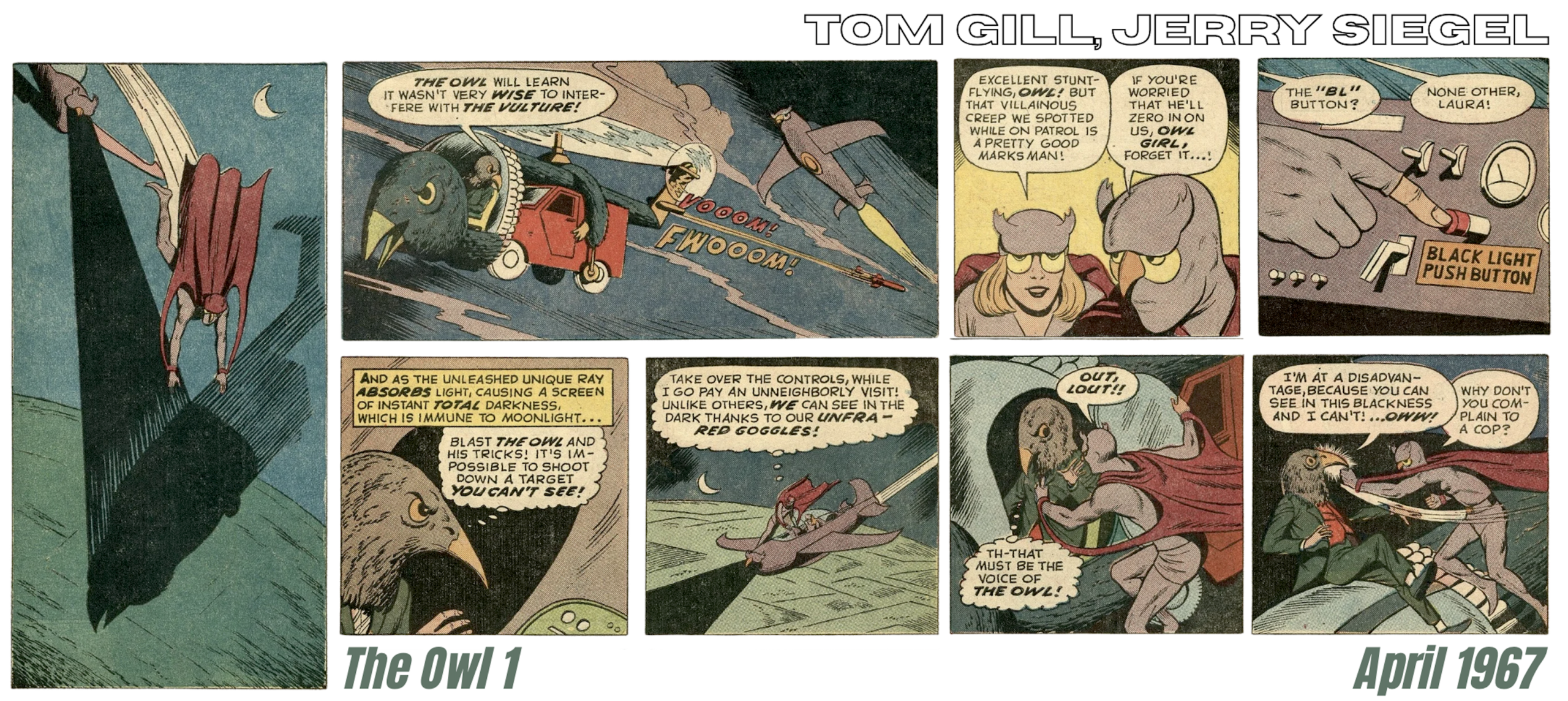
“Among his paraphernalia was a ‘black light,’ which worked as a reverse flashlight, casting dark, just like Phantom Lady’s Blackout Ray,” noted comics historian Don Markstein.
“He started barely mentioned on the cover, but by Crackajack 31, had become the main feature. In 32 (Feb. 1941), Nick’s girlfriend … found out his secret and became Owl Girl. They fought crime together until the title’s demise with its 43rd issue (Jan. 1942), then continued in the back pages of another title that mostly reprinted newspaper strips, Popular Comics, where Smilin’ Jack was the main star. They began in Popular 72 (Feb. 1942) and ran until 85 (March 1943). After that, they were gone for a couple of decades.”
Bill Baltz drew the first episode, with Frank Thomas handling the feature thereafter. The Owl’s adventures were fairly sedate for a 1940s superhero, and he spent a good deal of time out of costume.
“The Owl had a different vibe, thanks to its running as a serial rather than in discrete episodes,” observed Kurt F. Mitchell in American Comic Book Chronicles. “No shrinking violet, (Owl Girl) made herself invaluable to the costumed detective through her courage and her ability to think on her feet. The duo, first of the new breed of he-and-she partnerships, spent the rest of the year in a series of multi-issue duels with such opponents as the Pantherman, the Spectre, and the Mad Modespos, a family of homicidal maniacs with a pet gorilla.”
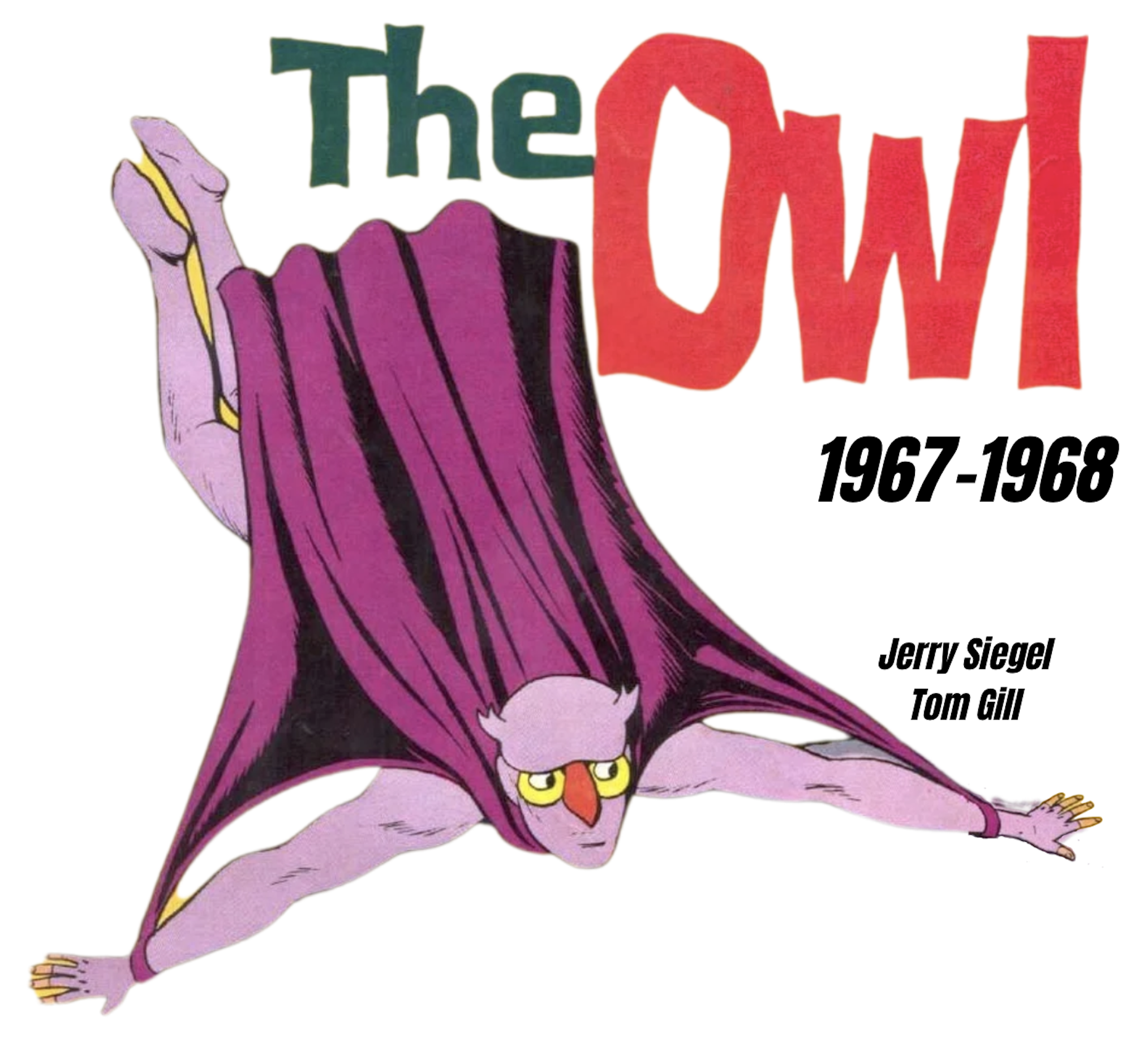
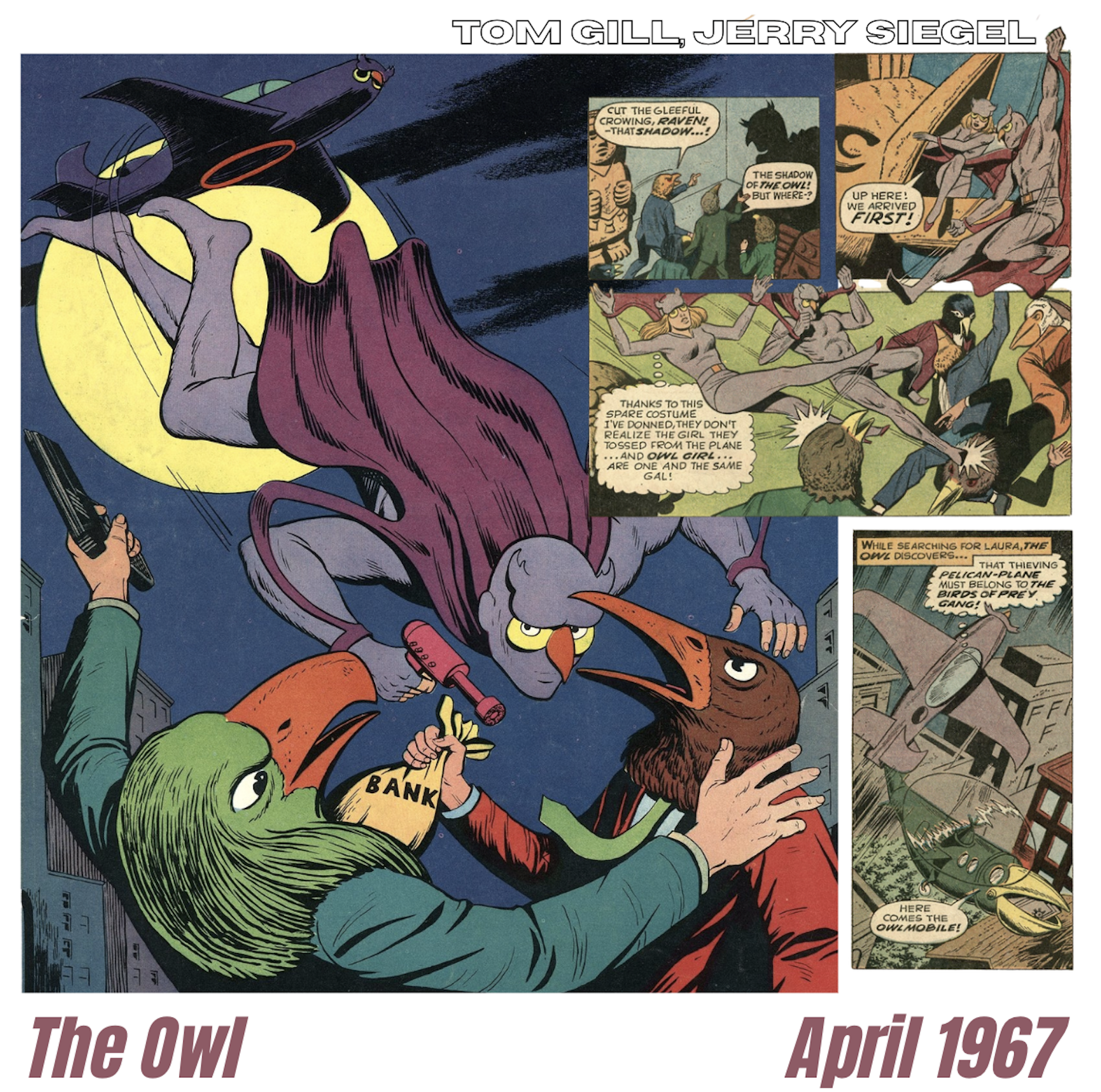
“In the wake of the 1966 Batman TV show, Gold Key Comics (which by that time controlled most of the early Dell properties) revived the Owl and Owl Girl in ‘camp’ style, the self-parodying ‘so bad it’s good’ way of handling the genre,” Markstein recalled. “Writer Jerry Siegel (co-creator of the Spectre, the Star-Spangled Kid, and, let’s not forget, Superman) and artist Tom Gill (who mostly drew westerns, including a long run on Dell’s Lone Ranger comic book) handled the pair’s bumbling adventures.”
“In the 1970s, the Owl made a minor comeback, but only as a supporting character/ guest star in issue 22 of Gold Key’s The Occult Files of Dr. Spektor,” Fischer said. “In 1999, his adventures were reprinted in black & white in Men of Mystery Comics, published by AC Comics — and new tales were related in 2008 in Project Superpowers, from Dynamite Entertainment.”
About Author
