
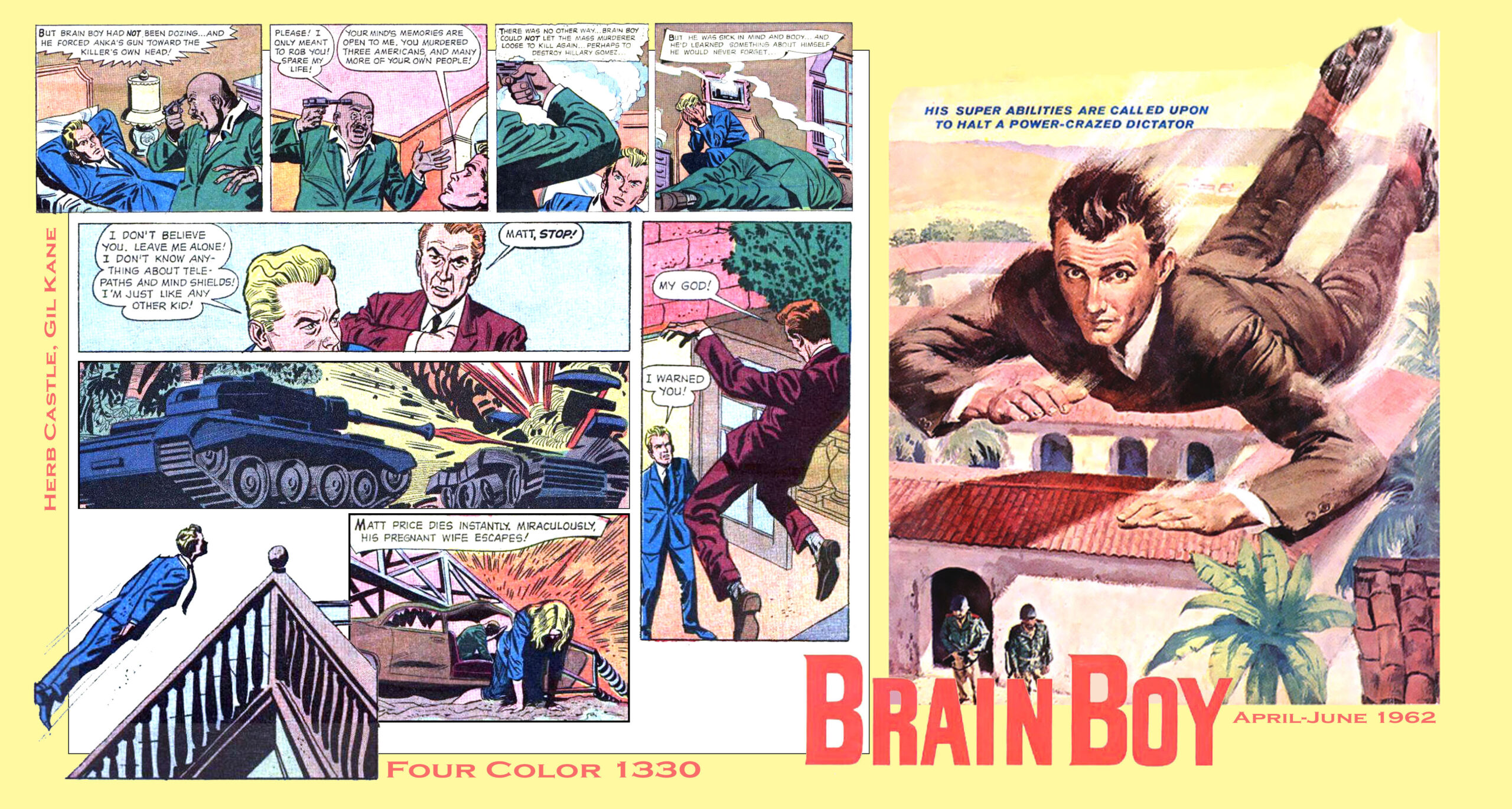
In 1962, while what would become Marvel Comics was evolving the superhero concept in a more mature direction, Dell Comics was headed in the same direction on a different path.
But Brain Boy would prove to be an abortive, if admirable, attempt.
Introduced in Four Color 1330 (April-June 1962), Matt Price was apparently a mutant whose psychic powers were activated by an electrical accident that killed his father and shocked his pregnant mother.
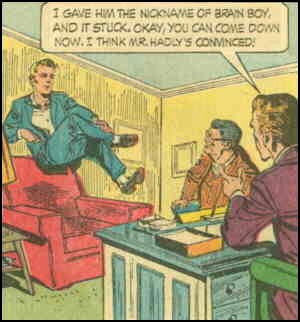
 Like Clark Kent, the young Captain Comet, and the X-Men, he grew up hiding his powers, fearing (correctly) that they would make others shun him. But the government discovered him when he was a teenager, and recruited him as a secret agent code-named “Brain Boy.”
Written by Herb Kastle and presented with rather perfunctory art by Gil Kane, Brain Boy jettisoned the superhero convention of costumes. Stan Lee tried that with the Fantastic Four title, but restored them in the third issue, heeding reader demand.
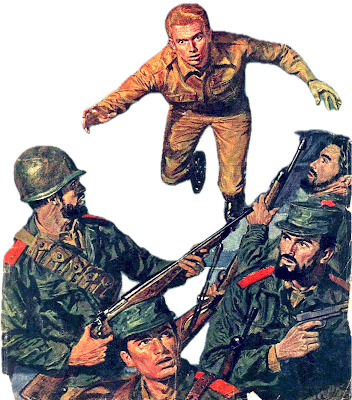
Price’s powers, confined to telepathy and telekinesis, were seemingly more plausible than Clark Kent’s. Price, too, could fly, but only with great effort, and he was always bitching about being forced to do so. Telepathic hypnosis enabled him to compel others not to see him or to turn enemy tanks against each other.
“The comics (Kastle) wrote were genuinely suspenseful, giving the reader an impression there were definite, even palpable limits to Brain Boy’s power, and as the story climaxed, he was closely approaching them,” noted comics historian Don Markstein.
His brief six-issue career focused on espionage against a Castro-like South American dictator, but also managed to include microscopic aliens, a time machine, and a telepathic Tyrannosaurus rex.
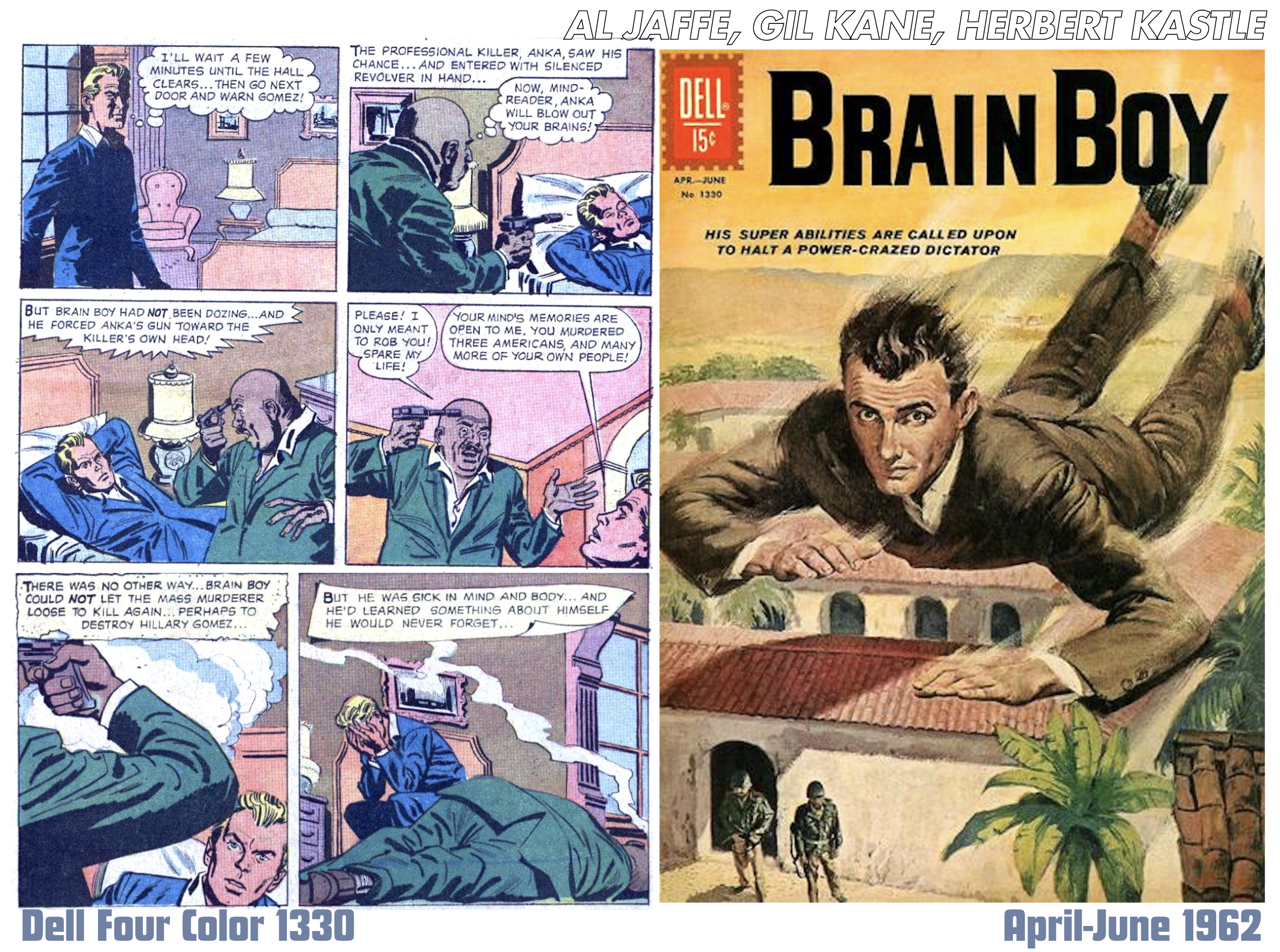
The model for the cover painting was obviously actor Robert Vaughn, then known for the films The Young Philadelphians and The Magnificent Seven. Three years later, he’d become a superspy himself, The Man from UNCLE.
The title, on newsstands in January 1962, also anticipated another famous spy. The first James Bond film, Dr. No, premiered in October 1962 and featured a scene in which 007 cold-bloodedly shoots an assassin who has stalked him in his bedroom while he is seemingly asleep. But the same thing had happened to Matt Price months before.
Price seized telepathic control of the assassin’s mind and, sensing a long history of murder there, forced the killer to turn his handgun on himself and blow his own brains out. Unlike Bond, Price had a moment of mute, face-in-hands revulsion at what he’d done.
I doubt that scene would have passed the Comics Code, but generally wholesome Dell Comics had never subscribed to it. They could print whatever they liked.
 “Dell Comics was an industry leader from the late 1930s to the early ‘60s, due primarily to its association with Western Printing, licensor of Bugs Bunny, Donald Duck, and other extremely lucrative properties,” Markstein noted.
“In 1962, the partnership broke up, and Western started publishing its own comics under the name Gold Key. The handwriting must have been on the wall for some time before the split, because Dell used that time to introduce one new character after another in an apparent attempt to give itself a few properties that would stay with it after the departure of practically everything it had. Thirteen Going on Eighteen, Kona, Monarch of Monster Isle, and Johnny Jason, Teen Reporter were only a small part of the company’s flurry of activity during 1961 and ‘62. Among the few Dell launches of the period that’s still remembered and highly regarded by aficionados is Brain Boy.”
Born too soon for both the mid-1960s’ superspy craze and the superhero boom, Brain Boy was an interesting effort, but his powers were distinctly un-visual. The whole comic took such an oddly low-key approach that it seemed designed to push young readers away. The concept might have worked better in paperback novels or a television series (starring Robert Vaughn?).
About Author
