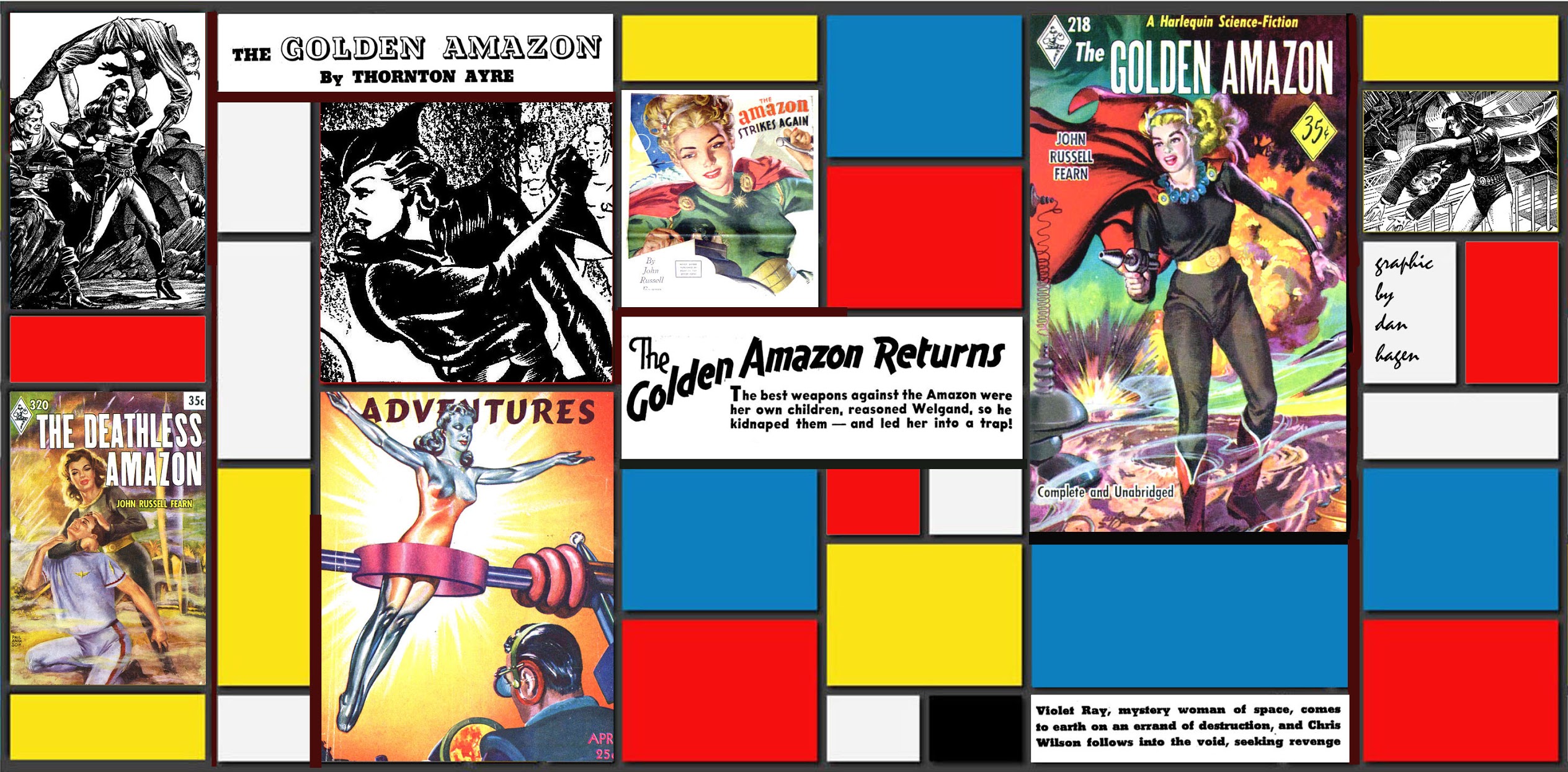
Combine Tarzan with Superman and make the character a woman who doesn’t mind snapping men’s spines, and you’d have the Golden Amazon.
Certainly she was a lot meaner than Wonder Woman, whom she preceded by two years, but their missions were quite similar — to use their powers to bring peace to a war-torn world. The difference is that the Golden Amazon quickly gave up that quest as futile, and decided to conquer the world instead.
Or at least that was her story in one of the twoentirely separate origins creator John Russell Fearn devised for her.
“In the original short stories, she was lost on Venus as a baby, and the Venusian climate turned her into a superwoman,” Fearn recalled in a 1948 letter. “In the first novel about her, published by World’s Work in April 1944, she was a baby lost in the Blitz, operated upon by a super-surgeon. He changed her glandular structure, which — at maturity — would mean she would have superhuman strength, abnormally brilliant intelligence and an almost sexless outlook on life.”
This Nietzschean superwoman was named Violet Ray (one suspects that Fearn was thinking of ultraviolet rays — Ultra became the name of her space ship). She debuted in the second issue of issue of Fantastic Adventures (July 1939), edited by Ray Palmer (who was to be immortalized as a superhero himself).
Ray healed quickly and aged slowly, and readers learned not to underestimate her in her first appearance.
“Chris gave a faint smile — then with a sudden vast leap, he hurled himself forward, his powerful hands closing around the girl’s wrists. Grimly he forced her backwards — then he got the shock of life. Her gun dropped, yes, and he had intended; but she recovered herself instantly. Like an uncoiled spring, she straightened up, tore herself out of his clutch and closed fingers of steel around his left elbow and right knee. Before he could realize what was happening, he was flying through the air like a sack of coals, landed dazed and bewildered a few feet from the Ultra.
“Hell,’ he breathed uncertainly, shaking his head violently. That had been no ju-jitsu trick, just plain superhuman strength. He glanced up to find the girl standing over him, her gun back in her hand.”
A strange way to treat your future husband and the father of your super-children — events marked in the four Golden Amazon stories (The Golden Amazon, The Amazon Fights Again, The Golden Amazon Returns and Children of the Golden Amazon) that would appear in the pulp, spanning 18 years of dramatic time. The end of that first adventure had telegraphed a series.
“(S)ome of things that have happened have made me want to go on and on — to try and find the source of all the trouble that clutters up the system with piracy, crime and threats of death.’ The girl smiled faintly. ‘I do get lonely sometimes,’ she admitted, almost naively. ‘And there are so many thing I have yet to do — things no ordinary woman could do. A partner would be useful perhaps…’
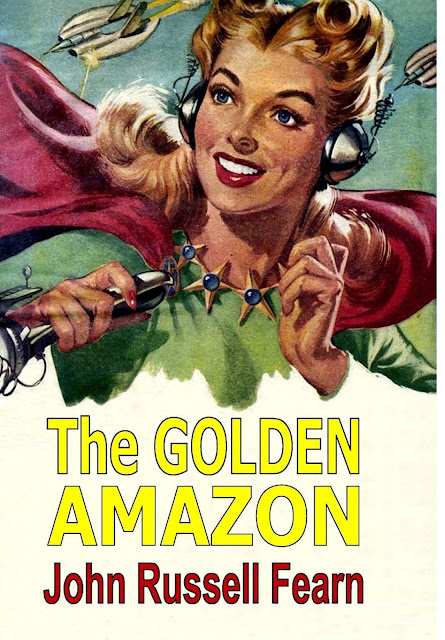 “Chris seized her slim, strong hand. ‘I’m not going back to Earth … yet,’ he said.”
“Throughout the late 1930s and into the 1940s, all of the pulp science fiction magazines featured their own ‘series’ characters (quite apart from the single character ‘hero’ magazines such as Captain Future),” noted popular culture historian Philip Harbottle. “They included, inter alia: Eando Binder (‘Adam Link’), and Nelson Bond (‘Lancelot Biggs’) in Amazing Stories; Arthur K. Barnes and Henry Kuttner (‘Gerry Carlyle’ and ‘Pete Manx’), Eando Binder (‘Anton York’), and John W. Campbell (‘Penton & Blake’) in Thrilling Wonder Stories;Lewis Padgett (‘Gallegher’) and Eric Frank Russell (‘Jay Score’) in Astounding Stories.”
“When Fearn learned via his American agent Julius Schwartz that Palmer was buying material for a new companion magazine — Fantastic Adventures — and offering a $75 bonus, he had the brainwave of creating a new regular character for it—Violet Ray, otherwise known as the Golden Amazon.”
The spectacular success of Superman in comic books the year before also undoubtedly crossed Fearn’s mind.
But as ruthless as the early comic book superheroes tended to be, this pulp heroine beat them at that game.
“She smiled as the man became dully conscious of her standing near him. Then she leveled the weapon and pressed the thumb-switch. A pencil of thin fire leaped straight for the man’s heart. ‘Evidence,’ she said, half to herself, ‘is better destroyed, especially when it can talk.’”
And then there was this: “All he could feel any more was that band of fire under his jaw and the core of pain eating into his back — breaking his back by inches.
“He screamed. Then the very fire of life exploded into agonizing darkness. There was a sound like a strong tree breaking in a silent wind…
“Slowly, the girl stood up again, then her final emotions exploded in a savage kick which landed in the dead airman’s ribs.”
The original Golden Amazon’s ruthless morality “…was caused because she had been brought up in the jungle, the same as Tarzan,” Harbottle noted. “Fearn himself had openly declared her origin was Tarzanesque.”
The Fantastic Adventures Amazon used interplanetary travel and operated 120 years into the future. The Amazon of the U.K. novels, rebooted in 1944, was contemporary, beginning her adventures during World War II.
The second version of the Amazon was orphaned in the Blitz at age 2, and given her superhuman powers by a sympathetic endocrinologist. Beginning as a heartless would-be conqueror, over the course of 24 novels she undergoes a moral evolution that finally turns her into a protector of humanity.
“Despite its shortcomings, the original Amazon series was of undeniable historical importance, not least because it began more than two years before the publication of Wonder Woman, science fiction’s more acclaimed super heroine, who debuted in DC’s All-Star Comics for December 1941!” Harbottle noted. “Wonder Woman Diana Prince was also an Amazon who, with her super strength and intelligence, routed criminals and villains.
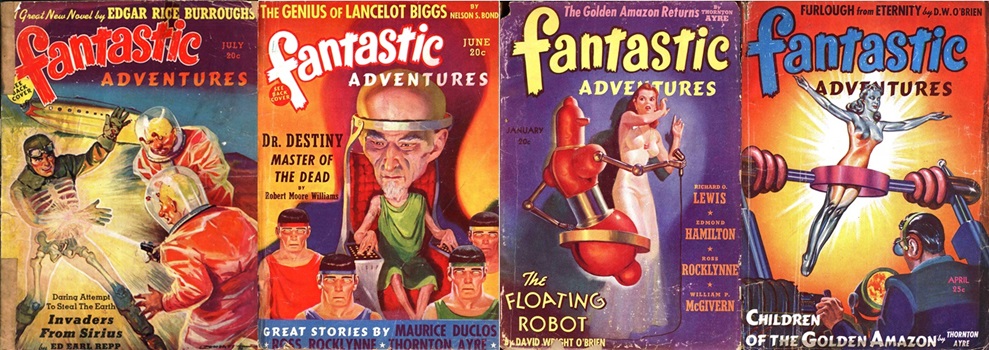
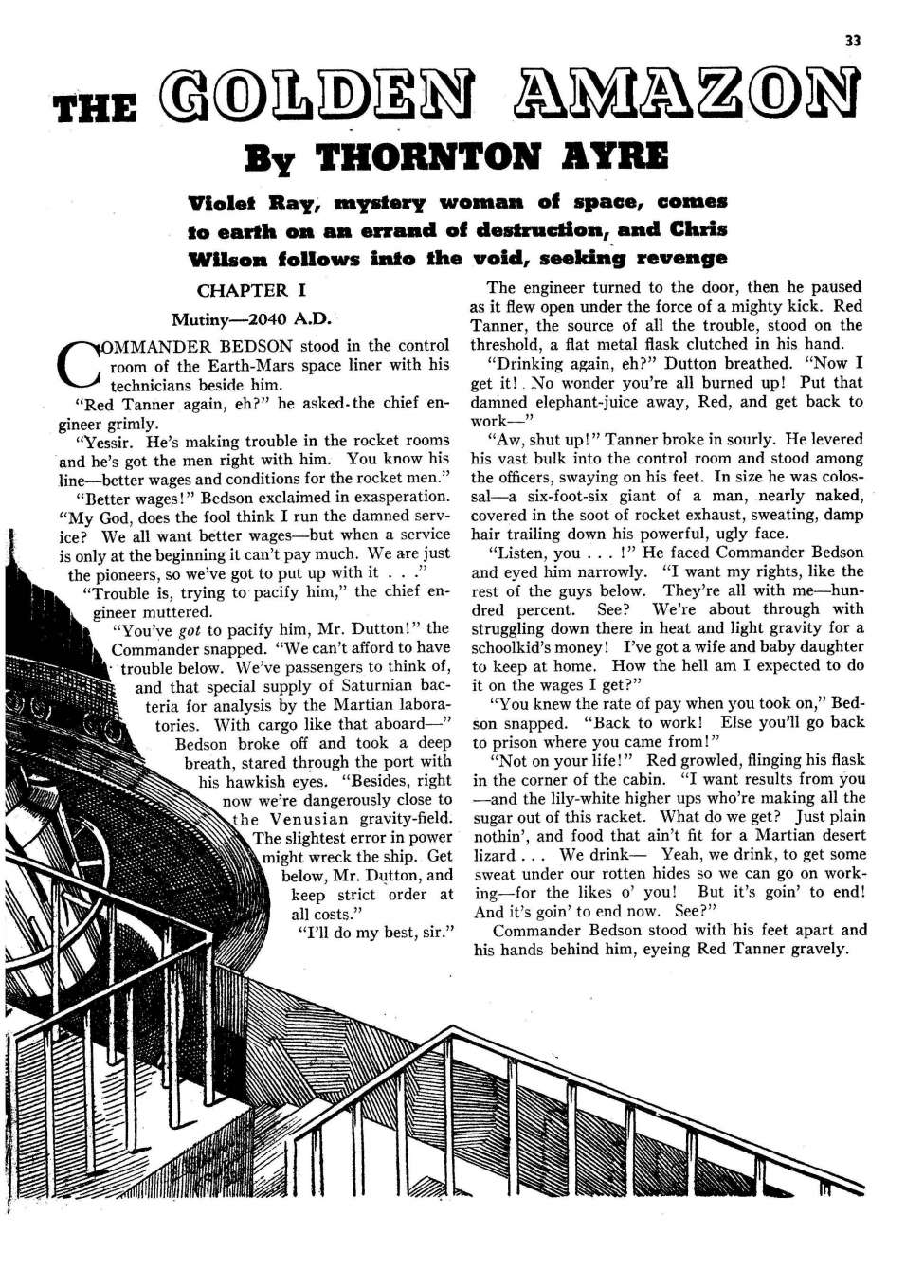
from Fantastic Adventures in July 1939.
About Author
