By 1942, four years after their introduction into comics, superheroes were already pretty commonplace. How could a new one be different?
Joe Simon and Jack Kirby came up with a fresh angle to try. Keep the costumed crusader, but make him a co-star with or even secondary to some other story element, in this case, a gang of boys that resembled Hollywood’s Dead End Kids (introduced in Sidney Kingsley’s Broadway play Dead End in 1935).
It was as if the spotlight had shifted to Bucky and his pals, with Captain America as their sidekick.
“Using the films as background material, Kirby, with Simon, was the first to exploit the juvenile element so completely and convincingly on the comic page,” recalled Jim Steranko. “With a cast of characters impossible not to identify with, the unwritten formula usually played the kids against the background of a city curiously like New York, teaming with hoods, conmen, killers and various other unsavory individuals.
None of the gang members seemed to have any parents. Instead, they flocked under the closely hovering wing of a guardian angel, a father image always resembling a cross between Robert Taylor and Adonis.
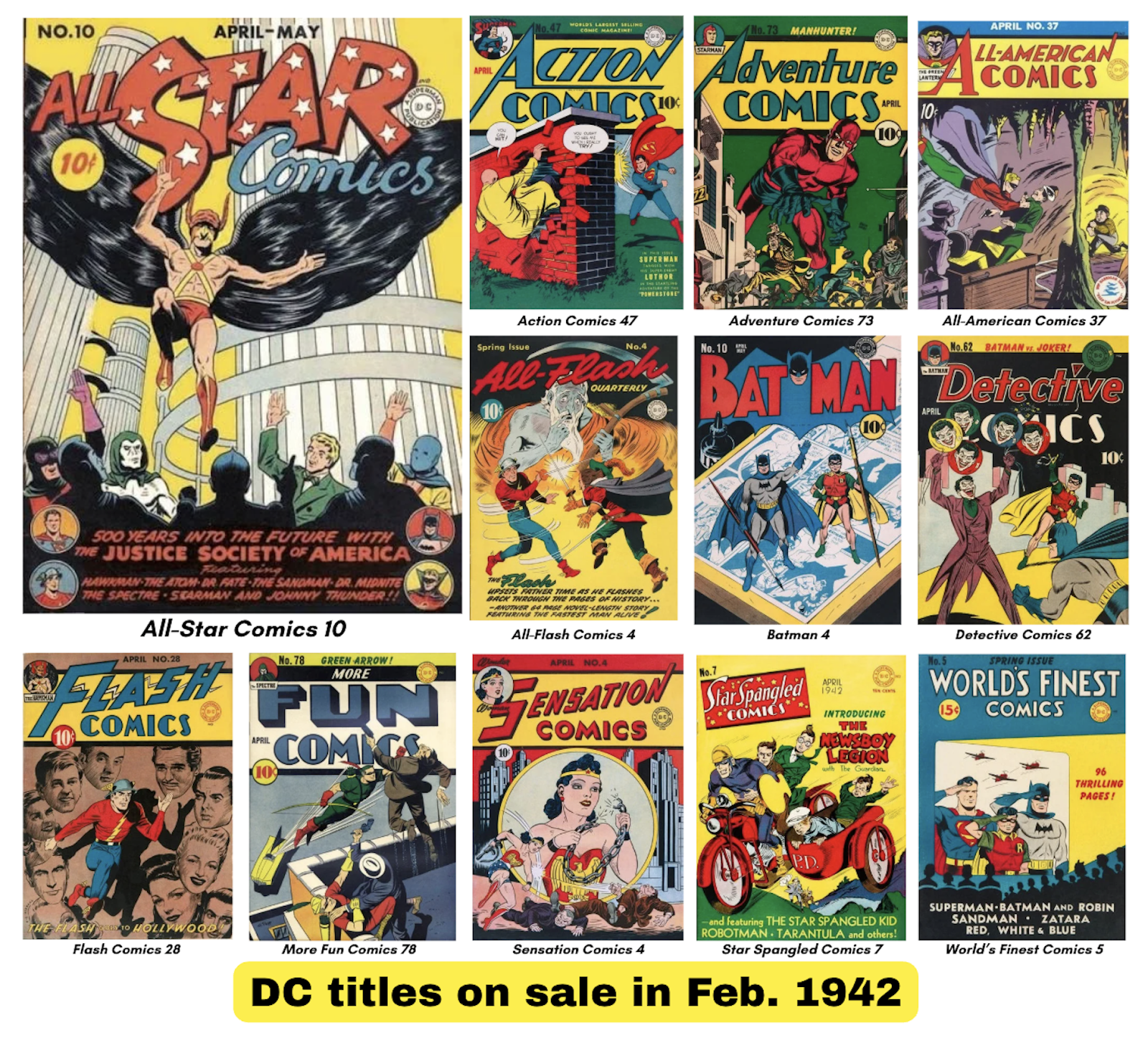
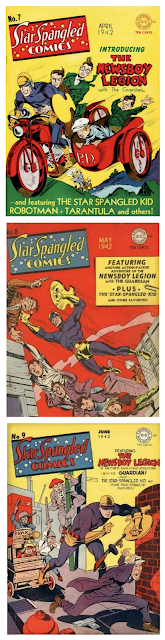 “The Newsboy Legion in the April 1942 issue of Star Spangled Comics initiated the real sidewalk and slum genre in the comics. Editors must have seen the handwriting on the wall, for they had the kids squeeze established superheroes out of the lead story position and off the cover for their almost five-year life span.”
“The Newsboy Legion is the second such feature Simon and Kirby did, debuting in Star Spangled Comics 7 (April 1942, the same issue that introduced Robotman), about eight months after The Young Allies, their first,” noted comics historian Don Markstein. “DC Comics, publisher of Star Spangled, showed such confidence in the new feature that they put it on the cover, permanently displacing the title’s original stars, the Star-Spangled Kid and Stripesy.”
Simon and Kirby’s new shield-wielding superhero’s nom de guerre had a double meaning. As both a costumed crusader and a beat cop, Jim Harper was a guardian of society, but he also quickly became the boys’ legal guardian.
“He may have been the first superhero to be used as a supporting character in a non-superhero series,” Markstein wrote. “The boys suspected their guardian was the Guardian, but were never quite sure, even though they had adventure after adventure together, month after month, until Star Spangled Comics 64 (Jan. 1947). As of the February issue, Batman’s partner, Robin, took over the cover and their space in the magazine, and they were out in the cold. No movies, TV shows or anything — their only excursion outside the Star Spangled series was in Detective Comics 76, where they and the Sandman guest-starred with the Boy Commandos.”
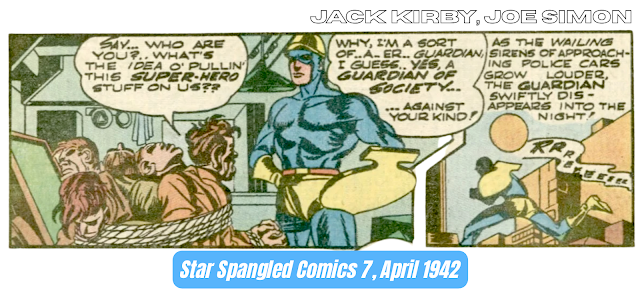
Interesting to note that the first crooks the Guardian captures refer to him as a “super-hero.” So that term was already in circulation by early 1942, four years after Superman sprang into Action.
“Simon and Kirby enjoyed unprecedented creative freedom at DC. That, and a contract that gave them among the highest page rates in the industry, caused some resentment,” noted Kurt F. Mitchell in American Comic Book Chronicles.
“Mort Weisinger, for one, chafed at being denied input into their strips. Jack Schiff and his new editorial assistant, fellow Pines alum Bernard ‘Bernie’ Breslauer, seemed satisfied to let the partners go their own way. But the war was about to bring their sweet ride to a screeching halt.
“Simon joined the Coast Guard in January, serving in its Public Information Division alongside comedian Sid Caesar, actor Cesar Romero and boxer Jack Dempsey. Kirby, as the sole provider for his family, had been given a deferment. By summer, the draft board dropped that exemption, and Jack was in the Army.”
About Author
