
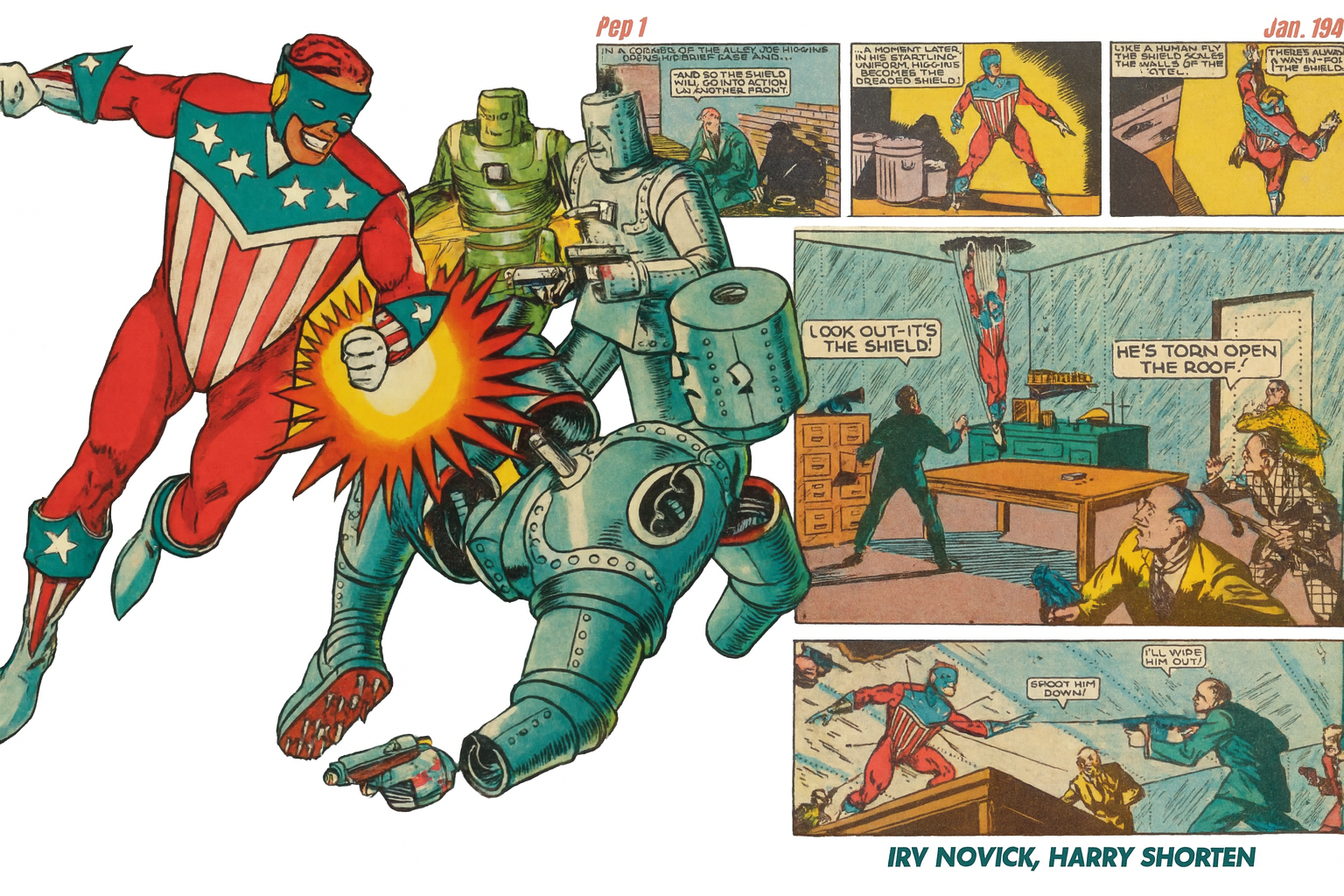
Fueled by Superman’s energy, the year 1939 was charged with possibilities for this new thing under the sun: comic book superheroes.
Must have been quite a heady time to be a kid who could scrounge a dime.
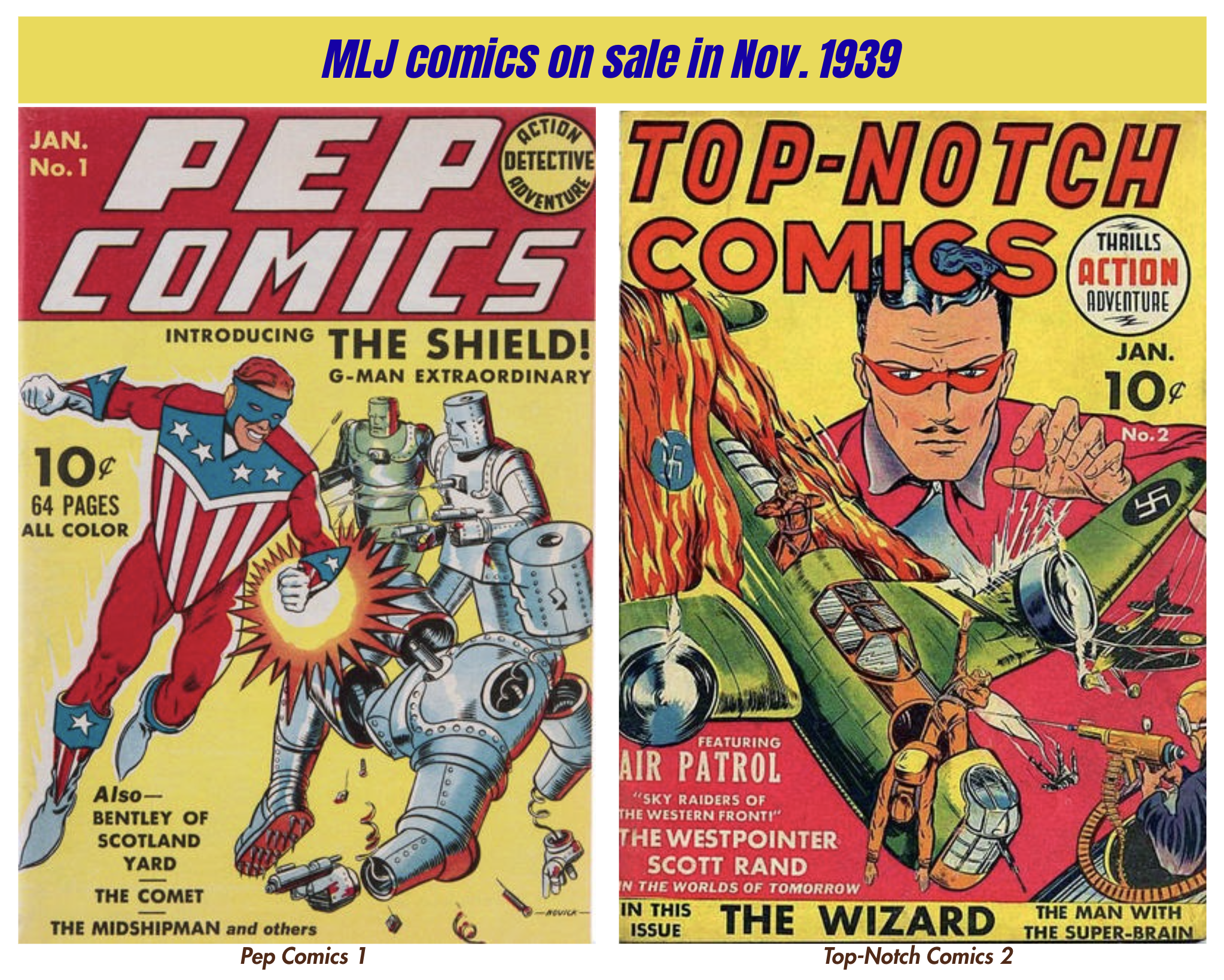
“Pep Comics began with a pair of strong features (in the Shield and the Comet),” observed Kurt F. Mitchell in American Comic Book Chronicles. “The Shield, G-Man Extraordinary, was the prototype of a long string of patriotically themed heroes to follow.
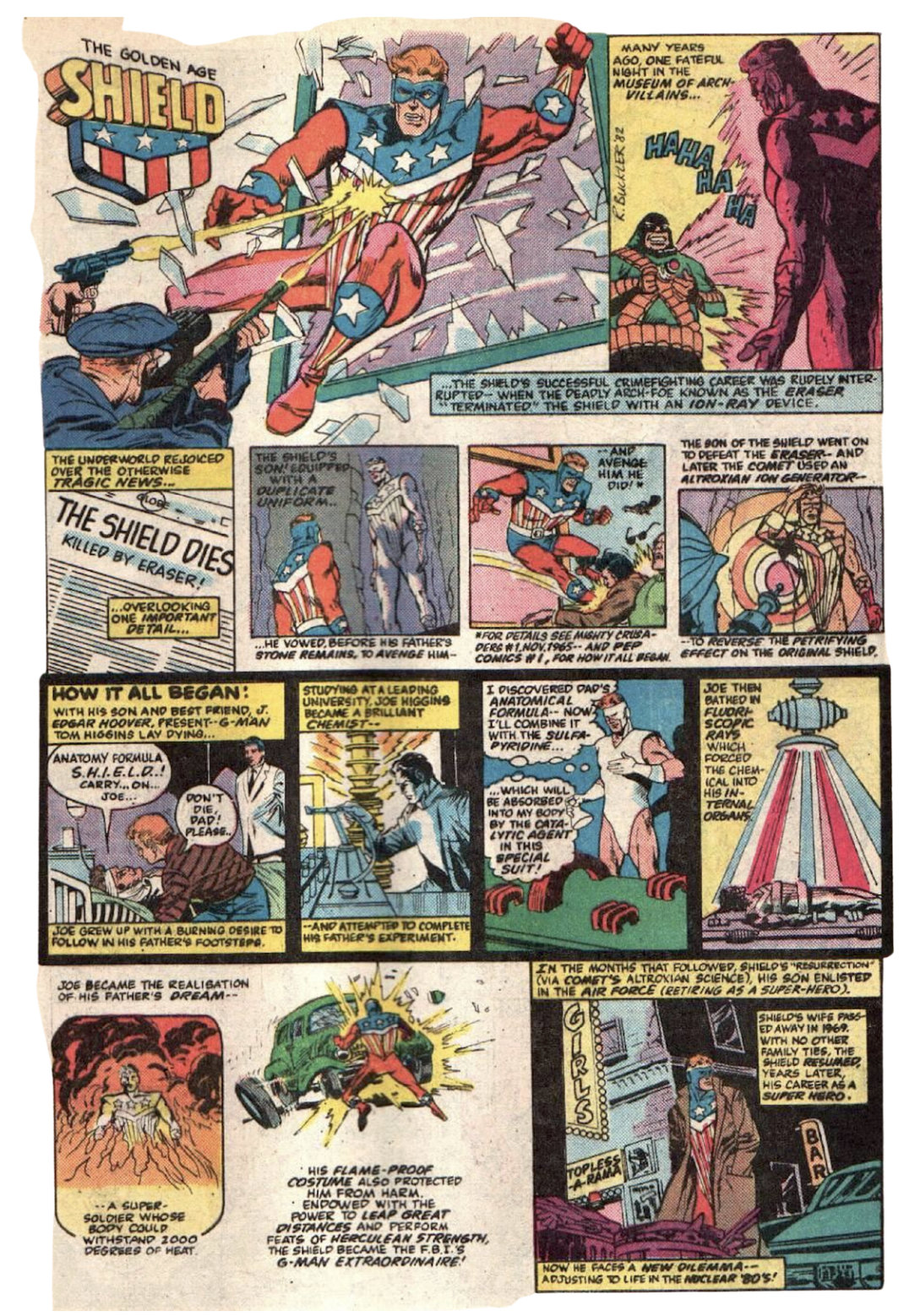
“At first, FBI agent Joe Higgins gained superhuman strength and agility whenever he put on his star-spangled bulletproof, flameproof costume. When creators Harry Shorten and Irv Novick revealed his origin in full later in the year, readers learned that his powers were actually derived from a chemical formula.
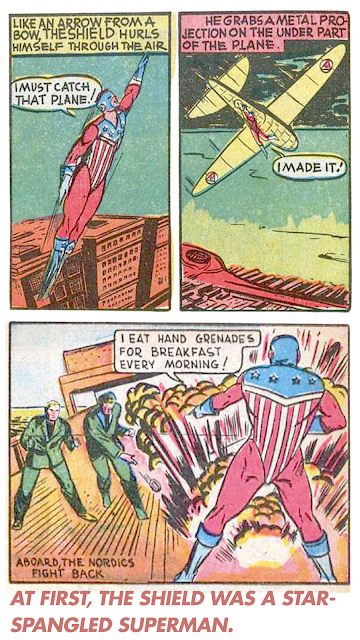 “Only J. Edgar Hoover, a friend of Joe’s late father, knew that Agent Higgins and The Shield were the same. Aided by his partners, inept Ju Ju Watson and impetuous Betty Warren, Shield spent 1940 tackling subversive organizations, crime rings, and foreign agents.”
MLJ’s debut issue featuring the Shield shared newsstand space with the first appearance of the Flash and Hawkman in Flash Comics 1.
On newsstands in November 1939, the Shield was one of the relatively heroes inspired by Superman who debuted in the 1930s. The deluge of imitators came in the 1940s.
“The Shield was a success right from the start — successful enough to almost get a comic of his own. Shield-Wizard Comics, the first issue of which had a summer 1940 cover date, teamed him up with the so-called ‘Man with a Super Brain,’ who starred in MLJ’s Top-Notch Comics,” noted comics historian Don Markstein. “The two had first met in the May 1940 issue of Pep, which, though a mere cameo, happens to be comics’ first superhero crossover. Shield-Wizard Comics lasted 13 issues, the last of which had a Spring 1944 cover date.”
Inspired by Superman, the Shield gradually veered toward Batman.
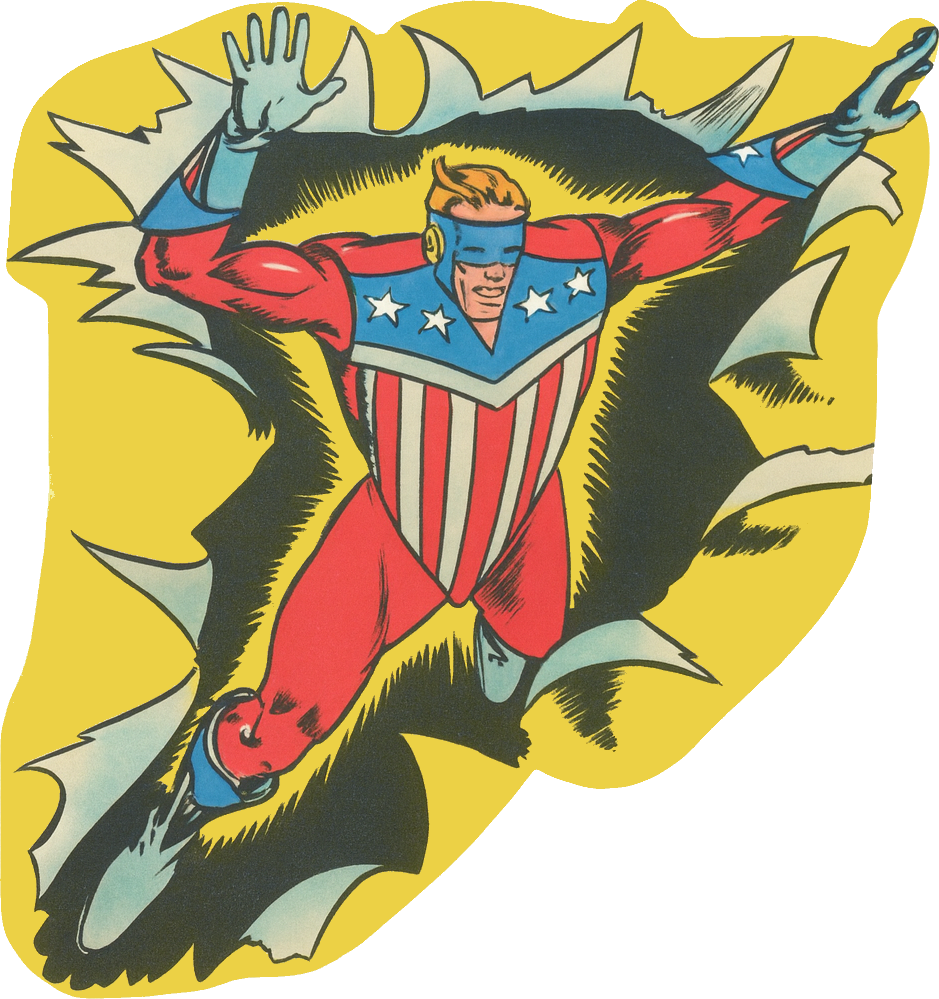 “In Pep 11, the Shield took a cue from Batman and began sharing his adventures with a kid sidekick, Dusty the Boy Detective,” Markstein recalled. “Dusty started hanging around with the Wizard’s sidekick, Roy the Super-Boy, as Boy Buddies. But six months after hooking up with Dusty, the Shield started sharing the cover, as well. The Hangman debuted in the 17th issue, and from then on, the Shield was no longer the only Pep Comics cover feature.”
In Pep Comics 29 (May 1942), MLJ stripped their red, white, and blue Superman of his superpowers. Now, just a costumed mystery man like Batman, the Shield soldiered on against ordinary mobsters and similarly costumed Nazis.
Eventually slipping into the back pages, the Shield disappeared after Pep 65 (Dec. 1945). But in 1959, the concept was revamped and revived — briefly — in the form of a new Shield, Lancelot Strong.
About Author
